
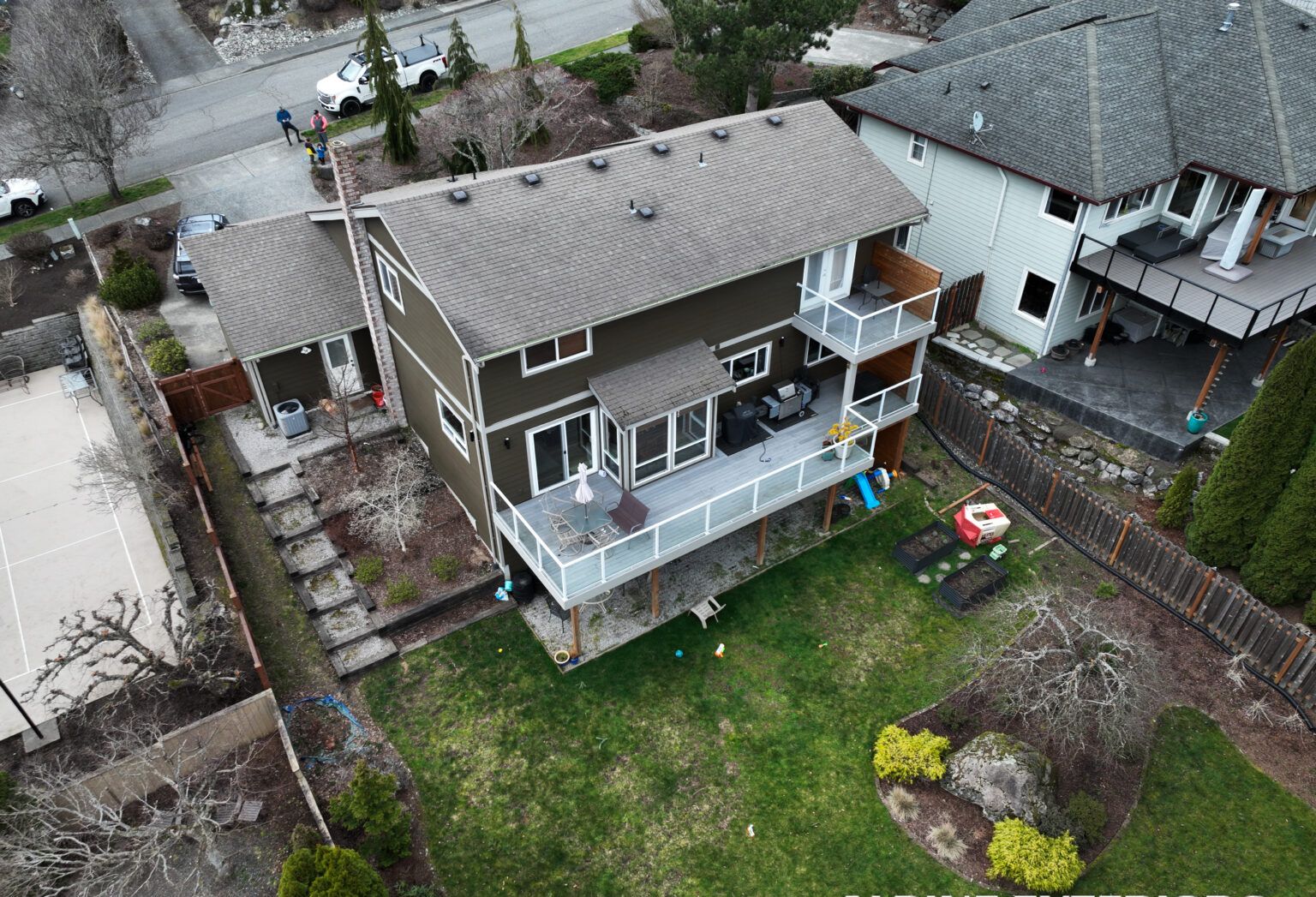
Blaine sits at the northwest corner of Whatcom County, with Semiahmoo Bay and Boundary Bay on one side and the open water of the Strait of Georgia funneling weather in on the other. Homes here take a different kind of beating than houses twenty minutes inland in Lynden or up on the hill in Sudden Valley: more wind-driven rain, more salt-tinged air, and siding that rarely gets a real chance to dry out between storms. When homeowners in Blaine, Birch Bay, and along the water in Bellingham ask us whether to re-side in James Hardie fiber cement or vinyl, the honest answer depends on exactly where the house sits and how long the owner plans to stay in it. Below is a straightforward look at both products as they actually perform in this corner of Washington, not a sales pitch for one over the other.
If your home faces the water directly, sits exposed to wind off Boundary Bay or the Strait, has a history of wood rot at the corners and butt joints, or you plan to own it for the next 15-plus years, James Hardie fiber cement is usually the better long-term investment. It resists the moisture intrusion and rot that drives most siding failures in this climate, and it holds paint and color better through decade after decade of Whatcom County drizzle. If you're working with a tighter renovation budget, siding a rental property, finishing a detached shop, or re-siding a home that's more sheltered — inland in Lynden, tucked into trees in Ferndale, or on a leeward wall in Sudden Valley — vinyl siding is a reasonable, lower-cost option that will do the job for a normal ownership window. Neither product is wrong; the mismatch happens when a high-exposure, water-facing wall gets vinyl because it was cheaper, or when a tight budget gets stretched to cover full Hardie on a house that will likely sell in five years.
James Hardie manufactures its siding in different formulations rated for different climate zones, and the products sold and installed in this region fall under Hardie's HZ5 designation, engineered specifically for areas with sustained damp and freeze-thaw cycling — which describes Whatcom County's weather almost exactly, from the wet lowlands around Bellingham to the colder foothill pockets. Fiber cement is a mix of cement, sand, and cellulose fiber, pressed into planks, shingles, or panel siding that will not absorb water the way wood does and will not support rot the way OSB-backed products can. It doesn't feed insects, it holds up to the freeze-thaw swings that hit the foothill and Sudden Valley side of the county harder than the immediate coastline, and Hardie's factory-applied ColorPlus finish is baked on to resist fading and chipping far longer than a field-applied paint job would.
The tradeoffs are real. Fiber cement is heavy — a full pallet weighs meaningfully more than the same coverage in vinyl — which means more careful handling, more fasteners, and generally a slower, more labor-intensive install. Material and labor costs run higher than vinyl. It also has to be installed correctly: proper flashing, correct nail placement, and adequate clearance from grade and roof lines matter enormously in a climate where a poorly lapped joint gets tested by rain dozens of times a month rather than a few times a year. Done right, though, it's the product we see holding up best on the homes closest to the water in Blaine and Birch Bay.
Vinyl siding is PVC-based, lightweight, and comes in a wide range of colors and profiles, including insulated panels that add a layer of rigid foam behind the vinyl shell. It installs faster than fiber cement, costs less per square foot in both material and labor, and never needs painting — the color runs through the material rather than sitting on top of it. For a garage, a rental, an addition, or a home on a more sheltered lot, that combination of speed and lower cost is genuinely attractive, and modern vinyl performs better than the thin, brittle product of decades past.
That said, vinyl has real limitations in this climate. It can become brittle and crack in a hard cold snap, which does happen in the foothills and occasionally even near the water during an arctic outflow event. Its seams, J-channels, and outside corners are the weak points where wind-driven rain off Boundary Bay or the Strait can be pushed behind the panel if the house wrap, flashing, and laps underneath weren't installed with real care — and because vinyl itself is just a rain screen, not a water barrier, everything depends on what's behind it. Vinyl also fades over time, even under Whatcom County's mostly overcast skies, particularly on darker colors and south- or west-facing walls, and once it fades there's no repainting your way out of it short of full replacement. It won't rot, but it also won't tell you when the wall behind it is rotting, since trapped moisture can do damage for years before it becomes visible.
| James Hardie Fiber Cement | Vinyl Siding | |
|---|---|---|
| Installed cost | Higher upfront — material and labor both run more due to weight and install time | Lower upfront — faster install, less specialized handling |
| Typical lifespan | Several decades of service when properly installed and maintained; ColorPlus finish holds color for a long stretch before repainting is needed | Multiple decades of service, but often ends via fading, cracking, or impact damage rather than structural failure |
| Maintenance | Occasional repainting eventually, caulk checks at trim and joints, periodic wash to slow moss/algae staining | No painting ever, but panels that crack or fade are hard to color-match and often need full-run replacement |
| Moisture/rot resistance | Does not rot or absorb water into the board itself; performs well against wind-driven rain when correctly flashed | Panel itself won't rot, but poor seam or flashing detailing lets water reach the wall assembly behind it undetected |
| Cold/freeze-thaw behavior | Stable across the freeze-thaw swings common in Whatcom's foothill areas | Can stiffen and crack in hard cold snaps or from impact in cold weather |
| Appearance | Convincing wood-grain or smooth lap look, holds crisp paint lines and shadow lines | Wide color range, but a more plastic sheen and visible seams up close |
For a home in Blaine itself — especially anything on or near the water in Semiahmoo, along Marine Drive, or up in Birch Bay where wind comes straight off the bay with little to break it — we lean toward recommending James Hardie fiber cement, particularly on the walls that take the brunt of the weather. The combination of near-constant rain, wind that drives that rain sideways into the siding, and salt-tinged air off Boundary Bay and the Strait of Georgia is exactly the exposure fiber cement was formulated to handle. We also see more legacy wood rot on Blaine-area homes than almost anywhere else in the county, and once a house has had rot at the corners or butt joints, most owners don't want to reintroduce a moisture-sensitive product at the next re-side.
That's not a blanket rule, though. A detached shop, a more sheltered wall on the lee side of the house, or a property you're renovating to sell rather than to hold can make good sense in vinyl — the cost savings are real, and not every square foot of a house sees the same exposure. Homes further inland in Lynden or Ferndale, or tucked into tree cover in Sudden Valley, see meaningfully less wind-driven rain than a house sitting exposed above the bay in Blaine, and that changes the calculus. The Washington State Energy Code also plays into the decision on any full re-side, since it sets minimum requirements for wall insulation and air sealing — insulated vinyl panels can help meet those continuous insulation targets on a budget, while a Hardie installation is usually paired with rigid foam or house wrap upgrades done separately during the tear-off. Either path can meet code; the question is which upgrade sequence fits your budget and your walls.
Alpine Exteriors works on both products across Whatcom County and doesn't have a default answer — we look at wall orientation, existing sheathing condition, and how long you plan to own the house before recommending one over the other. What we won't do is put vinyl on a west-facing, water-exposed wall in Blaine just because it's the cheaper quote, or spec full Hardie for a flip that doesn't need 30-year siding.
No siding material is immune to moss and algae staining in a climate this wet and shaded — both vinyl and fiber cement can develop surface growth, especially on north-facing walls or under overhangs that stay damp. What fiber cement resists is the underlying rot that moss-covered wood siding eventually develops once moisture works past the surface. A periodic soft wash keeps either material looking clean; the real difference is what happens to the wall behind the siding over the following years, not whether moss ever appears on the surface.
Modern vinyl can hold up structurally in most wind conditions typical of this area, but the concern isn't the panel blowing off — it's wind-driven rain getting pushed behind the panel through the seams, J-channels, and corners if the flashing and house wrap underneath weren't detailed carefully. On a directly exposed, water-facing wall, that installation quality matters more than it would on a sheltered inland lot, which is part of why we often steer those specific elevations toward fiber cement instead.
The Washington State Energy Code sets minimum insulation and air-sealing requirements for exterior walls on new construction and many re-sides, and it doesn't favor one siding material over the other directly — what matters is the wall assembly behind the siding. Insulated vinyl panels can contribute toward continuous insulation targets on a tighter budget, while a fiber cement job is more commonly paired with a separate layer of rigid foam or improved house wrap during the tear-off. Either approach can satisfy code; the siding choice and the insulation strategy are really two separate decisions that happen to get made at the same time.
No — rotted wood siding or sheathing needs to be removed and the framing inspected and repaired before either vinyl or fiber cement goes up. Covering rot with new siding, of either type, just traps the moisture problem behind a fresh surface where it keeps spreading unseen. This comes up often enough in older Blaine and Birch Bay homes that we treat a tear-off inspection as a standard part of any re-side quote rather than an optional add-on.
Every wall on a house sees different weather, and the right siding decision usually isn't the same for the whole exterior. Alpine Exteriors is a licensed Washington contractor (license ALPINI751OW) serving Blaine, Bellingham, Ferndale, Lynden, Birch Bay, Sudden Valley, and the islands, and we'll walk your house with you, point out where wood rot or poor flashing has already caused problems, and give you a clear recommendation on fiber cement versus vinyl for each elevation — along with a real cost range, not a guess. Reach out to schedule a walkthrough before you commit to a full re-side.