
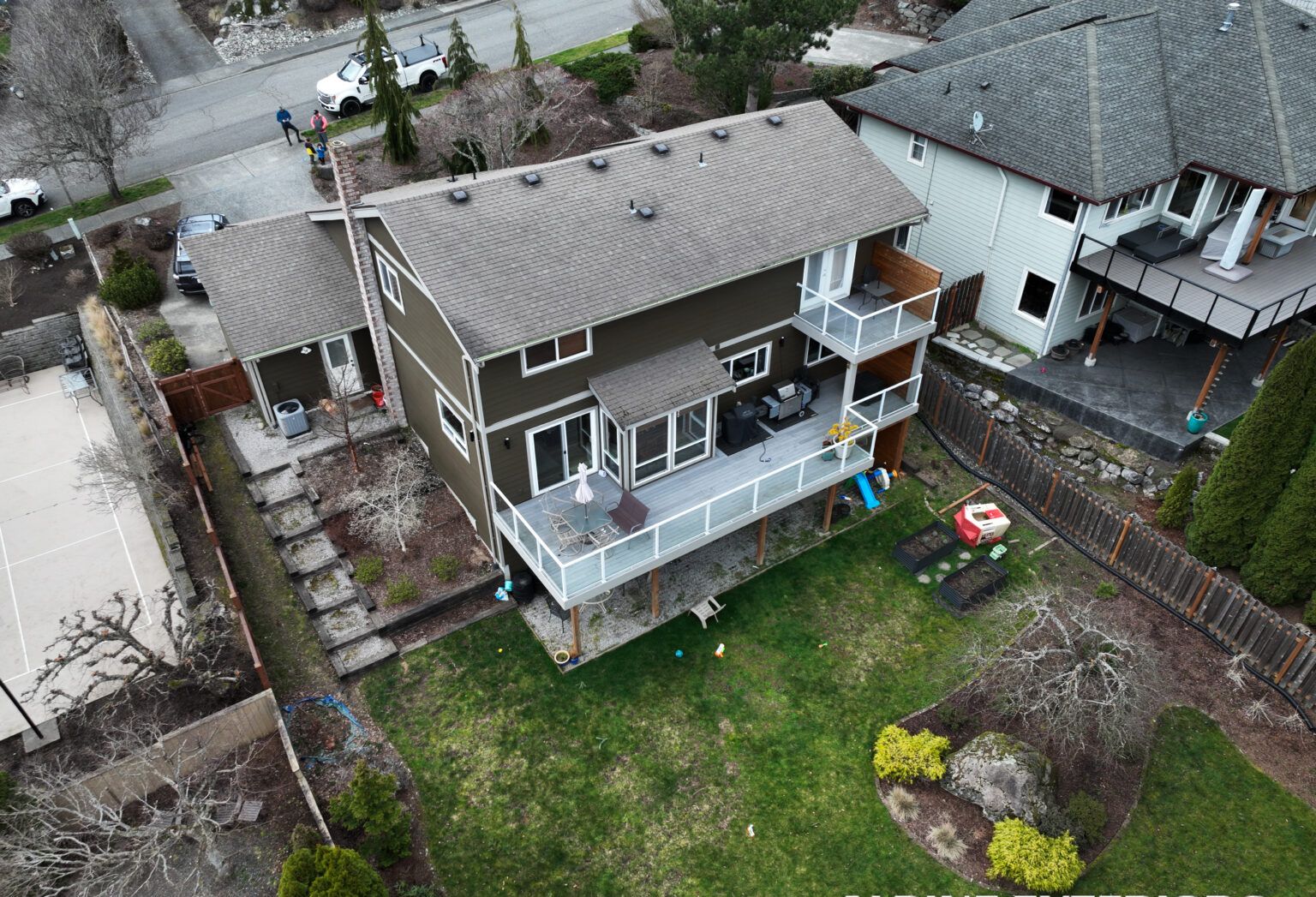
Both sidings can hold up in Nooksack if they're installed correctly, but they suit different owners. If you want the longest possible service life, the best resistance to moss staining and moisture damage, and you're planning to stay in the home for a decade or more, James Hardie fiber cement is the stronger fit for our climate. If your priority is keeping the upfront number down, or you're re-siding a rental or a home you may sell in the next few years, vinyl still has a place — as long as you go in with realistic expectations about how it performs after a wet Whatcom County winter or two. Neither material is wrong; the mismatch happens when the wrong one gets picked for the wrong situation.
James Hardie fiber cement siding is a blend of Portland cement, sand, and cellulose fiber, pressed into planks and factory-finished with baked-on ColorPlus coatings or left primed for field paint. It's manufactured with Pacific Northwest weather in mind — Hardie sells a specific HZ10 product formulation for our climate zone that's engineered to resist moisture intrusion and freeze-thaw damage better than the versions sold in drier regions of the country.
In Nooksack, that matters. The town sits along the Nooksack River in the flatter agricultural land east of Lynden, closer to the Mt. Baker foothills than to Bellingham Bay, which means winter mornings here run colder and foggier than the coastal parts of the county, and the ground stays saturated for long stretches. Fiber cement doesn't absorb water the way wood does, so it isn't a food source for the moss and algae that colonize damp, shaded siding across Whatcom County. It also won't rot, warp, or provide an entry point for carpenter ants and moisture-loving insects the way the original wood siding on a lot of older farmhouses and river-valley homes around Nooksack eventually does.
The tradeoffs are real, though. Fiber cement is heavy — it typically requires a two-person crew and specialized fiber-cement blades and fastening patterns, which is part of why installation labor costs more than vinyl. The boards need to be nailed correctly and caulked at the right joints, or you can trap moisture behind them instead of shedding it, which defeats the purpose. And while ColorPlus factory finishes hold their color well, field-painted fiber cement will eventually need a repaint, just on a much longer cycle than wood.
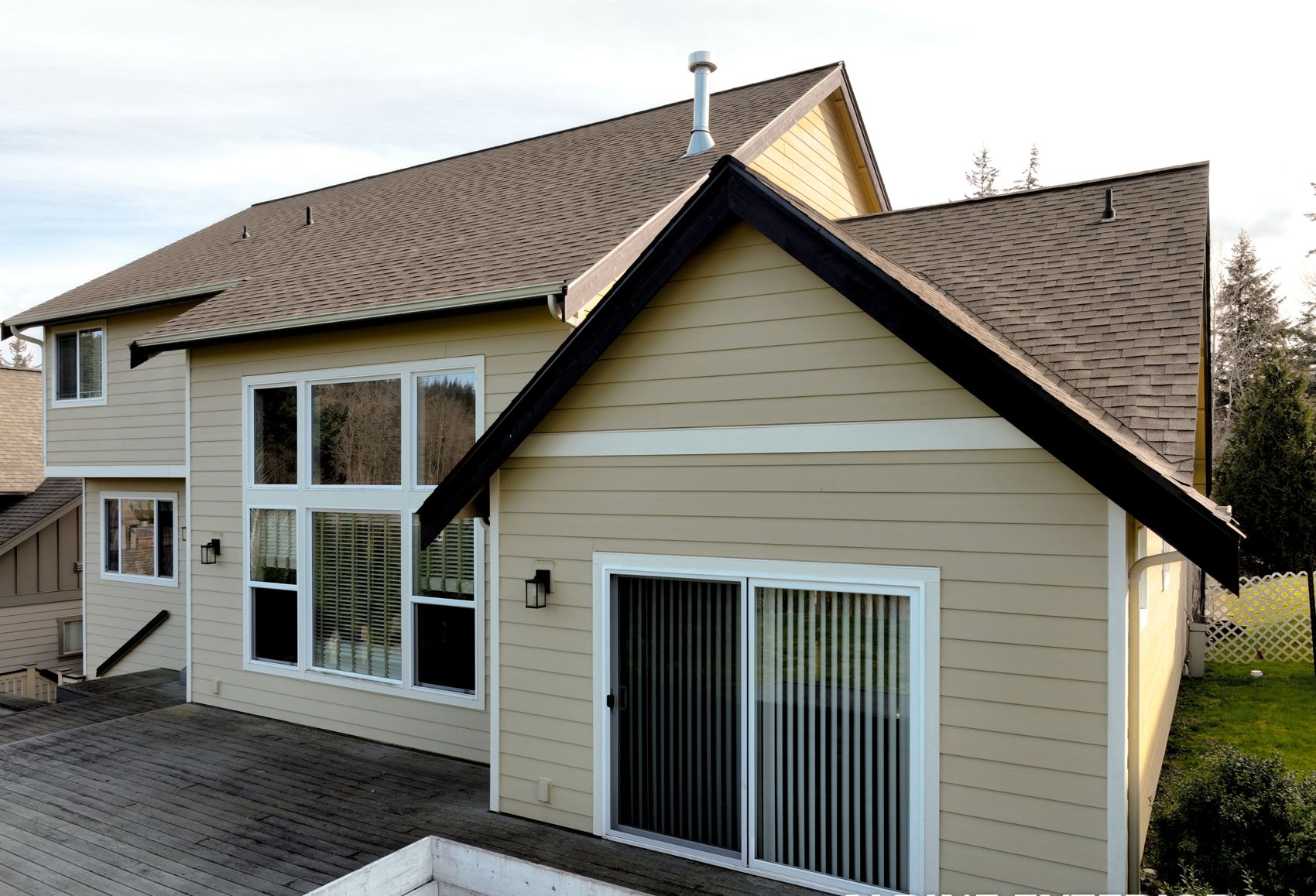
Vinyl siding is an extruded PVC product that's been the default budget re-side option in the Pacific Northwest for decades, and there are good reasons it's stuck around. It's light, it goes up fast, it doesn't need painting, and the material cost per square is meaningfully lower than fiber cement. For a straightforward rectangular home without a lot of trim detail, that labor savings adds up.
Modern insulated vinyl also does a reasonable job meeting the Washington State Energy Code's continuous insulation and air-sealing expectations when it's installed over a proper water-resistive barrier and the seams are handled correctly — it isn't automatically the weak link some homeowners assume.
Where vinyl struggles in a place like Nooksack is longevity and appearance over time. It's a plastic product, and Whatcom County's long damp season plus the freeze-thaw swings that hit the foothills harder than the immediate coastline can make panels brittle faster than in milder climates — a stray branch strike or a ladder set against the wall in January is more likely to crack a cold, brittle panel than the same impact in July. Vinyl also can't be painted to refresh a faded color the way fiber cement can; once the color chalks out, which happens faster on south- and west-facing walls, the only fix is replacement. And because vinyl siding isn't fully sealed at every seam by design — it's meant to move with temperature changes — water can work behind it over the years, especially at inside corners and around window trim, where it can sit against the sheathing without anyone noticing until there's a soft spot.
| Factor | James Hardie Fiber Cement | Vinyl Siding |
|---|---|---|
| Installed cost | Higher — generally runs somewhere in the range of $10–$18 per square foot installed in this area, depending on trim complexity and whether it's ColorPlus or field-painted | Lower — typically $4–$9 per square foot installed for standard-grade vinyl |
| Expected lifespan | Often 30–50 years with proper installation and normal maintenance; many manufacturer warranties reflect that long horizon | Commonly 20–30 years, shorter if panels see repeated impact or heavy UV exposure on south-facing walls |
| Maintenance | Occasional soft wash to clear moss/algae film, caulk checks at joints and trim, repaint eventually if not ColorPlus factory-finished | Occasional wash for algae film; no painting, but cracked or faded panels usually need full replacement rather than repair |
| Appearance | Convincing wood-grain or smooth textures, crisp shadow lines, holds color well; can look \"custom\" with varied board widths and trim | Wider range of low-cost color and profile options, but can look visibly plastic up close and color range skews lighter to hide fading |
For most owner-occupied homes in and around Nooksack — whether that's an older farmhouse off Cherry Street, a newer build closer to the school, or a property out toward the river bottomland — we lean toward recommending James Hardie fiber cement, and the reasoning comes down to the specific way this part of Whatcom County wears down siding. The combination of persistent rain, shaded tree lines along the river, and the sharper overnight cold that settles into the valley compared to the coast means moisture sits against exterior walls for longer stretches here than it does in, say, downtown Bellingham. Fiber cement's resistance to rot and its indifference to that dampness is worth the higher upfront cost over a 20-to-30-year ownership horizon, especially if the home already has any history of wood siding failure, which is common on older Nooksack-area properties that were originally sided with cedar or hardboard.
That said, we don't tell every homeowner to go with Hardie. If you're re-siding an outbuilding, a rental property where you need to control cost, or a home you know you'll sell within a few years, quality vinyl installed correctly — proper flashing, correct nailing, a real water-resistive barrier underneath — is a defensible, honest choice that will look fine and perform adequately for that shorter window. The mistake we try to steer people away from is installing bargain-grade vinyl on a forever home and expecting Hardie-level results, or over-spending on fiber cement for a property you're planning to flip in two years.
Alpine Exteriors has worked on both material types across Whatcom County, from Bellingham and Ferndale out through Lynden and into the Nooksack Valley, and we'll walk your specific home and give you a straight opinion rather than push whichever product has the better margin. As a Washington-licensed contractor (license ALPINI751OW), we also make sure whichever siding you choose is installed to meet Washington State Energy Code requirements for the building envelope, not just nailed up to look right on day one.
Better, yes, but not immune. Moss and algae need organic material and moisture to establish, and fiber cement's cement-based composition gives them less to grab onto than vinyl's slightly more porous, flexible surface, especially in the shaded, north-facing sections of a house that never fully dry out. Both materials will still show green or black staining in deeply shaded spots along the Nooksack River tree line if they're never washed, so periodic soft washing is a good idea on either material — it's just a smaller, less frequent job on fiber cement.
It can, more so than in milder parts of the county. Vinyl becomes noticeably more brittle in cold temperatures, and Nooksack's inland position means it sees colder overnight lows and more freeze-thaw cycling through the winter than homes right on Bellingham Bay. A hard impact — a branch, a dropped ladder, a thrown object — is more likely to crack a cold panel than the identical impact in summer. It's not a reason to avoid vinyl outright, but it's a real durability difference worth knowing before you choose it for a home with a lot of tree cover.
Material and labor for fiber cement generally runs meaningfully higher than vinyl — often close to double, depending on your home's trim detail, whether you choose factory ColorPlus finish or field paint, and how much of the existing siding and sheathing needs repair before the new material goes on. We won't quote an exact number without seeing the house, but we can walk you through both a vinyl and a Hardie estimate side by side so you're comparing real numbers, not guesses.
The siding material itself isn't what the energy code is primarily grading — it's the wall assembly underneath, including continuous insulation, air sealing, and the water-resistive barrier, that has to meet Washington State Energy Code requirements for our climate zone. Both vinyl and fiber cement can be installed as part of a code-compliant wall assembly. Where it goes wrong is when either material is installed quickly over an inadequate barrier or without the right insulation detailing, which is a workmanship issue more than a material one.
If you're weighing James Hardie fiber cement against vinyl for a home in Nooksack, Lynden, Sumas, or anywhere else in Whatcom County, the right call depends on your specific house, its exposure, and how long you plan to own it — not on a generic rule of thumb. Alpine Exteriors will look at your siding in person, tell you honestly what's driving any current damage, and give you real cost and lifespan numbers for both materials before you commit. Reach out to Alpine Exteriors to schedule a walkthrough and get a written estimate for your Nooksack-area home.