
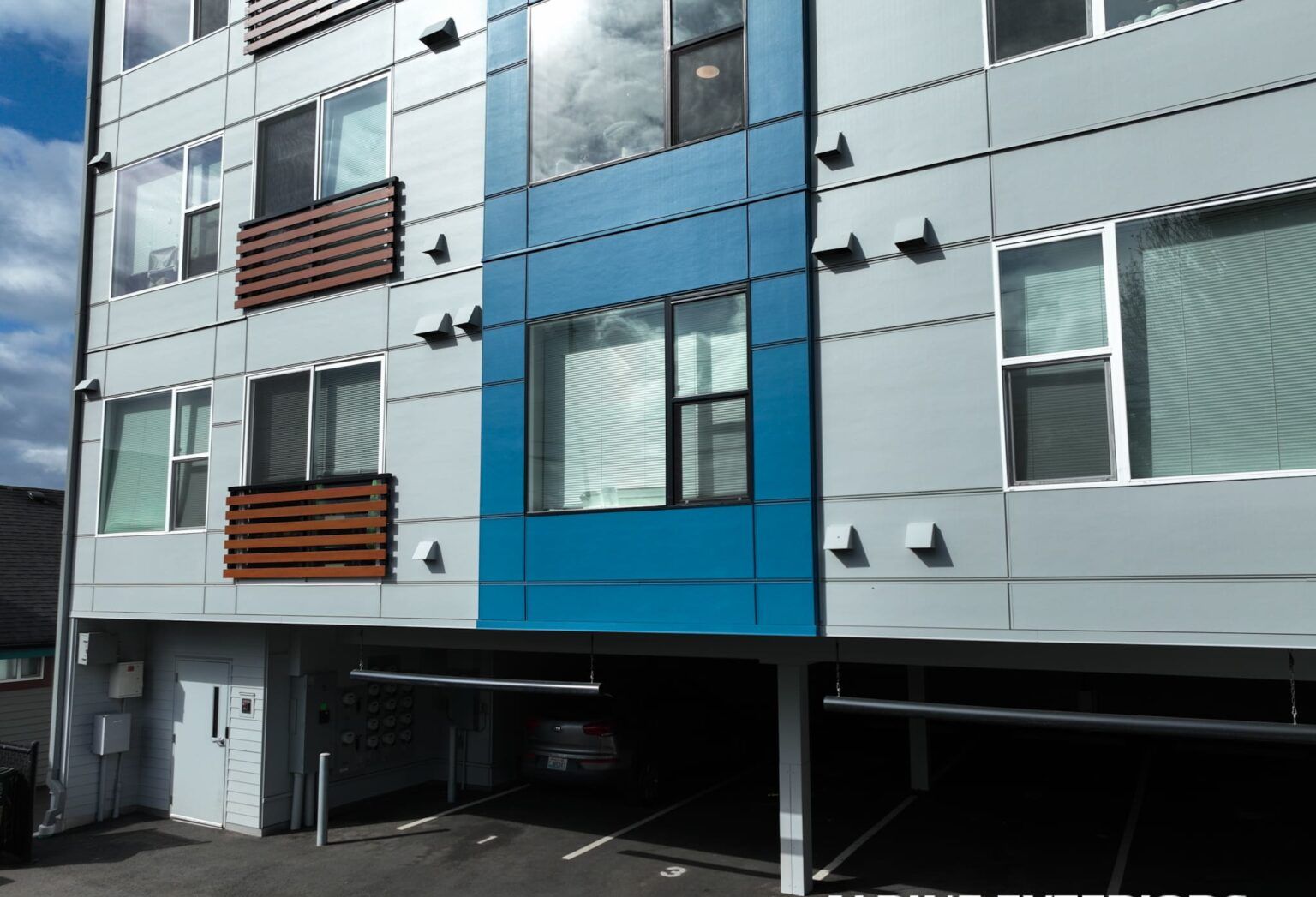
Sumas sits right up against the Sumas Gap, the low pass in the foothills where cold air spilling down from British Columbia's Fraser Valley funnels into Whatcom County. That gives Sumas a wider temperature swing and more genuine freeze-thaw cycling in winter than homes closer to Bellingham Bay, on top of the same long, damp fall-through-spring rainy season the rest of the county deals with. Add the low, flat ground around the Sumas River and Sumas Prairie farmland, where humidity lingers and shaded, tree-lined properties grow moss readily, and the honest answer to "Hardie or vinyl" depends on the house and the budget. James Hardie fiber cement siding tolerates this specific combination of moisture, freeze-thaw, and moss pressure better than vinyl and tends to be the stronger long-term choice on a home you plan to keep. Vinyl costs less to install and is a legitimate option on a budget-driven project, a rental, a detached shop, or a smaller addition where matching existing siding matters more than upgrading the material. Neither product is the wrong answer everywhere in Sumas — they just fit different situations, and it's worth understanding both before deciding.
James Hardie fiber cement siding is manufactured from cement, sand, and cellulose fibers pressed into planks, panels, or shingle-profile pieces, then either factory-primed for field painting or finished at the factory with Hardie's ColorPlus coating system. Around Whatcom County it has become the go-to upgrade when homeowners are replacing rotted cedar lap siding or aging, storm-worn vinyl, largely because it doesn't absorb and hold water the way wood does, and it doesn't soften, warp, or crack the way vinyl can under stress.
For a town like Sumas, where surrounding farm fields and the Sumas River keep ambient humidity elevated for a good part of the year, and where winter brings real freeze-thaw cycling rather than the milder swings you get right on Bellingham Bay, that moisture tolerance is genuinely useful. Fiber cement doesn't give moss and green algae the same foothold that wood grain or textured vinyl does, so the shaded, north-facing walls common on tree-lined or hedgerow-bordered Sumas Prairie properties tend to need a simple annual wash-down rather than scraping, re-caulking, and spot-priming. Fiber cement also holds paint substantially longer than raw wood, and Hardie's factory-applied ColorPlus finish carries a fade warranty that field-applied paint jobs simply don't have.
The tradeoffs are real and worth stating plainly. Fiber cement is heavy — a full board is noticeably harder to handle than a vinyl panel — and it has to be cut with proper dust-control equipment, which adds labor time and cost compared to snapping vinyl into place. It isn't a flexible material, so on an older Sumas farmhouse with some settling or slightly out-of-square framing, an installer has to shim, plane, and fit more carefully than they would with a forgiving product like vinyl. And while fiber cement resists moisture intrusion far better than bare wood, it's still only one layer of the wall assembly — it depends on correctly lapped house wrap, proper flashing at windows and penetrations, and in most cases a rainscreen gap behind it to actually shed the wind-driven rain this region sees. Fiber cement installed without those details behind it will still eventually let moisture into the wall cavity, just more slowly than wood would.
Vinyl siding is an extruded PVC product that interlocks in horizontal or vertical panels over the existing sheathing and house wrap. Its clearest advantages are upfront cost and speed of installation — panels go up quickly, there's no on-site painting or curing time, and the material itself costs meaningfully less per square foot than fiber cement.
In Whatcom County's climate, vinyl performs adequately as long as expectations are realistic about it. It won't rot, and today's vinyl formulations resist cracking better than the thin, brittle vinyl sold decades ago. But it has known weak points that are particularly relevant in Sumas. Vinyl expands and contracts noticeably with temperature swings, and the outflow winds that push cold air down through the Sumas Gap in winter drive that expansion-and-contraction cycle harder here than in more temperature-moderated parts of the county. Panels installed too tightly can buckle when they expand; panels installed too loosely can rattle or work loose in gusty conditions off the fields. Vinyl also softens somewhat under direct summer sun exposure and can become more brittle and prone to cracking on impact during a hard winter cold snap — a stray branch or a ladder bump that would just dent fiber cement can crack vinyl outright.
Moss and algae will colonize vinyl just as readily as any other siding material in a persistently damp climate, and because vinyl's color runs all the way through the panel rather than being a surface coating, a heavy algae bloom shows up as a visible green or black cast that's genuinely hard to fully remove without risking damage from aggressive pressure-washing. Vinyl also can't be repainted a different color down the road without specialty vinyl-safe paint products, so whatever color you pick today is close to a permanent decision until the siding itself is replaced.
| Factor | James Hardie Fiber Cement | Vinyl Siding |
|---|---|---|
| Installed cost | Roughly $9–$14 per sq. ft. installed in this market, depending on plank profile, trim detail, and whether a rainscreen gap is added | Roughly $4–$8 per sq. ft. installed, depending on panel thickness, profile, and insulated-backer options |
| Lifespan | Commonly 30–50 years with correct installation and periodic maintenance | Commonly 20–30 years, often shorter where panels are repeatedly stressed by wide temperature swings or impact |
| Maintenance | Annual wash-down to control moss and algae; repaint or refresh the ColorPlus finish roughly every 12–15 years; recaulk joints and trim periodically | Occasional wash-down for moss and algae; no painting required, but cracked, warped, or faded panels generally have to be replaced rather than patched or repainted |
| Appearance | Authentic wood-grain or smooth-panel profiles, crisp paint lines, deeper trim shadow lines, ages evenly across the wall | Wide color and profile selection at a lower cost, but a more plasticky sheen up close, and color fades unevenly over one to two decades |
For most owner-occupied homes in Sumas — particularly older farmhouses near the river, properties backing onto open fields, or anything shaded by mature trees or hedgerows — Alpine Exteriors generally steers homeowners toward James Hardie fiber cement. The reasoning is specific to this location: the combination of higher ambient humidity from the surrounding farmland, real freeze-thaw cycling driven by the Fraser Valley outflow winds through the Sumas Gap, and steady moss and algae pressure from the long rainy season all favor a material that doesn't absorb moisture, doesn't flex and buckle with temperature swings, and doesn't provide much of a surface for organic growth to grip. On a home you intend to own for a decade or more, that durability tends to offset the higher installed cost, and it typically shows up as a plus rather than a neutral when the house eventually sells in a market where buyers increasingly ask what the siding is made of.
The Washington State Energy Code also plays into this decision indirectly. The code sets minimum requirements for wall insulation and air-sealing, and many contractors meet those requirements with a continuous exterior insulation layer under the siding — a detail that pairs cleanly with fiber cement's rigidity and furring-strip installation approach. Vinyl can absolutely be installed over the same code-compliant wall assembly, but it's worth confirming with your installer that whichever siding you choose is being installed over an assembly that actually meets current code, rather than assuming the siding material itself does that work.
That said, vinyl is a reasonable, honest choice in several situations that come up regularly in Sumas: a rental property where minimizing cost matters more than maximizing lifespan, a detached shop or outbuilding where cosmetic longevity is less of a priority, an addition where matching the vinyl already on the rest of the house avoids an obvious mismatched look, or simply a budget that doesn't stretch to fiber cement right now. Alpine Exteriors will quote both materials honestly rather than push one product regardless of fit — the right siding is the one that matches the house, the budget, and how long the owner plans to stay.
The code governs the wall assembly's insulation and air-sealing performance rather than dictating a specific siding material, so both vinyl and James Hardie fiber cement can be installed over a code-compliant wall. What matters is that the insulation, house wrap, and any continuous insulation layer underneath meet current Washington State Energy Code requirements — your contractor should be able to walk you through how the specific wall assembly on your home meets that standard regardless of which siding you pick.
Siding itself is a wall-cladding and rain-shedding material, not a flood barrier, so it isn't designed to withstand standing floodwater at either the vinyl or the fiber cement level. Where it does matter is ordinary ground-level moisture and splashback along the lower courses of a wall near low-lying or poorly drained areas — fiber cement tolerates repeated wetting at the base of a wall better than vinyl or wood over time, but proper grading, gutters, and a clearance gap between the siding's bottom edge and the ground matter more than the siding material for that specific risk.
Yes, and it's a fairly common approach on additions, accent gables, or garage sections where budget or design intent calls for a different look or cost point than the main house. The main things to get right are the transition detail where the two materials meet — proper flashing and trim so water doesn't get trapped between them — and making sure the color and profile pairing looks intentional rather than mismatched.
For an average single-family home, a full siding tear-off and replacement generally runs one to three weeks depending on square footage, how much of the underlying sheathing or house wrap needs repair, weather delays during the wetter months, and whether trim and window flashing are being upgraded at the same time. Fiber cement installations often run a bit longer than vinyl because of cutting, fitting, and painting or caulking time, but the difference is usually measured in days, not weeks.
If you're weighing James Hardie fiber cement against vinyl for a home in Sumas, Bellingham, Ferndale, Lynden, Blaine, Birch Bay, Sudden Valley, or the islands, Alpine Exteriors can walk your property, look at sun exposure, shading, drainage, and the current condition of your walls, and give you a straightforward comparison of both materials for your specific house rather than a one-size-fits-all recommendation. Alpine Exteriors holds Washington contractor license ALPINI751OW and works throughout Whatcom County. Reach out for a no-pressure estimate and an honest read on which siding makes sense for your home and budget.