
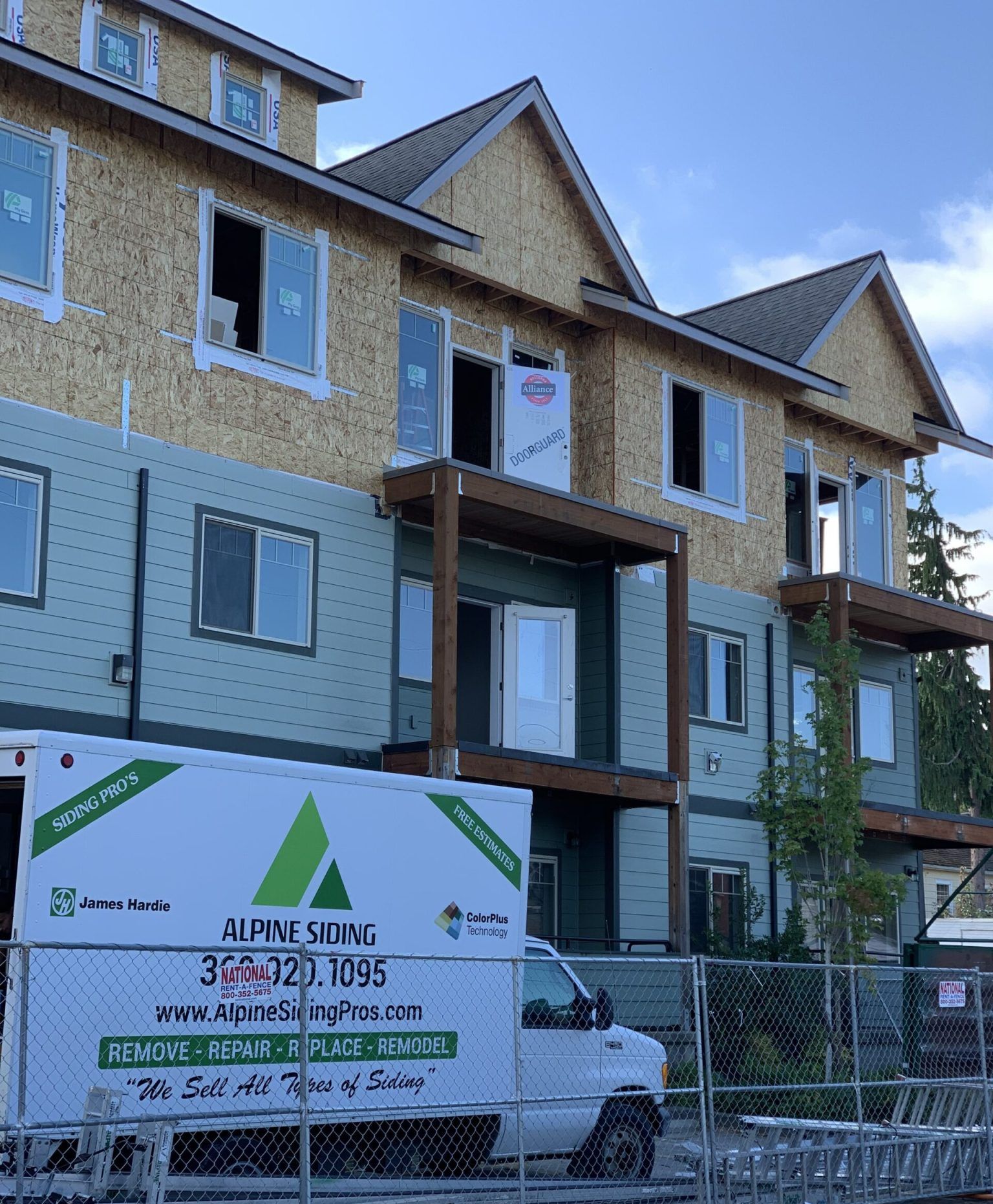
Alpine Exteriors has installed and repaired siding across Whatcom County long enough to see both James Hardie fiber cement and vinyl siding perform, and fail, in real Ferndale weather. This guide compares the two head to head so you can decide based on how each product actually holds up here, not on a showroom sample or a national brand's marketing sheet. Both materials have a legitimate place on Whatcom County homes; the difference comes down to exposure, budget, and how long you plan to own the house.
Choosing between James Hardie fiber cement and vinyl siding in Ferndale usually comes down to how much rain and wind exposure your walls take, how long you plan to own the home, and your budget. If your home sits on an exposed lot near Bellingham Bay, along the Nooksack floodplain, in Birch Bay, or anywhere wind-driven rain hits the walls directly off the Strait, fiber cement is generally the more forgiving material because it will not soften, warp, or blow loose in gusty coastal weather. If you own a smaller rental, a starter home, or a property you plan to sell within five to seven years, vinyl siding can still be a reasonable, budget-conscious choice as long as it is installed correctly with proper flashing and a drainage gap behind it. Neither product is wrong for Whatcom County; the mismatch happens when the wrong product goes on the wrong house, or either product goes up without correct moisture detailing behind it.
James Hardie fiber cement siding is a blend of cement, sand, and cellulose fiber pressed into planks, panels, or shingle-style pieces, then factory-finished with a baked-on ColorPlus coating or left primed for field paint. It is heavy, rigid, and dimensionally stable, which matters in Ferndale because our siding spends a large share of the year damp. Fiber cement does not absorb bulk water the way wood does and will not rot, and it resists moss and algae staining better than most vinyl profiles because its surface is less hospitable to the organic growth that thrives in our humid, low-sun winters. It also holds paint and factory color extremely well over time, so a home keeps a crisp, flat appearance instead of the wavy reflections vinyl can show on a warm afternoon.
The drawbacks are real and worth stating plainly. Fiber cement costs more upfront, it is heavier to handle and ship, cutting it generates silica dust that requires proper dust-control practices on site, and installation quality matters enormously. Hardie board installed without correct clearance to grade, without a weather-resistive barrier and rainscreen gap, or with caulked butt joints instead of properly flashed ones will trap moisture behind it just as badly as any other cladding. Alpine Exteriors follows the manufacturer's published installation instructions on clearance, fastening, and flashing on every Hardie job in Ferndale specifically because our rainfall makes shortcuts show up early, sometimes within a single wet season.
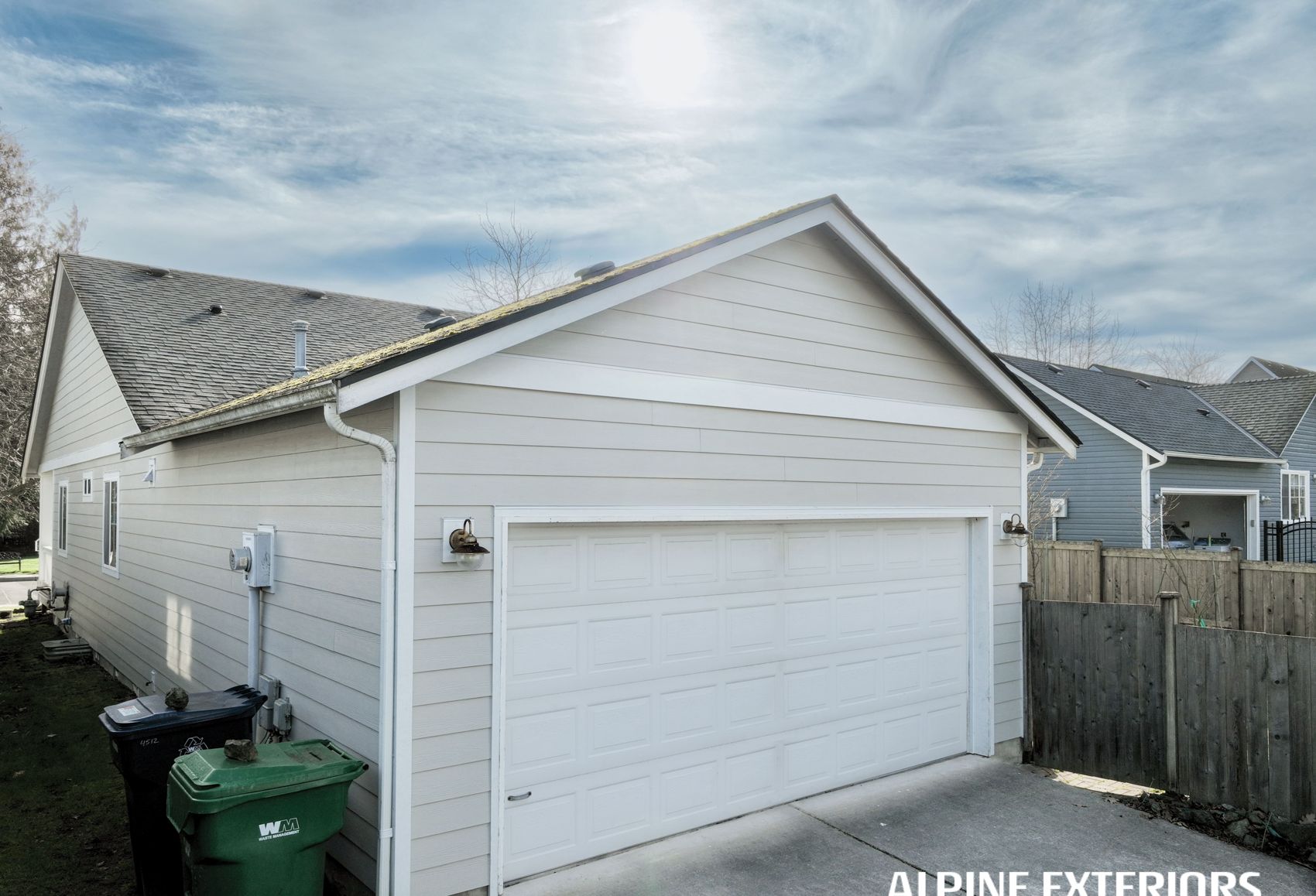
Vinyl siding is an extruded PVC product available in a wide range of profiles, colors, and insulated-backer options. Its biggest advantages are material cost and installation speed, which keeps labor hours, and therefore total project cost, lower than fiber cement. Modern vinyl is also low maintenance in the sense that it never needs painting, and a rinse with a garden hose or a soft wash handles most surface dirt.
In Ferndale's climate, though, vinyl has real weaknesses worth naming honestly. Standard vinyl panels can be pushed inward or even pulled loose during a wind-driven rain event off the bay or the Strait if the installer used wide nail slots or over-drove the fasteners, since vinyl is designed to hang loosely and expand and contract with temperature rather than be nailed tight. Lower-grade vinyl also tends to show chalking and color fade faster under our long gray-to-bright seasonal swings than a factory-baked Hardie finish, and thinner-gauge vinyl can become brittle and crack in the colder snaps that reach the foothills toward Deming and the Mount Baker corridor, where freeze-thaw cycling is more pronounced than right on the water. Vinyl also does nothing to stop moss and algae from forming in the shaded, damp corners common on wooded Whatcom County lots; it simply doesn't feed the growth the way bare wood does, so it still needs occasional washing to look its best.
Cost, lifespan, maintenance, and appearance trade off differently between the two products, which is why a side-by-side comparison is more useful than a single blanket verdict.
| Factor | James Hardie Fiber Cement | Vinyl Siding |
|---|---|---|
| Installed cost | Higher material and labor cost; typically a meaningful premium over vinyl per square foot | Lower material cost and faster installation; generally the more affordable upfront option |
| Expected lifespan | Often 30+ years with proper installation and periodic caulk/paint upkeep | Often 20-30 years, shorter if lower-grade panels face direct wind-driven rain or repeated freeze-thaw stress |
| Maintenance | Low; ColorPlus finish resists fading, but primed boards need eventual repainting and caulk joints need checking | Very low; no painting needed, but panels can crack, warp, or blow loose and require full-section replacement |
| Appearance | Holds a flat, true-color, wood-grain or smooth finish; accepts a wide range of trim and shake styles | Can look slightly plastic up close and may show a wavy reflection in direct sun; color range has improved but fades over time |
Choosing the right siding for a specific Ferndale property means weighing the site conditions against the trade-offs above rather than picking a product in the abstract. A home with open exposure to wind off the bay, on a bluff, or on a rural lot with no windbreak is a strong candidate for fiber cement, because the wind and rain load on that wall assembly is genuinely higher than on a home tucked into a tree-sheltered lot closer to town. A home in Ferndale's older, more established neighborhoods, shielded by mature trees and neighboring structures, faces a gentler wind load, and a quality mid-grade or premium vinyl product installed with correct fastening and flashing can perform well for a long time at a lower cost.
Budget and timeline matter too: if you are preparing a rental or a house for near-term sale, the lower material and labor cost of vinyl may make more financial sense than a fiber cement upgrade you will not be around to enjoy. If you are renovating your forever home, or dealing with a wall that has already shown wood rot or moisture damage from a failed previous siding system, fiber cement's rigidity and moisture resistance generally justify the higher cost over a two- to three-decade ownership horizon. Either way, the wall assembly behind the siding matters as much as the siding itself. Washington State Energy Code compliance on the wall assembly, correct weather-resistive barrier lapping, and a drainage gap or rainscreen strategy behind the cladding do more to prevent moisture problems in Whatcom County than the choice of finish material alone. Alpine Exteriors walks every Ferndale customer through both the product decision and the wall assembly detailing before a single panel goes up, because in a climate this wet, installation detailing is often the bigger variable than the brand on the box.
For most homes with real rain and wind exposure, yes. Fiber cement's resistance to rot, moss staining, and wind-driven rain typically pays off over a long ownership period, especially on exposed lots near the water. On sheltered, low-exposure lots the gap in real-world performance is smaller, so the extra cost is a closer call and depends more on your budget and how long you plan to stay in the home.
Quality vinyl installed correctly, with proper fastening, flashing, and clearance, can hold up reasonably well even in a wet climate like ours. The failures we see in Ferndale usually trace back to over-driven nails, missing flashing at windows and trim, or thinner low-grade panels rather than vinyl as a category, so installation quality matters as much as the product choice itself.
Siding itself is a cladding and weather barrier, not the primary insulation layer, so neither fiber cement nor vinyl by itself satisfies Washington State Energy Code requirements. Code compliance comes from the wall assembly as a whole, including continuous insulation, air sealing, and the weather-resistive barrier behind the siding, which is why Alpine Exteriors evaluates the full wall assembly rather than just the finish material.
Factory-finished fiber cement with ColorPlus coating can often go 15 years or more before it needs attention, while primed fiber cement typically needs repainting on a similar cycle to painted wood. Vinyl generally does not need repainting, but panels that crack, warp, or fade unevenly usually need section replacement rather than refinishing, and matching older discontinued colors can be difficult by the time that happens.
If you are weighing James Hardie fiber cement against vinyl siding for a home in Ferndale, Bellingham, Lynden, Blaine, Birch Bay, Sudden Valley, or the islands, Alpine Exteriors can walk your property, point out the specific wind and moisture exposures at play, and give you an honest recommendation along with a written estimate for both options. Alpine Exteriors is licensed in Washington under contractor license ALPINI751OW. Contact Alpine Exteriors to schedule a siding evaluation and get a clear, no-pressure comparison for your home.