
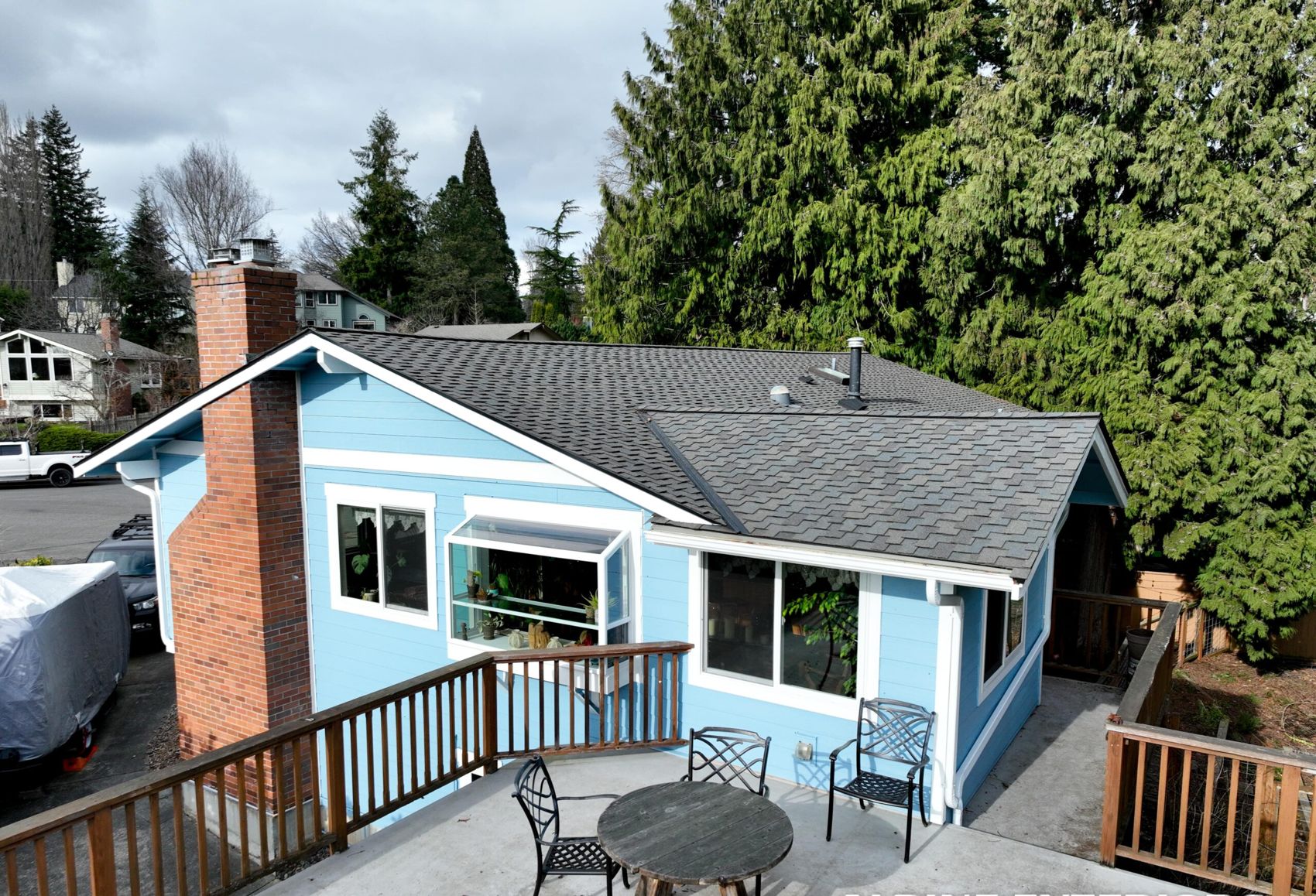
Maple Falls sits up in the Whatcom County foothills along the Mt. Baker Highway corridor, well inland from Bellingham Bay but no easier on a house exterior for it. Homes here deal with heavy tree canopy, long damp shoulder seasons, and a bigger freeze-thaw swing than you get closer to the water, since elevation climbs steadily as you head toward the mountain. Old wood or vinyl siding in this area tends to show its age through moss streaking on shaded north walls, soft trim at the bottom corners, and paint that never quite dries between rains. James Hardie fiber cement siding is a common upgrade for exactly these conditions, and homeowners researching it usually want one thing first: a realistic sense of what it costs before a crew ever measures a wall. This page walks through that, plus what actually drives the number up or down, and what a competent quote should include.
For a typical single-family home in the Maple Falls area, installed James Hardie fiber cement siding usually lands somewhere in the neighborhood of $9 to $16 per square foot of wall area, once you account for tear-off, prep, materials, trim, and labor. On an average-size home that often works out to a total project cost in the wide range of roughly $18,000 to $45,000, though smaller homes, additions, or partial re-sides can fall below that and larger custom homes with steep rooflines or extensive trim work can run above it. These are directional ranges, not a quote — the only way to get an accurate number is a walk-around of the actual house. What pushes a project toward the low end or the high end almost always comes down to the same handful of variables, which we've broken out below.
| Cost Factor | Typical Low End | Typical High End |
|---|---|---|
| Siding profile & texture (lap, shingle, panel, board-and-batten) | Standard smooth or woodgrain lap | Shingle profiles, mixed textures, ColorPlus premium finishes |
| Tear-off & disposal of existing siding | Single layer vinyl or hardboard, easy haul-away | Multiple layers, old wood, or hazardous material handling |
| Sheathing & rot repair behind old siding | Dry, sound sheathing, no repairs needed | Significant rot, soft sheathing, or framing repair |
| Weather-resistive barrier & flashing detail | Standard housewrap, code-minimum flashing | Upgraded rainscreen/drainage plane, extensive window and door flashing |
| Trim, fascia & corner boards | Minimal trim, simple massing | Extensive trim, multiple gables, dormers, decorative detail |
| Prefinished vs. field paint | Factory ColorPlus finish | Field-primed and painted after install |
| Site access & logistics | Flat, open lot with easy driveway access | Long gravel driveways, steep terrain, heavy tree cover, well/septic obstacles |
| Permitting & code compliance | Straightforward re-side, minimal wall assembly change | Wall assembly upgrades tied to Washington State Energy Code compliance |
A few conditions specific to this part of Whatcom County tend to show up in almost every Maple Falls estimate. The first is moisture. Persistent rain, shaded lots, and slower drying times mean crews frequently find more moss, algae staining, or soft wall sheathing than a homeowner expects once the old siding comes off. That's not a sales tactic — it's just what several decades of damp coastal-mountain climate does to a wall assembly that wasn't detailed with a drainage gap or was painted over one too many times without fixing the underlying leak. Finding rot during tear-off is common enough that any honest quote should address how it's priced if discovered, rather than promising it won't happen.
The second is elevation and freeze-thaw. Maple Falls sits high enough in the foothills that winter brings real freeze-thaw cycling, more than homes down in Bellingham or along Birch Bay typically see. That cycling is hard on caulking, trim joints, and any gaps in the weather barrier, which is part of why proper flashing and a continuous water-resistive barrier matter more here than in milder microclimates. Homes closer to Bellingham Bay and the Strait deal more with wind-driven rain pushed straight into wall assemblies off the water; Maple Falls doesn't get that particular exposure being inland, but it trades it for the freeze-thaw and prolonged dampness that come with elevation and tree cover instead.
Third, site access genuinely affects price in this area more than it does in town. Long gravel driveways, septic fields that limit where a dumpster or lift can sit, and mature trees crowding the walls all add labor time that a flat suburban lot in Bellingham wouldn't require. It's worth mentioning during a walk-through rather than letting it become a surprise change order later.
A usable quote is more than a single total. At minimum it should spell out the siding profile and product line, the underlying weather barrier and flashing approach, tear-off and disposal terms, and a clear statement of how hidden sheathing damage is handled if it's found once the old material comes off. It should also separate labor from materials, note whether trim and fascia are included or priced separately, and specify whether the finish is factory ColorPlus or field-painted, since that's one of the bigger swing factors in both cost and long-term maintenance. Permit costs, if a permit is required for the scope of work, should be called out rather than buried. Alpine Exteriors builds quotes this way specifically because vague, single-line totals are where disputes start once work is underway — a homeowner should be able to see exactly what they're paying for before signing anything.
It's also reasonable to ask a contractor how they handle wall assembly changes tied to the Washington State Energy Code, particularly on older Maple Falls homes where a re-side is a natural point to add continuous insulation or correct an undersized water-resistive barrier. Not every job needs it, but a contractor who can't explain the current code requirements for wall assemblies in a re-side scenario probably isn't the one who should be pricing your foothill home.
The biggest mistake homeowners make comparing siding bids is lining up the bottom-line numbers without checking whether the scope underneath them is the same. One contractor's number might include full tear-off, sheathing repair as needed, and a proper weather-resistive barrier; another's might assume the sheathing is fine and price a bare-minimum barrier, which looks cheaper on paper but can turn into change orders once the walls are open. Ask each bidder the same set of questions: what siding line and profile, prefinished or painted, what happens if rot is found, what weather barrier and flashing details are included, and what the timeline and cleanup process look like. Get everything in writing, and don't assume the lowest number is the best value if it can't answer those questions clearly. Confirm the contractor is licensed to work in Washington — Alpine Exteriors holds WA contractor license ALPINI751OW, and any contractor bidding your home should be able to give you a license number you can verify independently.
It's also fair to ask how a contractor handles the realities of a Maple Falls lot specifically — driveway access, tree removal or trimming needed to work safely, and how they protect landscaping and septic infrastructure during tear-off and disposal. A quote that doesn't mention any of that for a rural foothills property is either optimistic or hasn't actually walked the site.
Many siding contractors can point homeowners toward third-party financing options for larger re-side projects, which can make it easier to spread a $20,000-plus project over time rather than paying it in full upfront. Terms, rates, and approval vary by lender, so it's worth comparing more than one financing offer rather than accepting the first one presented. On the insurance side, a siding replacement prompted by storm damage, a tree strike, or long-term rot that's caused a covered loss may be partly or fully covered under a homeowner's policy — but routine wear, moss staining, or age-related deterioration typically isn't. If you suspect a covered loss is involved, it's worth calling your insurer before work starts, since documentation of the damage matters for a claim. A contractor can help document conditions found during tear-off, but the coverage decision itself is between the homeowner and the insurance carrier.
Fiber cement is a heavier, denser material that costs more upfront in both product and labor than vinyl siding, but it holds paint and color longer, resists moisture-driven warping, and stands up better to the kind of persistent damp conditions common in Maple Falls. Many homeowners here see it as a longer-horizon investment rather than the cheapest re-side option, though vinyl remains a legitimate lower-cost choice for budget-conscious projects.
A contractor can give a solid estimate range from an exterior walk-through and photos, but the final price often isn't locked in until the old siding is off and the sheathing underneath is visible. This is especially true on older Maple Falls homes where hidden rot behind wood or hardboard siding is common. A good quote should explain up front how those discoveries are priced, so there's no ambiguity if it happens.
Depending on the scope of work, a re-side can trigger Washington State Energy Code requirements around wall insulation and the water-resistive barrier, particularly if sheathing is exposed or replaced. It's worth asking your contractor directly whether your project's scope crosses that threshold, since it affects both cost and the materials used behind the new siding.
Timelines vary with home size, trim complexity, weather windows, and how much sheathing repair is needed, and Whatcom County's rainy stretches can extend a schedule beyond what a drier climate would allow. A realistic project plan should build in some weather contingency rather than promising a fixed number of days regardless of conditions.
Ranges are useful for budgeting, but the only way to know what your Maple Falls home actually needs is a walk-through that accounts for its specific siding condition, wall assembly, and site access. Alpine Exteriors serves Maple Falls and the rest of Whatcom County, from Bellingham and Ferndale out to Lynden, Blaine, Birch Bay, and Sudden Valley, and can put together a scoped, itemized quote rather than a rough number pulled from a phone call. If you're weighing a James Hardie re-side for a foothills home, reach out for an on-site estimate before budgeting off any online range, including this one.