
Whatcom County asks more of exterior siding than most inland climates do. Between the marine air moving off Bellingham Bay, the near-constant drizzle from October through May, and the shaded, moisture-holding lots common in neighborhoods like Fairhaven, Sehome, and the York and Columbia districts downtown, siding here works harder and fails in different ways than siding in a dry climate. This checklist walks Whatcom County homeowners through a practical, room-by-room way to inspect their own siding before small problems become expensive ones.
Bellingham's weather pattern is defined by long stretches of low-intensity rain rather than short violent storms, and that matters for how siding fails. Water doesn't blow siding off the wall here the way it might in a hurricane-prone region — instead, it finds small gaps and sits there, day after day, for months at a time. Wind off the Strait of Georgia and Bellingham Bay pushes rain sideways into west- and southwest-facing walls, driving moisture into seams, laps, and fastener holes that would stay dry in a calmer climate. Over a wet winter, that wind-driven rain can work its way behind siding that looks perfectly fine from the sidewalk.
Shade and humidity are the other half of the equation. Many downtown Bellingham lots sit close together with mature trees overhead, and homes tucked against the hillsides toward Sehome Hill or out in Sudden Valley often get less direct sun and airflow than an open lot would. That combination of moisture and shade is exactly what moss, algae, and lichen need to establish themselves on siding, trim, and roof edges. Left alone, that growth holds water against the surface and accelerates wood rot underneath painted trim and fiber cement laps alike.
Homes in the foothills toward Lake Whatcom and Sudden Valley face an added freeze-thaw cycle in winter that flatter, closer-to-sea-level neighborhoods in Bellingham or Blaine see less often. Water that has already worked its way into a crack or seam can freeze overnight, expand, and widen that crack — a slow, repeating process that turns a hairline gap into a real entry point for moisture over a few winters. And on the islands and in Birch Bay, salt-laden air adds a layer of corrosion risk to fasteners, flashing, and any exposed metal trim.
Finally, siding and the wall assembly behind it are part of a home's energy performance, not just its appearance. The Washington State Energy Code sets requirements for the insulation and air-sealing of the building envelope, and siding that has failed — allowing moisture into wall cavities or compressing insulation through rot — undermines that performance even if the code compliance was correct at the time the home was built or last re-sided. A siding failure is rarely just cosmetic; it's usually a slow leak in both the building envelope and the energy budget.
Walk the full perimeter of the house on a dry day, working section by section. A pair of binoculars helps for anything above the first floor, and a garden hose can help confirm suspected leak points once you've spotted them. Do not get on a ladder for anything above single-story eave height — leave upper-level and roofline inspection to a professional.
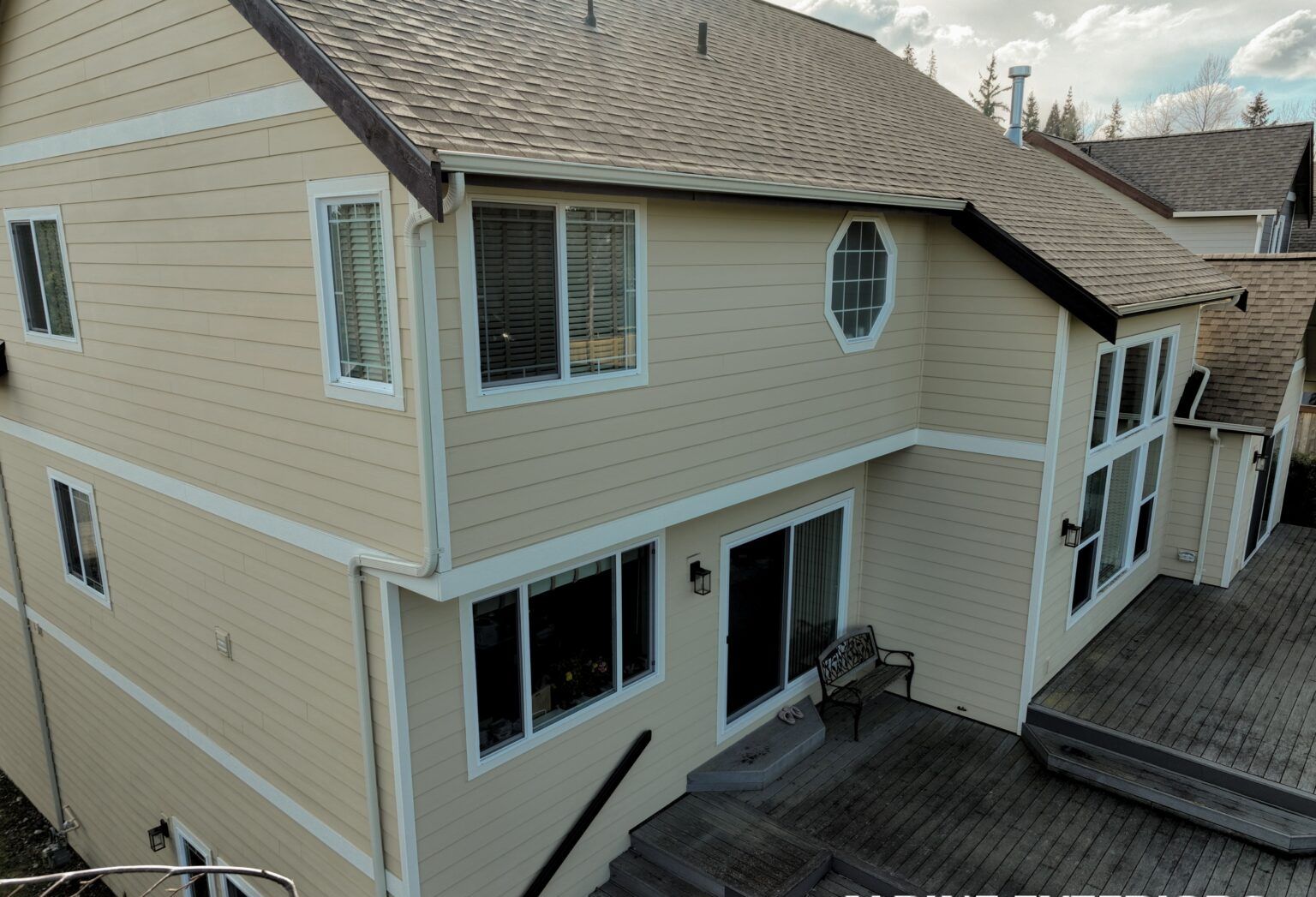
Not every failed item on this list means a full re-side. Sort what you find into three categories. Minor issues — a bit of surface moss, a small caulk crack, mulch piled too high — are reasonable DIY fixes: a soft wash (not a high-pressure wash, which can drive water behind siding and damage the surface), a bead of quality exterior caulk, or pulling mulch back a few inches from the wall. Moderate issues — soft spots that haven't fully given way, a loose panel, minor trim gaps — are worth documenting with photos and a date, then monitoring closely through the next rainy stretch, since these often indicate a problem that will progress. Serious issues — spongy or crumbling wood, visible rot, buckled panels, or interior staining on drywall near an exterior wall — should not wait. Moisture problems in this climate tend to move fast once they start, because the wall rarely gets a long enough dry spell to slow them down.
For anything beyond a simple caulk touch-up, get a written estimate before paying for repairs, and ask what the contractor found once panels or trim are opened up — hidden rot is common enough in this region that the visible damage is often smaller than what's underneath.
Call a licensed siding contractor rather than tackling the repair yourself when you find soft or crumbling wood, any sign of moisture inside the home near an exterior wall, siding that has visibly separated from the wall, or damage near the roofline where flashing and multiple materials meet. Those are also the situations where DIY repair risks trapping moisture rather than removing it — a cosmetic patch over unresolved rot just hides the problem for another wet season. It's also worth having a professional assess the whole wall assembly, not just the visible siding, any time you're planning to re-side more than a small section, since older Whatcom County homes — including many of the historic houses downtown and around the Columbia neighborhood — often have layers of past repairs, inconsistent flashing details, or wall assemblies that don't match current code expectations.
Alpine Exteriors inspects and repairs siding throughout Whatcom County, from Downtown Bellingham and Fairhaven out to Ferndale, Lynden, Blaine, Birch Bay, and Sudden Valley, and works with island homeowners on scheduling around ferry access. As a Washington-licensed contractor (license ALPINI751OW), Alpine Exteriors can identify whether a repair is truly local or a sign of a broader moisture problem before recommending a scope of work.
A full walk-around inspection twice a year is a reasonable baseline here — once in early fall before the wet season sets in, and once in spring after the rains ease up, when new staining, moss growth, or winter freeze-thaw cracking will be most visible. Homes in shadier or more exposed spots, like heavily treed lots downtown or wind-exposed properties near Birch Bay and the bay shoreline, may benefit from a quick check partway through the winter as well.
High-pressure washing can do more harm than good on most siding materials, since it can force water behind laps and seams, strip protective coatings, and even crack brittle or aged panels. A soft wash with a garden hose, a soft brush, and a cleaner appropriate for the siding material is the safer approach for routine moss and algae removal, with pressure washing reserved for surfaces and settings where a professional has confirmed it's appropriate.
The Washington State Energy Code governs the building envelope's insulation and air-sealing performance, and re-siding work that opens up the wall assembly — adding a weather-resistive barrier, insulation, or new sheathing — can trigger code requirements depending on the scope of the project. A licensed contractor can tell you which parts of a given project fall under current code requirements before work begins.
Small, isolated rot — a single trim board or a small section caught early — is sometimes within reach for a handy homeowner comfortable with basic carpentry. But rot rarely stays isolated in this climate, since the moisture source that caused it is usually still active, and what looks like a small spot from the outside often extends further into the wall than expected. Once rot is found, it's worth at least a professional opinion on how far it extends before deciding whether it's a DIY repair or not.
A siding problem caught in the checklist stage is a caulk tube and an afternoon; the same problem caught a year later can mean torn-out sheathing and interior repairs. If any item on this list turned up a soft spot, a gap, or growth you're not sure about, Alpine Exteriors offers siding inspections across Whatcom County — Bellingham, Ferndale, Lynden, Blaine, Birch Bay, Sudden Valley, and the islands — and can give you a straightforward, no-pressure read on what's cosmetic and what needs attention before the next wet season sets in.