
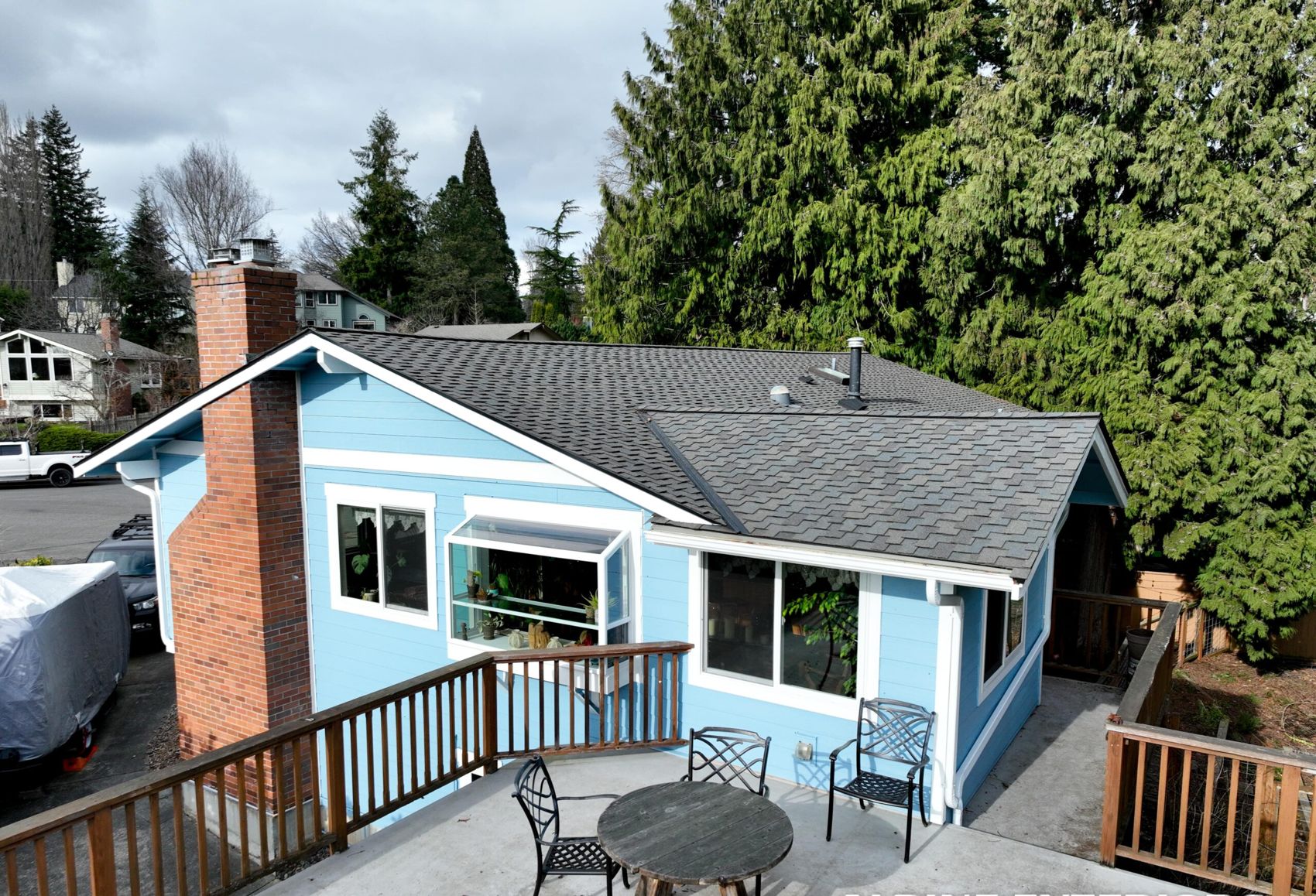
Birchwood sits in one of Bellingham's greener, more tree-shaded pockets, tucked between the Guide Meridian corridor and the rolling lots that back up toward Lake Whatcom. It's a neighborhood of mature conifers, damp lawns most of the year, and a lot of variety in home age and style — postwar ramblers next to newer infill, split-levels next to the occasional daylight basement home built into a slope. That mix means there's no single "correct" siding color for Birchwood, but there are colors that hold up better here, read better against the landscape, and cause fewer headaches five and ten years down the road. This guide is our honest take, based on what we actually see holding up — and failing — on siding jobs across Whatcom County, from Birchwood and the Sehome side of Bellingham out to Ferndale, Lynden, Blaine, Birch Bay, Sudden Valley, and the islands.
If you want one paragraph and no more reading: for most Birchwood homes, we lean toward deep charcoal, slate gray, warm greige, or a muted sage/forest green as the strongest all-around choices, usually paired with white or a soft cream trim. These colors do three things well in this specific climate — they hide the moss and algae bloom that's inevitable under Western Washington's tree cover and cloud cover, they read as timeless rather than trend-driven against a backdrop of Douglas fir and cedar, and they tend to fade more gracefully than bright or saturated colors under our long gray-sky stretches punctuated by intense summer UV. Bright white can look sharp on a clean, sunny lot, but in a shaded, moss-prone neighborhood like Birchwood it shows dirt and algae fastest. Very dark colors near true black look striking in photos but can run hotter and telegraph every water spot after a wind-driven rain off the Bay. The sections below walk through why, with real trade-offs for each option.
We didn't rank these by what's trending on a paint company's mood board. We judged them against conditions that actually hit a Whatcom County house:
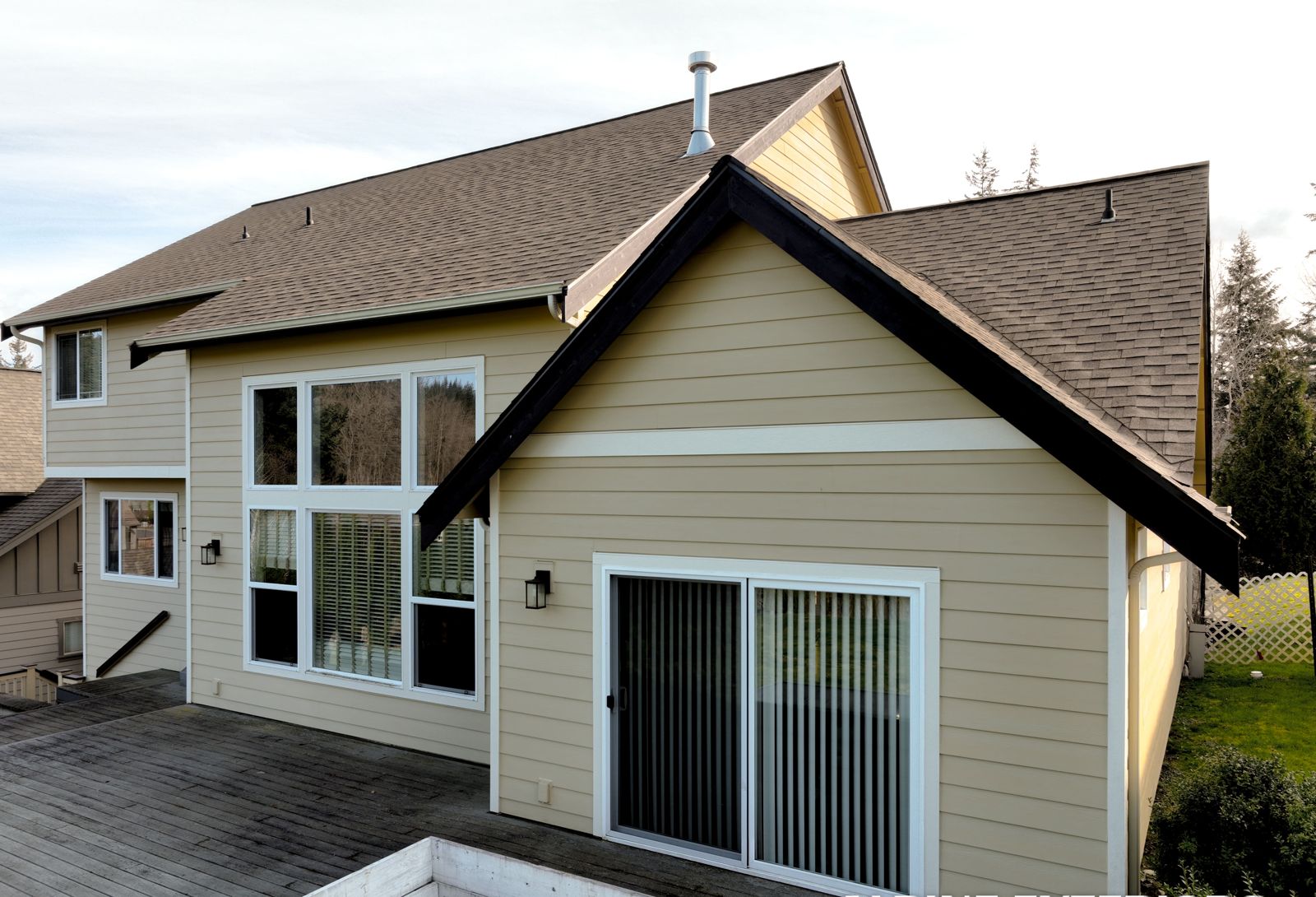
Charcoal and slate gray are probably the most requested colors we install in Whatcom County right now, and for good reason. Against the deep greens of Birchwood's tree canopy, a well-chosen charcoal reads as intentional and current without chasing a fad. It hides moss staining reasonably well on shaded elevations, and it doesn't show water spotting the way lighter colors do after a heavy wind-driven rain event. The honest downside: true near-black tones can fade unevenly on the sun-exposed side of a house, especially south- and west-facing walls that get the most direct summer sun, and uneven fading is more noticeable on a dark color than a mid-tone one. Darker colors also absorb more heat, which is a minor consideration but worth knowing if you're installing over older wall assemblies without much insulation.
Greige — the gray-beige blend — and lighter "fog" gray tones are a strong middle-ground pick for Birchwood. They're forgiving of dirt and light algae film between cleanings, they photograph well against both the green landscape and Bellingham's gray sky, and they tend to fade slowly and evenly because they're already a muted, low-saturation color. The trade-off is that greige can look slightly flat or indecisive on very plain, boxy home shapes — it works best with some architectural detail, trim contrast, or a stone or masonry accent to give it depth. It's also one of the more common choices in the area right now, so if you want something that stands out on your street, it may not be it.
This is the color family that arguably works with the landscape most literally. A muted sage or deep forest green siding tucks a home into its tree-lined lot rather than fighting it, and it's genuinely excellent at camouflaging the green-black algae streaking that shows up on shaded, north-facing walls faster than most homeowners expect. It also ages gracefully — small color shifts from UV exposure are far less visible in a green that's already close to the color of the moss and lichen around it. The downside is resale-market caution: green sells more slowly to a broad buyer pool than gray or white does in most real estate markets, and a poorly chosen bright or "minty" green can look dated within a few years in a way a neutral gray won't. Stick to muted, desaturated greens rather than bright ones.
White and soft cream have real advantages: they brighten a lot that's shaded most of the year, they pair well with the region's older farmhouse and craftsman-style homes common around Lynden and outer Birchwood, and they make a smaller home feel larger against a dense tree line. The honest problem is maintenance. White is the color that shows algae, moss spores, and roof-runoff staining fastest and most obviously of any option on this list, and in a damp, shaded neighborhood like Birchwood that usually means noticeably more frequent soft-washing to keep it looking good. If you love white, it's still a legitimate choice — just go in knowing the upkeep cadence is real, not occasional.
For homes with water-adjacent character or a more coastal aesthetic — more common toward Birch Bay and Blaine than deep in Birchwood, but still seen on plenty of Bellingham lots — a deep navy or marine blue can look sharp and distinctive. It hides moderate algae growth reasonably well because it's already a dark, cool tone, and it holds its own against gray skies rather than washing out. The drawback is that blue is more polarizing than gray or greige for resale, and some deeper navy pigments are prone to noticeable fading with prolonged UV exposure, which in our climate tends to show up unevenly rather than uniformly, since sun exposure varies so much wall to wall under mature trees.
Woodgrain-textured siding in cedar or warm brown tones is popular with homeowners who want a natural, Pacific Northwest look without the maintenance of real wood. It fits Birchwood's tree-heavy setting visually better than almost anything on this list. The honest caveat is about material, not just color: if you're drawn to this look because you actually want real cedar siding, know that in our rain and humidity, real wood is the highest-maintenance option on the market and the most exposed to the wood rot risk this region is known for at joints, corners, and anywhere flashing is imperfect. A quality engineered or fiber-cement product in a cedar-tone finish gets you the look with far less long-term risk, and it's what we generally steer Whatcom County homeowners toward when this style is the goal.
A few choices consistently cause more regret than satisfaction on Whatcom County homes, and Birchwood's specific conditions make some of these worse than they'd be elsewhere.
Color doesn't change how fast moss or algae actually grows — that's driven by shade, moisture, and how much airflow a wall gets — but color changes how visible that growth is. Darker grays, charcoals, and muted greens camouflage early algae staining far better than white or pale colors, which is one reason they hold up better cosmetically on the shaded, tree-covered lots common in Birchwood.
It depends on exactly where your lot sits. Much of Birchwood is not governed by an active homeowners association, but some pockets of Bellingham and several nearby Whatcom communities, including Sudden Valley, do have architectural review committees that approve exterior colors before installation. Check your covenants, conditions, and restrictions, or ask your HOA directly, before you finalize a color — it's a quick step that avoids a costly reorder.
Not necessarily faster overall, but the fade pattern can be more uneven. Western Washington gets long stretches of overcast weather punctuated by strong, unfiltered UV in summer, and because tree cover in a neighborhood like Birchwood shades some walls far more than others, you can end up with a south-facing wall fading noticeably more than a shaded north wall on the same house. Darker, more saturated colors tend to show this unevenness more than muted mid-tones.
Mid-tone and darker colors — charcoal, slate gray, deep greens, and cedar-tone woodgrain finishes — generally camouflage the mineral streaking and water lines left by wind-driven rain far better than white or pale colors, which show that staining as visible dark lines. This is worth extra weight on homes with more open exposure toward Bellingham Bay or the Strait, and on any wall that regularly takes rain at an angle rather than straight down.
Every one of the trade-offs above plays out differently depending on your lot's tree cover, sun exposure, and which direction your walls face — which is exactly why we bring physical samples out to the house rather than asking Birchwood homeowners to decide from a paint chip indoors. Alpine Exteriors is a licensed Washington contractor (ALPINI751OW) serving Bellingham, Ferndale, Lynden, Blaine, Birch Bay, Sudden Valley, and the islands, and we've installed enough siding across Whatcom County's varied microclimates to give you a straight answer on what will actually hold up on your specific lot. If you're planning a siding project in Birchwood, reach out to Alpine Exteriors for an on-site color and material consultation — we'll walk your property, talk through the honest pros and cons for your exposure, and help you land on a color you won't be second-guessing in five years.