
Lynden sits in a different light than most towns its size. Between the Nooksack River valley's open dairy fields, the tree lines that ring nearly every subdivision, and the low, diffused cloud cover that defines a Whatcom County winter, siding color here has to do more work than it does in drier climates. A color that photographs well in a showroom sample can look flat, pink, or streaked with green within a couple of wet seasons once it's actually on a wall facing north toward a stand of Douglas fir. This guide walks through the colors that hold up honestly in Lynden's conditions, the ones that tend to disappoint, and why — based on how siding actually behaves here, not on trend lists written for a different climate.
For most homes in Lynden, Ferndale, and the rest of Whatcom County, warm grays and greiges, deep charcoal used selectively, classic white on well-drained and sun-exposed elevations, and muted sage or moss greens are the safest, best-looking long-term choices. These colors either hide the moss and algae streaking that's unavoidable under our tree cover and rainfall, or they're forgiving enough that streaking doesn't stand out against the color itself. They also tend to sit comfortably with Lynden's mix of working farmland, foothill views, and the more traditional architectural committee guidelines found in newer developments like those off Line Road and near Bender Fields. None of these colors is universally "correct" — the right pick still depends on your home's sun exposure, tree cover, and roofline — but they're the categories that consistently perform well rather than just look good on day one.
Color advice that ignores climate is just decorating advice, and decorating advice doesn't help a homeowner who's repainting or re-siding once and wants it to look right for fifteen years. We weighed each color category against the specific conditions Whatcom County siding actually faces:
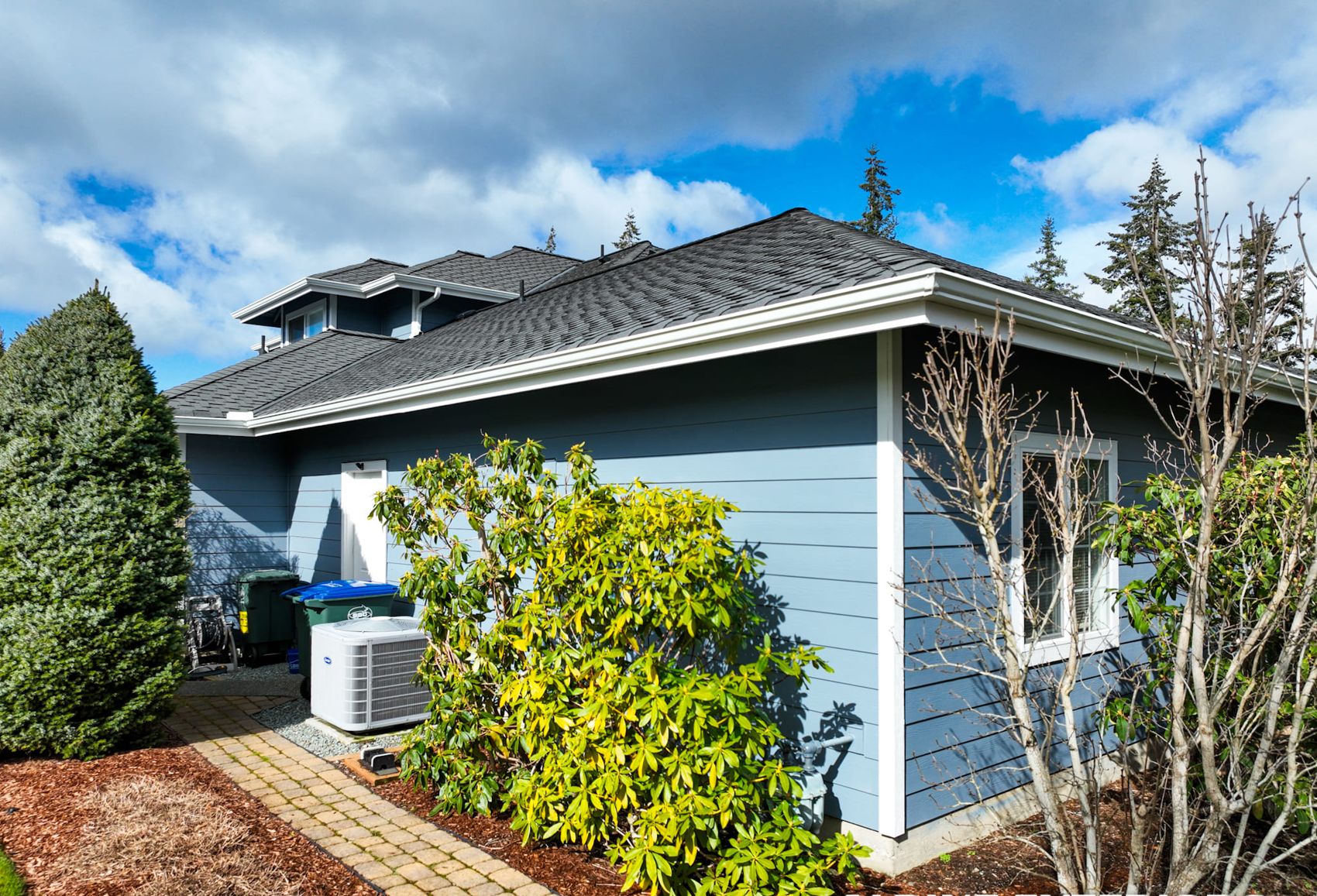
Warm gray and greige (gray with a hint of brown or tan) are the most consistently reliable choice we see across Lynden and the wider county. The mid-tone value does a good job of visually blending with the early stages of moss and algae growth rather than highlighting it the way white does, and it pairs naturally with the stone and brick accents common on Whatcom County farmhouses and craftsman-style homes.
Pros: Hides early algae streaking well; timeless enough to outlast trends; flatters both traditional and modern trim packages; generally accepted by HOA architectural committees.
Cons: Very light warm grays can shift toward a pink or lavender cast under Whatcom County's overcast, blue-toned daylight — a phenomenon worth checking with a large sample board outdoors, not a paint chip indoors. Shaded north walls under heavy tree cover will still need periodic washing regardless of color.
Charcoal and near-black siding has become popular for modern farmhouse styles around Lynden, and it does look striking against the green of the surrounding landscape. It's also genuinely useful for hiding moss shadowing on shaded elevations, since dark tones and dark growth read similarly from the street.
Pros: Strong curb appeal against evergreen and farmland backdrops; effective camouflage for moss on shaded walls; pairs well with black-frame windows, a look increasingly common in newer Whatcom County builds.
Cons: Dark colors absorb more heat on afternoon-sun (south and west) elevations, and that heat cycling stresses caulk joints and can contribute to visible expansion issues on vinyl products over time — a real concern given the freeze-thaw swings homes see toward Sudden Valley and the foothills. Fade also tends to be more visible on dark colors because it shows up as chalky unevenness rather than uniform lightening. Several Lynden subdivisions with architectural guidelines also restrict very dark facade colors, so it's worth checking your covenants before committing.
White has a long history in Lynden's dairy-country architecture, and it's still a strong choice on homes with good sun exposure and manageable tree cover, particularly in the more open parts of town near the valley floor.
Pros: Traditional look that fits Lynden's historic downtown character; reflects rather than absorbs heat; easy to match trim and accent colors to.
Cons: White shows moss, algae, and general grime faster and more obviously than any other color on this list — a genuine drawback in a climate where some algae growth on north-facing and shaded walls is close to inevitable. It also shows wind-driven rain splashback near the foundation and streaking below window sills more visibly, and it requires more frequent washing to keep looking presentable, especially on homes tucked under cedar or fir canopy.
Muted greens are an underused option that work particularly well on wooded lots around Lynden and toward the county's more forested edges. The color echoes the surrounding evergreen cover rather than fighting it, and it's forgiving of the algae growth that would stand out sharply against white or light gray.
Pros: Blends naturally with farmland and forest surroundings; hides tannin staining and light algae growth well; fits the craftsman aesthetic common in Bellingham and Whatcom County generally.
Cons: The undertone matters enormously — a green that leans too yellow or olive can look dated within a few years, while a green with too much gray can read as simply drab under our cloud cover. Sample boards should be viewed outdoors on an overcast day, since Whatcom County's diffuse light shifts green undertones more than it shifts neutral colors. Trim contrast options are also more limited than with a neutral base.
Navy and deep blue-gray siding shows up on some of the more architecturally distinct homes around Bellingham Bay and increasingly on newer Lynden builds. It's a bolder choice, but one that can work very well with white or cream trim.
Pros: Distinctive curb appeal; camouflages moss reasonably well on trim-heavy craftsman-style homes; pairs naturally with cedar accent details.
Cons: Blue pigments tend to fade unevenly toward slate or gray over years of UV exposure, which can be more noticeable than fade on a neutral color since the shift changes the color's character, not just its brightness. High-contrast trim is close to mandatory for the look to work, which adds cost and maintenance. Some architectural committees in newer developments treat blue as a "bold" color requiring separate approval.
Brown and cedar-toned siding fits naturally with Lynden's Nooksack Valley and foothill setting, especially on properties with real wood accents, board-and-batten details, or a barn-adjacent aesthetic.
Pros: Complements natural wood trim and the surrounding agricultural and foothill landscape; low visible dirt on lower wall sections; warm without being stark.
Cons: On homes near gravel drives or unpaved farm access, brown siding can visually merge with mud splashback during the wet season rather than standing apart from it. Some manufactured wood-look browns don't hide moss and algae as effectively as gray-greens do, since the growth reads as a slightly different, distracting shade rather than blending in.
A few choices come up often enough in consultations that they're worth calling out directly. Stark, bright white without any warm undertone shows mildew and algae staining faster than almost anything else, and on a shaded lot under mature cedar or fir, that can mean a visibly streaked wall within a single wet season. Very dark, highly saturated colors — true black in particular — on large south- or west-facing walls without adequate ventilation behind the panels can run hot enough to stress vinyl siding and accelerate caulk failure at trim joints, a problem that's worse, not better, given the freeze-thaw swings some Whatcom County properties see. Trendy high-gloss finishes also deserve a second look: gloss shows every ripple in an older wall substrate and tends to highlight, rather than hide, the fine surface staining that develops from years of wind-driven rain off the Bay and the Strait. Finally, it's worth confirming any color choice against your subdivision's architectural guidelines before ordering material — a rejected color after installation is an expensive mistake, and several newer Lynden developments do enforce a specific approved palette.
One more point worth flagging: color choice doesn't fix moisture problems, only disguises or reveals them. If your current siding shows soft spots, dark staining that won't wash off, or gaps at trim joints, that's a wood rot or flashing issue that a new color will only mask temporarily. Alpine Exteriors typically checks the wall assembly and flashing details before ever getting to color selection, because a beautiful color on a compromised substrate is a short-term fix.
Color doesn't change how much moss or algae actually grows — that's driven by shade, moisture, and airflow around the wall — but it changes how visible that growth is. Light colors like white show green and black streaking almost immediately, while mid-tone grays, greens, and browns tend to visually absorb early growth so it reads as a texture rather than a stain. Homes under heavy tree cover in Lynden will develop some growth regardless of color; the real question is how forgiving the color is between cleanings.
It depends entirely on your specific development's covenants. Several newer subdivisions around Lynden maintain approved color palettes or require architectural committee sign-off for anything outside a neutral range, and dark or saturated colors are the ones most often flagged. Older neighborhoods and standalone rural properties typically have no such restriction. Check your covenants, or ask your architectural committee directly, before ordering siding material in a bold color.
UV radiation passes through cloud cover; it's just diffused rather than direct. Over years, that diffuse UV still breaks down pigment in siding and paint, and because Whatcom County's light comes from a low angle for much of the year, fade tends to show up unevenly — heavier on upper walls and gable ends that get more sky exposure, lighter on sheltered or shaded sections. Darker, more saturated colors typically show this unevenness more visibly than muted neutrals.
There's no rule that you have to match the landscape, but colors that echo it — muted greens, warm grays, earthy browns — tend to age better visually because they're forgiving of the moss, tannin, and weather staining that's part of living in this climate. A color you love that fights the surroundings can still be the right choice for you; just go in aware that it may show wear and streaking more visibly than a landscape-complementary tone would, and plan your cleaning schedule accordingly.
Choosing a siding color for a Lynden home means weighing curb appeal against how a color actually performs against Whatcom County's rain, moss, and light — not just how it looks on a sample chip. Alpine Exteriors, WA contractor license ALPINI751OW, works with homeowners across Lynden, Ferndale, Blaine, Birch Bay, Sudden Valley, and the islands to pick colors and materials suited to each property's sun exposure, tree cover, and HOA requirements, and to make sure the wall assembly underneath is sound before color ever becomes the focus. If you're planning a re-side or a color change, reach out to Alpine Exteriors for a consultation and a look at real samples in your own yard's light.