
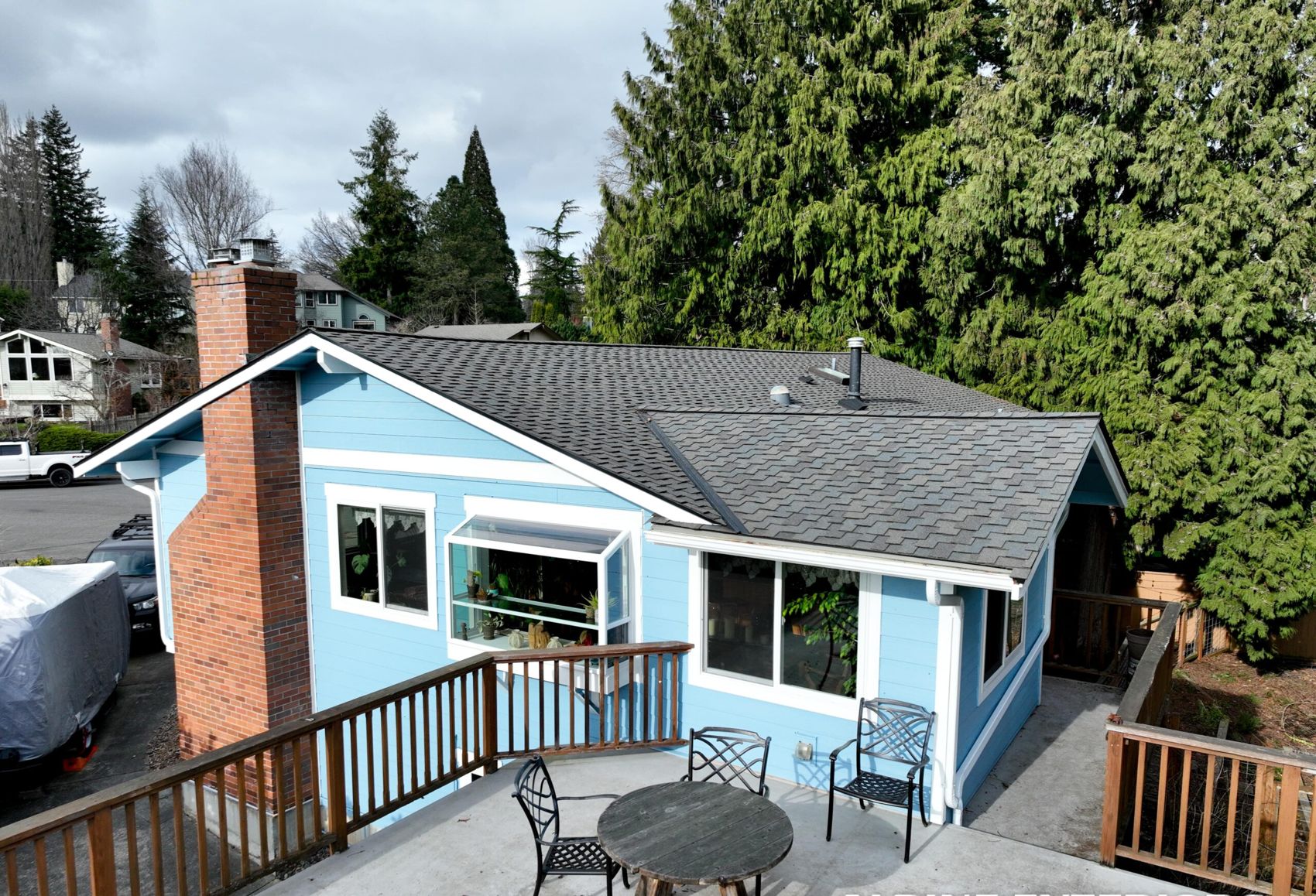
Blaine sits right on Semiahmoo Bay and the Strait of Georgia, which means the town takes weather most Whatcom County neighborhoods only get a taste of. Wind off the water drives rain sideways into north- and west-facing walls for months at a time, salt-laden air works on fasteners and finishes year-round, and the tree cover that shades so many Whatcom County lots keeps siding damp long after a storm has passed. Add in a housing stock that ranges from older beach cottages near the Semiahmoo waterfront to newer builds out toward Birch Bay and Sudden Valley, and "best siding" stops being a single answer — it depends on what the house is, where it sits, and how much upkeep the owner actually wants to do. This guide walks through the materials we install and recommend as Alpine Exteriors, contractor license ALPINI751OW, after years of siding and re-siding homes across this specific stretch of coastline.
For most Blaine homes, especially anything within a few blocks of the water or exposed to prevailing westerly wind, fiber cement lap siding is our default recommendation. It doesn't absorb water the way wood does, it resists the moss and algae staining that's constant in this climate, and it holds paint far longer than wood siding in a marine environment. Where budget is tighter or the home is more sheltered — a Lynden-style inland lot with less wind exposure — a heavier-gauge vinyl siding with proper rigid backing can be a reasonable, honest choice. And for owners who want the look of traditional Northwest cedar and are willing to commit to a real maintenance schedule, cedar still has a place here, particularly on architecturally sensitive homes near the historic parts of town. What we steer almost everyone away from in Blaine specifically is stucco and EIFS systems, for reasons we get into below — this is not a climate where a water-managed drainage plane can be an afterthought.
We didn't rank these materials on looks or price alone. The criteria that actually matter for a house sitting a few miles from open water in northwest Washington are:
Fiber cement is cement, sand, and cellulose fiber pressed into planks or panels, and it's become the most common upgrade we install in Blaine and across Whatcom County generally. It doesn't rot, it doesn't feed moss and mildew the way raw wood does, and factory-applied finishes hold color for a long time even under the gray, low-UV skies typical here. It handles wind-driven rain well when installed with correct flashing, weather-resistant barrier, and proper lap and caulk detailing at penetrations — the material itself is not the weak point, the installation is, which is why we're careful about laps, gaps, and fastener placement on every job.
Honest drawbacks: it's heavier than vinyl or wood, so installation labor costs more, and it must be field-cut and painted at cut edges to keep water from wicking into the cut ends of a plank — a detail some crews skip. It's also a poor DIY material; this is one where installer skill genuinely changes long-term performance more than brand choice does.
Engineered wood siding is wood strand product bonded with resins and coated with a factory finish, giving it the grain look of cedar at a lower cost and lighter weight than fiber cement. Newer formulations handle moisture significantly better than older engineered wood products from decades past, which is worth knowing if a homeowner remembers bad experiences with older hardboard siding that failed in Pacific Northwest conditions.
Honest drawbacks: it is still a wood-based product, so any breach in the factory coating — a scrape, an unsealed cut edge, a poorly flashed window — gives moisture a path in, and once water gets behind the coating it can swell and delaminate. In a town with as much sustained wet weather as Blaine, we treat every seam and penetration as a place that has to be sealed correctly the first time, because callbacks on this material are almost always a flashing or caulk failure, not a material failure.
Vinyl remains the lowest-cost option and it has real advantages: it doesn't rot, it doesn't need painting, and it's forgiving of the freeze-thaw cycling the foothills see because it simply doesn't absorb water the way wood-based products do. For homes set back from the water with more tree and terrain shelter, a quality, heavier-gauge vinyl product installed with rigid foam backing can be a sound, budget-conscious choice.
Honest drawbacks: standard vinyl is not our first recommendation for homes with direct west or northwest exposure toward the Strait, because sustained high wind can work at loose or improperly nailed panels over time, and at the seams it relies heavily on correct overlap and nailing to keep wind-driven rain from getting behind it. Vinyl also becomes brittle in a hard cold snap, which matters more the closer a home is to the colder foothill microclimates than in Blaine proper, and its color can fade faster than factory-finished fiber cement under years of exposure.
Cedar is the traditional Pacific Northwest choice for a reason — it looks right on a lot of Whatcom County homes, particularly older character homes near Blaine's waterfront and downtown core, and it has natural rot resistance compared to other softwoods. Done well, with a breathable, high-quality stain or finish and back-primed boards, it can look excellent for years.
Honest drawbacks: cedar is the highest-maintenance option on this list in a climate this wet. It needs refinishing on a real schedule — not the every-decade promise sometimes made, but genuinely inspecting and recoating every few years — or moss, algae, and eventually rot set in, especially on north-facing walls that never fully dry between rain events. We install and repair cedar for owners who value the look and are committed to the upkeep, and we're upfront when a homeowner's maintenance expectations don't match what cedar actually demands here.
Metal panel siding has grown more common on modern and contemporary builds around Whatcom County, and it performs well against moss, algae, and moisture absorption for the simple reason that it doesn't absorb water at all. It also tolerates salt air reasonably well when it's a quality coated steel or aluminum product rather than bare or thin-gauge material.
Honest drawbacks: cost is higher, the aesthetic is a specific modern look that doesn't suit every house, and lower-quality or improperly coated metal can show corrosion streaking over time in a salt-air environment like Blaine's. Dents from debris are also a consideration on more exposed lots.
Stucco and EIFS (exterior insulation and finish systems) are the two products we most often recommend against for Blaine specifically. Both were designed and perform best in drier climates where a wall can dry out between rain events. In a location with Blaine's rainfall pattern and wind-driven exposure, any gap in the drainage plane behind stucco or EIFS traps moisture against the sheathing, and because the finish itself is largely non-permeable, that trapped moisture doesn't get a chance to dry — it just sits there working on the wall assembly, often invisibly, until a much larger repair is needed than anyone expected. We also see this on some of the older stucco-clad homes we're called out to inspect after owners notice soft spots or staining; by the time it's visible, the damage is usually already extensive.
Beyond the material itself, we'd flag a few practices to avoid regardless of siding choice in this specific area: skipping a proper weather-resistant barrier and correctly lapped flashing at every window, door, and penetration; face-nailing or under-driving fasteners on lap siding, which loosens under sustained wind loading; and using interior-grade caulk or sealant instead of exterior-rated product at joints exposed to salt air, which breaks down faster here than it would inland.
For homes with direct exposure to wind off Semiahmoo Bay or the Strait, we generally think so — the added upfront cost buys better wind-driven rain resistance, less staining from moss and algae, and a finish that tends to outlast vinyl's color life under this region's cloud cover. For a more sheltered inland lot, quality vinyl can still be a defensible, lower-cost choice.
Yes, but only for owners who will keep up a real maintenance schedule of inspection and refinishing, particularly on north-facing walls that stay damp longest. If low maintenance is the priority, engineered wood or fiber cement will give a similar look with less upkeep.
The energy code's requirements around continuous insulation and air sealing at the wall assembly can affect how a new siding system is detailed, particularly on full re-sides where the wall is opened up. It's worth discussing wall assembly and code compliance with your contractor before choosing a product, since some siding systems integrate more easily with rigid insulation layers than others.
Often yes. Homes with direct west or northwest exposure to wind and salt air benefit from materials and installation details — deeper flashing laps, corrosion-resistant fasteners, moisture-tolerant materials — that a more sheltered Lynden or Sudden Valley lot may not strictly require, though good flashing and moisture management are never wasted anywhere in Whatcom County.
Every lot in Blaine faces the water a little differently, and the right siding for a beachfront home near Semiahmoo isn't always the right siding for a place set back in the trees. Alpine Exteriors has spent years fitting siding choices to Whatcom County's specific weather rather than a national average, and we're happy to walk your property, point out where wind and moisture are actually hitting your walls, and lay out honest options with real trade-offs. Reach out to Alpine Exteriors (WA contractor license ALPINI751OW) for a straightforward assessment of what will actually hold up on your home.