
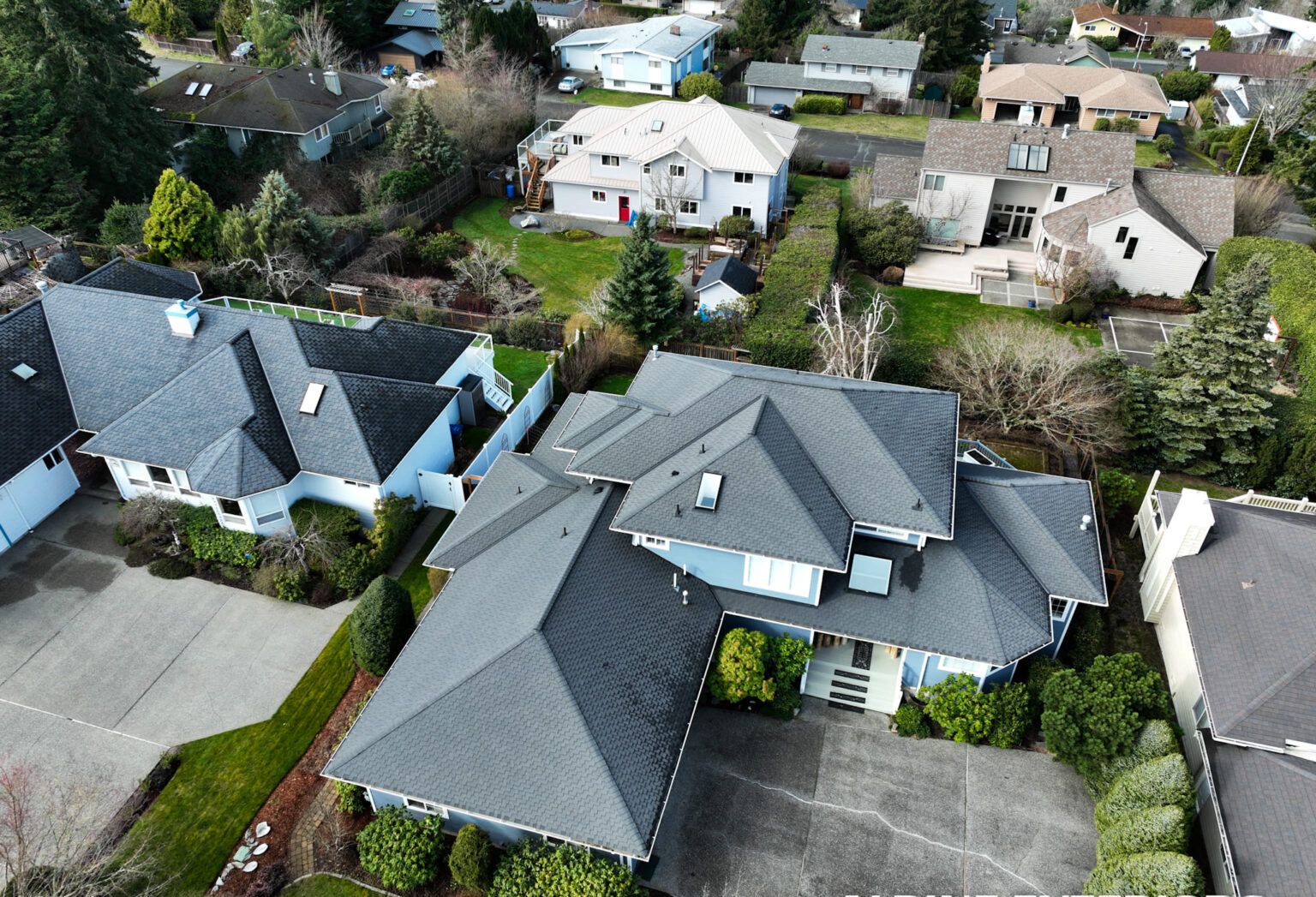
Meridian sits in that in-between stretch of Whatcom County — north of Bellingham, south of Lynden, strung along the Guide Meridian corridor where subdivisions back up against dairy farms, second-growth fir, and long views toward the foothills and Mount Baker on a clear day. It's a different palette than the waterfront in Blaine or the bluffs at Birch Bay, and it should be treated that way when you're picking siding colors. What holds up on a wind-scoured lot along Bellingham Bay isn't always the right call on a shaded half-acre off Depot Road. Below is our honest read on the colors that actually work here, the ones that fight you every year, and why.
For most Meridian homes, we point people toward warm greige or "driftwood" gray, deep forest green, and charcoal — in that order of general popularity, though the right pick depends on your lot's tree cover, your home's trim and roof, and whether you're inside an HOA. Warm greige reads as neutral without going stark white, hides the fine dust and pollen film that settles on siding near open farmland, and photographs well against both cedar-and-fir backdrops and open sky. Deep forest green leans into the landscape instead of fighting it — it's a color that has always belonged in this part of Whatcom County, from old farmhouses to newer builds tucked against tree lines. Charcoal is the boldest of the three but, done in a fade-resistant pigment backed by the manufacturer, holds its value on trim-heavy homes and doesn't show moss the way pale colors do. None of these are the only right answers — they're simply the three that give you the fewest regrets five years in.
| Color family | Moss/algae visibility | Fade resistance | HOA fit | Best lot type |
|---|---|---|---|---|
| Warm greige / driftwood gray | Low — hides green streaking well | Good with quality pigment | Usually approved | Mixed sun/shade, open subdivision |
| Deep forest / hunter green | Low to moderate | Moderate — darker greens can bronze over time | Usually approved | Treed lots, farmland-adjacent |
| Charcoal / near-black | Low | Depends heavily on pigment quality | Case by case | Full sun, contemporary builds |
| White / linen / cream | High — shows moss and algae fastest | Good | Usually approved | Full-sun, well-drained, low tree cover |
| Earth browns / bark tones | Moderate | Good | Usually approved | Wooded, rural-edge lots |
| Muted blue / slate | Moderate | Moderate | Case by case | Open view lots, foothill-facing |
We didn't rank these colors on looks alone. Whatcom County's climate and Meridian's specific setting push certain choices to the top and quietly rule others out, so this is the checklist Alpine Exteriors actually works through with homeowners before a color goes on the order form.
This has become the default recommendation for good reason. Warm greige splits the difference between true gray and beige, so it doesn't read cold under Whatcom County's grey winter sky and doesn't look washed out against a green tree line in summer. It camouflages early moss streaking better than white without going as dark as charcoal, and it's close to universally accepted by HOA design committees because it's the neutral everyone expects. The honest drawback: it's common enough now that a driftwood-gray house doesn't stand out on a street where four other homes made the same choice. It also can look flat without contrasting trim — pair it with a darker window trim or a black roof to keep it from reading as beige mush on a cloudy day, which is most days here.
Green siding has real history in this part of the county — it shows up on old farmhouses and outbuildings as much as on newer builds, and it's one of the few colors that genuinely blends into a fir-and-cedar backdrop instead of standing against it. It also does a decent job hiding light moss growth simply because the color family overlaps. The tradeoffs are real, though. Cheaper pigment formulations in dark green can bronze or yellow unevenly as they age, which looks worse than a uniform fade — check that any green you're considering carries a manufacturer fade warranty backed by real pigment technology, not just a color name. Deep green can also read almost black in deep shade under heavy tree cover, which some owners like and others find gloomy through the darker months.
Charcoal has become popular on newer, more contemporary builds in Meridian's subdivisions, usually paired with black-framed windows and light wood or stone accents. It photographs well, hides moss better than almost anything except true black, and gives an older ranch-style home a noticeably updated look without changing its shape. The honest cons: heat gain against foam-backed wall assemblies is a real consideration under current energy code detailing, fade — if it happens unevenly — is far more visible on dark siding than light, and on a lot with heavy tree cover, an all-charcoal house can look severe rather than modern. It's a color that rewards good trim contrast and punishes a flat, monotone application.
White and near-white siding still has a place here, particularly on farmhouse-style builds with open, sunny lots and good drainage away from the foundation. It brightens a home during the long overcast stretch of a Whatcom County winter, and it pairs naturally with black or dark green trim for a look that reads clean without being stark. The drawback is unavoidable: white shows moss, algae, and general grime faster and more visibly than any other color family on this list. On a shaded or north-facing wall, expect visible green or black streaking well before a mid-tone color would show the same growth. If you love a light color, it's worth budgeting for more frequent exterior washing, or choosing a warmer cream over a stark, cool white, which tends to show staining even more starkly by contrast.
Bark brown, chestnut, and other earth-toned siding colors do exactly what you'd expect against Meridian's forest-edge and farmland setting — they disappear into it in a good way. These tones are forgiving of dust, pollen, and light moss because they already sit in that visual range, and they tend to age evenly since brown pigments are generally stable formulations. They're also an easy HOA approval almost everywhere in the county. The downside is that on a lot without much greenery around it — a bare new-construction yard, for instance — brown siding can look plain until landscaping fills in, and it's not a color that makes a strong style statement if that's what you're after.
Blue-gray and slate tones show up more often on homes with a view — toward the foothills, toward open pasture, or in the parts of the broader service area that look out over Bellingham Bay or the Strait. In Meridian specifically they work best on lots with some open sky rather than deep shade, where the color can read as intentional rather than muddy. Slate blends reasonably well with both green landscaping and gray winter light. The tradeoff is that blue pigments, especially lighter ones, can fade toward gray over time faster than earth tones or grays that start out closer to their faded end-state, and some HOA committees are more selective about blue than they are about grays, greens, or browns, so it's worth confirming before you commit.
A few choices consistently cause regret on this stretch of the county, and it's worth naming them plainly. Stark, bright white on a shaded or tree-lined lot is the most common one — it looks sharp for the first year and then shows every bit of moss and algae streaking that follows, often within a couple of seasons on the shadier elevations. Very light pastels have the same problem and add a second one: on a home without significant roof overhang, driving rain off the eaves can leave visible tannin and dirt streaking that's much harder to hide on a pale, low-saturation color. High-gloss, dark, poor-quality paint films are another mismatch here — the freeze-thaw cycling common at Meridian's foothill-adjacent elevation is exactly the kind of repeated expansion and contraction that cracks a brittle gloss finish at seams and caulk lines faster than it would in a milder microclimate. Finally, be careful with any color that isn't on your neighborhood's approved covenant list — a beautiful, well-installed job in a color the HOA rejects after the fact is a genuinely painful and avoidable problem.
The color itself doesn't cause moss or algae growth — shade, moisture, and airflow do — but color strongly affects how visible that growth is and how soon you'll notice it. Pale colors show green and black streaking almost immediately, while mid-tone grays, greens, and browns can mask the same amount of growth for a season or more. If your lot has heavy tree cover or north-facing walls that stay damp, lean toward a mid-tone or darker color rather than white if hiding early growth between cleanings matters to you.
Many of the newer developments along the Guide Meridian corridor, as well as established communities like Sudden Valley, have architectural review committees that pre-approve exterior color palettes, typically favoring neutrals, grays, greens, and browns over bright or highly saturated colors. If you're in a covenant-controlled neighborhood, check the approved palette or submit your color choice for review before ordering materials — reversing an installed job over an unapproved color is a headache worth avoiding entirely.
The energy code itself doesn't regulate color, but current WSEC requirements for continuous insulation on new construction and many re-sides mean more homes are going over rigid foam backers. Very dark siding on a foam-wrapped wall absorbs more heat, which can affect material behavior and detailing at seams. It's not a reason to avoid dark colors, but it's worth discussing with your contractor if you're planning a near-black or true-black exterior over an insulated assembly.
Whatcom County's overcast, low-UV climate is gentler on siding color than a sunnier region would be, but fade still happens gradually over many years, especially on sun-exposed south and west walls. Quality matters more than climate here — a manufacturer-backed, fade-resistant finish on fiber cement or engineered siding will hold its color far longer and more evenly than a field-painted surface or a budget pigment, regardless of which color you choose.
Color choice is easier to get right when you can see actual samples against your own trees, your own roofline, and Meridian's particular gray-sky light rather than guessing from a chip in a showroom. Alpine Exteriors works throughout Whatcom County — Bellingham, Ferndale, Lynden, Blaine, Birch Bay, Sudden Valley, and the islands — and can bring real samples out to your lot, walk through your HOA's approved palette if you have one, and talk through how a color will actually perform against your specific exposure and tree cover. Alpine Exteriors holds Washington contractor license ALPINI751OW. If you're planning a re-side in the Meridian area, reach out and we'll help you land on a color you won't be second-guessing in five years.