
Everson sits along the Nooksack River on the flat farmland east of Bellingham, close enough to the water and the Cascade foothills to catch weather from both directions. Homes here take on wind-driven rain funneled up from Bellingham Bay and the Strait of Georgia, long stretches of gray damp that never quite dry between storms, and, in the colder pockets nearer the foothills, real freeze-thaw cycling in winter. None of that is dramatic in any single event, but it adds up year over year, and it's why the siding question in Everson is different from the siding question in, say, Spokane or Yakima. This guide walks through what actually holds up here, what we've seen fail, and how to think about the trade-offs before you commit to a material for your home.
For most Everson homes, James Hardie fiber cement siding — specifically the HZ5 product line engineered for the Pacific Northwest's moisture and temperature swings — is the material we recommend most often, and it's what Alpine Exteriors has standardized around for full siding replacements in this part of Whatcom County. It resists moisture absorption far better than wood or engineered wood products, it doesn't feed moss and algae the way some composite sidings do, and its factory-applied ColorPlus finish holds color under our low, filtered light without the chalking you get from field-painted products after a decade of Whatcom rain. That said, fiber cement isn't automatically right for every house or every budget, and vinyl and engineered wood siding (LP SmartSide is the main brand in that engineered wood category) both have legitimate uses. We'll cover the honest pros and cons of vinyl, SmartSide, and fiber cement below rather than just telling you what we sell.
We're not ranking siding materials on looks alone. For a climate like ours, four things matter more than curb appeal photos from a manufacturer's brochure:
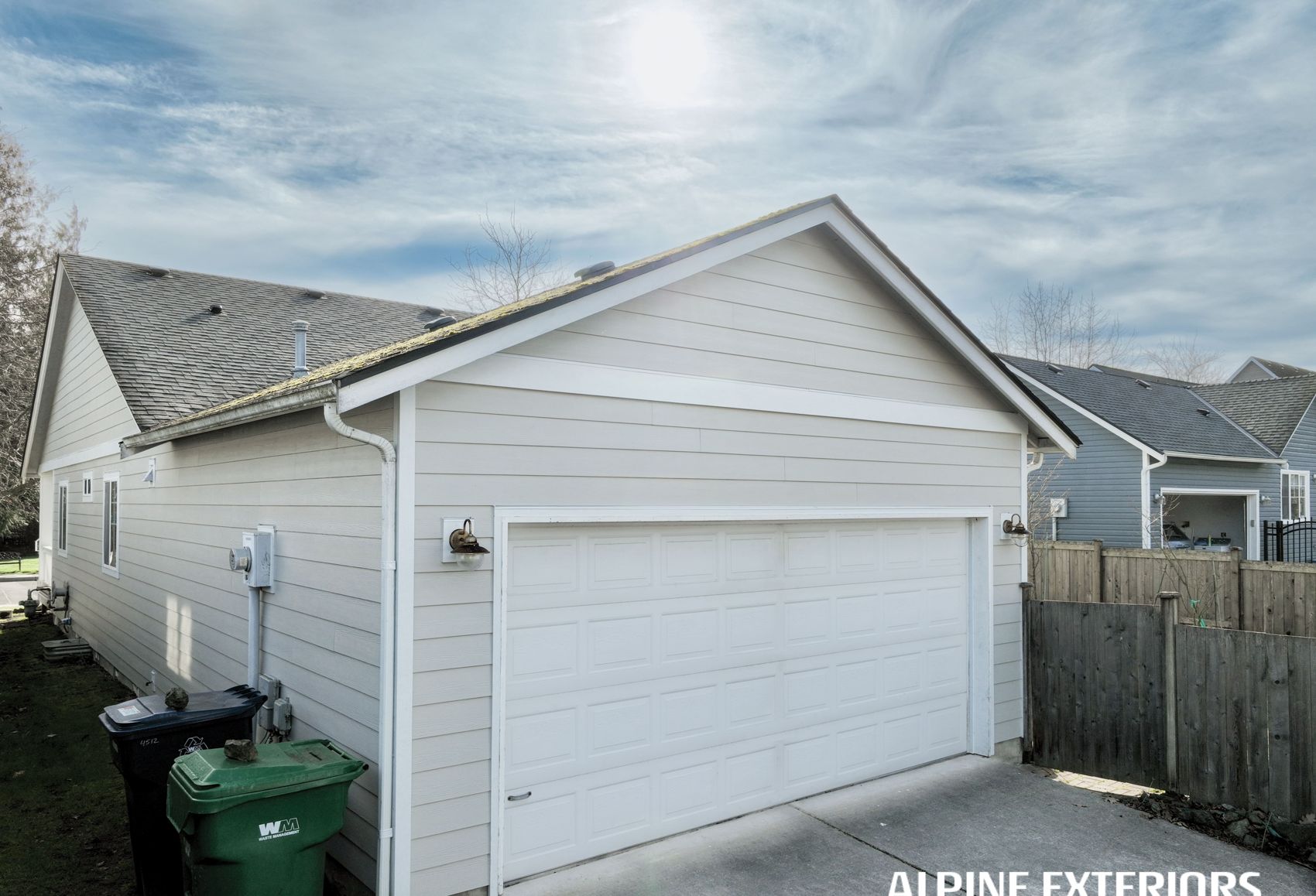
James Hardie is a fiber cement product — a mix of cement, sand, and cellulose fiber pressed into planks or panels — and it's the material we install most on full re-sides in Whatcom County. The HZ5 line is specifically formulated for climate zones with high moisture exposure and temperature swings, which describes Everson well: wet, mild winters with occasional hard freezes, and dry-ish but still humid summers. We install the HZ5 line across lap, panel, and trim profiles depending on the home's style, and can match shingle-style accents where a house calls for it.
Pros: Fiber cement doesn't absorb water into its structure the way wood-based products do, so it doesn't swell, cup, or develop soft spots from prolonged dampness. It's non-combustible, which matters less for weather but is worth noting. The ColorPlus factory finish is baked on rather than field-applied, so it resists fading and chipping far longer than site-painted siding, and touch-up match is more consistent. It also doesn't feed moss growth the way porous or textured composite products can.
Cons: It's heavier and more labor-intensive to install correctly than vinyl, which raises labor cost. It has to be cut with the right tools and dust controls (fiber cement dust is a real jobsite hazard if a crew isn't set up for it), and improperly sealed cut edges are one of the few ways moisture can eventually get into the plank itself. It's also a harder product to DIY, which is fine for a crew but means the material savings some homeowners chase on other sidings aren't really available here.
Vinyl is still common on older Everson homes and on budget-driven new construction across Whatcom County. It's worth being straight about where it's a reasonable choice and where it isn't.
Pros: Lower material and installation cost than fiber cement. It won't rot, and since it's a solid plastic product, it doesn't absorb moisture into the material itself. It's lightweight and fast to install, which keeps labor costs down.
Cons: Vinyl expands and contracts more than fiber cement across our seasonal temperature swings, and over enough freeze-thaw cycles that can loosen fastening points or cause panels to bow slightly away from the wall. Seams and laps are more numerous and more visible than on Hardie board, and if the barrier flashing behind those seams isn't detailed correctly, wind-driven rain off the bay can find its way behind the panel. Vinyl also holds up moss and algae reasonably well on its face, but the cavity behind it can trap moisture longer than a fiber cement rainscreen assembly does, since vinyl itself isn't repainted or refinished — once the color fades or a panel cracks, replacement is the only fix, and matching an older run of vinyl gets harder every year as manufacturers change product lines.
Engineered wood siding, most commonly sold under the LP SmartSide brand, uses wood strand technology treated with resin and zinc borate to resist moisture and insects, then finished with a factory coating. It sits between vinyl and fiber cement on price and it has real fans in this region.
Pros: Lighter and easier to install than fiber cement, with a more traditional wood grain look than vinyl if that's the aesthetic you want. Treated correctly, it resists the moisture absorption that plain primed spruce or cedar lap siding struggles with.
Cons: It is still a wood-based product at its core, which means any breach in the factory coating — a deep scratch, an unsealed cut edge, a fastener that splits the strand board — gives moisture a path into the substrate. Once wood-strand siding does absorb moisture, it doesn't dry out cleanly the way fiber cement does; it swells at the point of intrusion, which is one of the more common ways we find soft spots when we take a look at an aging Everson exterior during an inspection. In a climate like ours, with long damp stretches rather than short heavy storms, that failure mode shows up more than it would in a drier state.
Cedar and primed spruce lap siding have real history in this part of Washington, and plenty of older Everson farmhouses still wear it. We're not going to pretend it doesn't have appeal.
Pros: Natural material, repairable board by board, and it can be refinished almost indefinitely if it's maintained. Cedar in particular has natural rot resistance when it's properly finished and ventilated.
Cons: Maintenance is the whole story here. Wood siding needs re-staining or repainting on a real schedule, often every five to ten years rather than every decade or two, and any gap in that maintenance lets our sustained moisture do its work. We see the most severe moisture damage on wood siding jobs of any material we work on: boards cupping, paint failing and trapping water behind it, and rot starting at the bottom courses where the siding sits closest to grade or against a wall that doesn't get airflow. It's also the material most likely to host moss growth directly on its surface, since bare or lightly finished wood holds surface moisture longer than a factory-finished product.
James Hardie isn't the only fiber cement brand on the market — Cemplank and Allura are the two other fiber cement brands most commonly available to contractors in this region, and both make a comparable product on paper: cement, sand, and cellulose fiber pressed into planks with a factory finish. We've standardized on installing James Hardie specifically, mainly because of consistent panel tolerances, the HZ5 climate-zone engineering, and factory finish warranty coverage that we've found easier to service for homeowners over the life of the product. That's a business decision, not a claim that the other cement brands are unusable — a well-installed Cemplank or Allura job can perform reasonably well too. What matters more than the brand badge, honestly, is installation quality: correct fastening pattern, correct clearance from grade and decks, and correct flashing at every penetration, on any fiber cement brand.
| Material | Moisture resistance | Moss/algae resistance | Typical maintenance | Rough installed cost |
|---|---|---|---|---|
| James Hardie fiber cement (HZ5) | Very good — doesn't absorb into the plank | Good, factory finish sheds surface growth | Low; occasional wash, repaint in 15+ years | $$$–$$$$ |
| Vinyl | Good on the face; seams are the weak point | Fair; cavity behind panel can trap moisture | Low, but no refinishing option once faded | $–$$ |
| Engineered wood (SmartSide) | Fair; vulnerable at cuts and breaches | Fair | Moderate; coating needs monitoring | $$–$$$ |
| Cedar/primed spruce wood | Poor without diligent upkeep | Poor; grows moss readily | High; repaint/restain on a real cycle | $$–$$$$ |
| Cemplank / Allura fiber cement | Very good, comparable to Hardie | Good | Low | $$$–$$$$ |
A siding job that holds up here starts before anyone touches a panel. We walk the exterior with the homeowner, note problem elevations — usually the north or west wall that stays shaded and damp longest — and pull sections of existing siding in a few spots to check the sheathing underneath for rot or soft spots. From there:
Siding is one piece of a larger exterior system, not a standalone product, and it only performs as well as the gutters, trim, and grading around it let it. A short homeowner checklist that applies regardless of which material you choose:
A few choices we'd steer most Everson homeowners away from, based on what we see fail in this specific climate:
We've worked with several cement brands like Cemplank and Allura over the years, and they're legitimate products, but we've standardized one primary line — James Hardie's HZ5 — because its panel tolerances, climate-zone engineering, and factory ColorPlus finish have been the most consistent for us to install and warranty over time in Whatcom County conditions. When a homeowner has a specific reason to prefer another fiber cement brand, we'll talk through it honestly rather than push our default.
Yes, particularly on a budget-driven project or a home with good sun exposure and simple wall geometry with fewer seams and penetrations. It performs worse than fiber cement on shaded, moisture-prone elevations and in homes where wind-driven rain hits directly, so we'd steer a full west- or south-facing exposure toward fiber cement if the budget allows it.
Cost depends heavily on square footage, how much of the existing wall sheathing needs repair, trim complexity, and material choice, so we won't quote an exact figure without seeing the house. As a rough range, vinyl re-sides tend to run at the lower end, engineered wood in the middle, and full James Hardie fiber cement replacements at the higher end of the typical spectrum for this region — but a smaller, simpler home in fiber cement can cost less than a large, complex vinyl job. Get a written estimate that breaks out material, labor, and any sheathing repair separately.
Look for soft spots when you press against the wall near the bottom courses, paint that's bubbling or peeling in sheets rather than just fading, persistent moss growth that comes back within weeks of cleaning, and any staining that follows a seam or window trim line — that pattern usually points to water getting behind the siding rather than just sitting on its surface. Any of those is worth having a crew take a look before the next wet season.
A local crew matters more with siding than with almost any other exterior trade, because the failure modes here — sustained dampness, moss on shaded walls, wind-driven rain off the Strait, occasional foothill freeze-thaw — aren't the same failure modes a crew trained in a drier or hotter climate is used to watching for. Everson and Lynden sit close enough together, both on the flat Nooksack valley floor east of Bellingham, that they face essentially the same weather to fight, and a crew that already works this area day in and day out learns those patterns house by house rather than guessing from a manual. Alpine Exteriors is licensed to work in Washington under contractor license ALPINI751OW, and we work throughout Whatcom County — Bellingham, Ferndale, Lynden, Blaine, Birch Bay, Sudden Valley, the islands, and out to Everson along the Nooksack River. If you're weighing James Hardie against vinyl or engineered wood for your home, or you're seeing early signs of moisture damage on existing siding, we're glad to come take a look, walk you through what we're seeing, and give you a straightforward written estimate — no pressure to put your name behind a contract on the spot. Reach out to Alpine Exteriors to schedule a siding evaluation for your Everson home.