
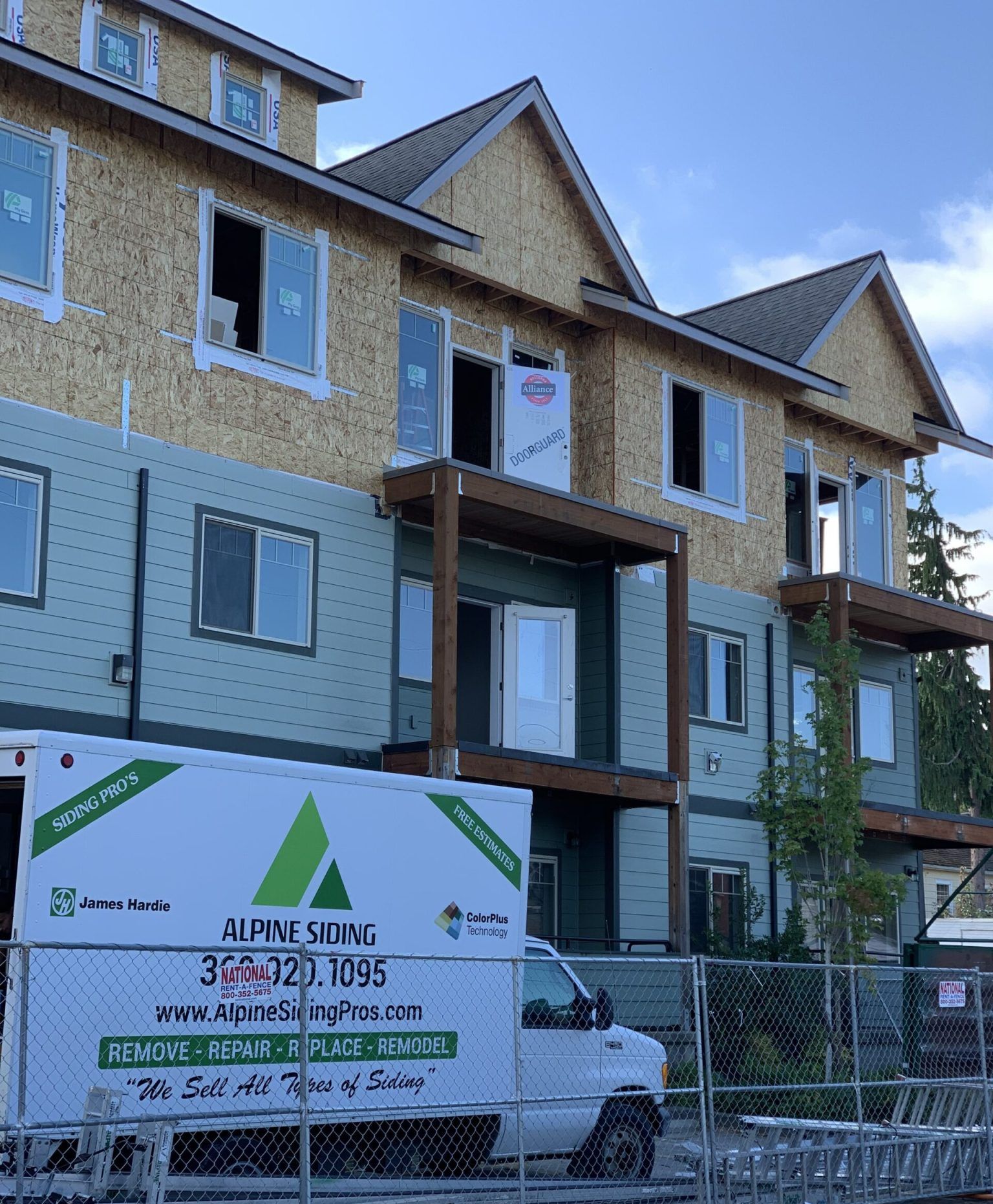
Ferndale sits in an odd spot climate-wise: close enough to Bellingham Bay and the Strait of Georgia to catch wind-driven rain off the water, close enough to the foothills to see real freeze-thaw cycles in a cold snap, and wet enough almost year-round that moss and algae are a fact of life rather than an occasional nuisance. The housing stock reflects decades of building here — 1960s-80s ranch homes with T1-11 or cedar board siding, farmhouses on the flats toward Lynden and the Nooksack valley, newer subdivisions off Vista Drive and Portal Way with vinyl or fiber cement, and a scattering of older wood-sided homes near downtown and the historic district. What holds up on a dry-side Washington home doesn't always hold up here, and what survives a Gulf Coast humidity load doesn't necessarily matter in a place that never sees a hurricane but does see 90-plus days of measurable rain a year. This guide walks through the siding options we actually recommend for Ferndale properties, how we weigh them, and what we tell homeowners to avoid.
For most Ferndale homes, fiber cement siding is our default recommendation, with engineered wood siding as a strong second choice for homeowners who want a warmer, more traditional look at a lower material cost. Vinyl remains a reasonable budget option on homes without much wall complexity, provided it's installed with attention to drainage rather than just nailed flat to the sheathing. Real cedar still has a place here — it's part of the region's architectural character — but only for owners willing to keep up with maintenance. Metal siding is a smaller niche, best suited to modern-style remodels or accent applications rather than whole-house use. None of these is universally "best"; the right pick depends on your home's exposure to wind-driven rain, how much upkeep you want to do, and your budget. Alpine Exteriors installs all of these across Whatcom County, from Bellingham and Ferndale out to Blaine, Birch Bay, Lynden, Sudden Valley and the islands, so our ranking here reflects what we see actually failing and actually performing well in this specific climate, not a generic national list.
We didn't rank these products on looks alone. In Whatcom County, five factors decide whether a siding choice ages well or turns into a callback:
Fiber cement is a blend of cellulose fibers, sand and portland cement pressed into planks or panels. It doesn't rot, doesn't feed moss the way wood does, and holds paint far longer than wood siding before it needs recoating. In a climate defined by sustained damp, that durability is the whole appeal. It also handles wind-driven rain well when installed with proper flashing and a rainscreen gap, and it's rated for the freeze-thaw swings the foothills see.
Pros: excellent moisture and rot resistance, doesn't support moss growth the way wood substrates do, long paint life, good fire resistance, holds up to wind-driven rain when detailed correctly.
Cons: heavier and more labor-intensive to install than vinyl or wood, meaning higher labor cost even though the material itself is mid-range; it must be painted or comes pre-finished, so there's still a repaint cycle eventually, just a longer one; cutting it generates silica dust that requires proper equipment and precautions on site.
Engineered wood products (strand-based wood siding, sometimes sold under names like LP SmartSide) use wood strands bonded with resin and coated with a resin-saturated overlay, giving a look closer to traditional lap or board-and-batten siding than fiber cement typically achieves. It's lighter than fiber cement, easier to install, and holds up reasonably well to Whatcom County's moisture as long as the factory-applied coating stays intact at cut edges and seams.
Pros: closer to a traditional wood look at a lower material and labor cost than real cedar; resists impact better than vinyl; treated to resist fungal decay, which matters given how much of the year Ferndale spends damp.
Cons: any cut edge, nail hole or seam that isn't properly sealed with the manufacturer's touch-up product becomes a point where moisture can wick in and the strand core can swell; it depends more on installer discipline than fiber cement does, so workmanship matters even more here; long-term track record in the Pacific Northwest, while generally good, is shorter than fiber cement's.
Vinyl remains common on Ferndale's more recently built subdivisions, and for good reason: it's the least expensive option up front, never needs painting, and doesn't rot. Modern vinyl with a thicker gauge and a proper rainscreen installation performs decently in this climate. The knock against it isn't moisture resistance so much as the way it's often installed — flat against the sheathing with minimal drainage plane, which traps moisture behind it during Ferndale's long wet stretches.
Pros: lowest material and installation cost of the mainstream options; no repainting; doesn't rot or feed mold the way wood does; wide color and profile selection.
Cons: thinner, budget-grade vinyl can crack in a hard frost and become brittle with age; it can rattle or loosen under sustained wind-driven rain and gusts off the water if not fastened correctly; seams and J-channels are common points where water intrudes if flashing details are skipped; it doesn't add meaningful structural or insulating value on its own, so hitting Washington State Energy Code targets depends entirely on what's happening behind it.
Cedar is part of the region's visual identity, and plenty of older Ferndale homes still wear their original cedar lap or shingle siding. Western red cedar has natural rot and insect resistance that's genuinely useful here, and a well-maintained cedar exterior looks like nothing else. But "well-maintained" is doing a lot of work in that sentence. In a climate this wet, cedar needs a refinish cycle — stain or paint — on a schedule most homeowners underestimate, and any spot where finish has worn through becomes an entry point for the rot and moss that Whatcom County's dampness practically guarantees over time.
Pros: natural resistance to decay and insects when properly finished; distinctive, regionally appropriate appearance; can be repaired board-by-board rather than replaced wholesale.
Cons: highest ongoing maintenance of any option on this list — expect to refinish every few years, sooner on south- and west-facing walls exposed to driving rain; north-facing and shaded walls are prone to moss and mildew regardless of finish quality; material cost has risen significantly and continues to be volatile; any homeowner not prepared to keep up the finish schedule will see wood rot show up faster here than almost anywhere else in the state.
Steel or aluminum panel siding shows up occasionally on modern remodels and additions around Ferndale and Bellingham. It won't rot, won't feed moss, and handles wind-driven rain well because water simply sheds off a hard, non-porous surface. It's a legitimate option, just not usually the right one for a whole traditional house.
Pros: excellent moisture and moss resistance; very low maintenance; strong performance against wind-driven rain; doesn't absorb water, so freeze-thaw isn't a real concern.
Cons: can dent from impact (ladders, hail, thrown debris); condensation can form on the interior face of the panel if the assembly behind it isn't detailed for it, which is a real consideration under Washington State Energy Code wall assemblies; limited color and profile range compared to fiber cement or vinyl; often reads as more modern or industrial than the traditional homes common in Ferndale's older neighborhoods, so it's a better fit for a purpose-built remodel than a like-for-like replacement.
Two things come up repeatedly when we inspect siding failures on Whatcom County homes. The first is stucco, particularly synthetic stucco or EIFS systems installed without a drainage plane behind them. Stucco was never designed with this rainfall pattern in mind, and once water gets behind a face-sealed stucco wall in a climate that rarely gets a long enough dry stretch to let it fully dry out, the sheathing and framing behind it can rot for years before anyone notices — by the time staining or bulging shows up on the surface, the damage underneath is often extensive. We don't recommend stucco for new siding work anywhere in Ferndale or the surrounding towns.
The second is any siding installed face-sealed and flat against the sheathing with no rainscreen gap, regardless of material. This is less about which product you choose and more about how it's installed. A gap that lets bulk water drain and air circulate behind the cladding is what actually keeps a wall assembly dry through a Whatcom County winter; skipping it to save labor cost is one of the most common reasons we get called out to homes with siding that's only a few years old. Untreated wood in ground contact, and old-growth cedar or fir trim left unpainted at end grain, are smaller but related problems — end grain soaks up water fast, and it's usually the first place rot appears on an otherwise sound wall.
For most homes here, yes. Ferndale's sustained dampness and periodic wind-driven rain off the bay reward a siding that resists moisture and moss without depending entirely on installation quality for its performance, and fiber cement's longer paint life and durability tend to offset the higher upfront labor and material cost over the life of the siding.
No — Whatcom County doesn't see hurricane conditions, and hurricane-rated products or wind-zone certifications relevant to Gulf or Atlantic coast homes simply don't apply here. What matters locally is wind-driven rain resistance and proper flashing at joints and corners, not a wind-speed rating.
The code's requirements are mostly about the wall assembly behind the siding — continuous insulation, air sealing and vapor control — rather than which cladding material you pick. That said, some installations (like furring-strip rainscreen systems used with fiber cement or engineered wood) make it more straightforward to meet those continuous insulation requirements cleanly than a flat, face-sealed installation does.
It depends on how widespread the damage is. If rot is limited to a few boards or a section around a leaking gutter or downspout, board-by-board repair can extend the life of the existing siding for years. If soft spots show up across multiple walls or you find rot at the sheathing level once boards are removed, that's usually a sign the whole system has been absorbing moisture for a long time, and full replacement with a lower-maintenance material is generally the more cost-effective path.
Every home on this list of Ferndale neighborhoods — from the flats near the Nooksack River to the higher, more exposed lots toward Blaine and Birch Bay — has its own mix of exposure, shade, and existing wall condition that changes which siding makes sense. Alpine Exteriors has been assessing and installing siding across Whatcom County, including Bellingham, Ferndale, Lynden, Blaine, Birch Bay and Sudden Valley, and we're happy to walk your specific home and give you a straight answer on what will actually hold up, not just what's cheapest to quote. Alpine Exteriors is licensed in Washington under contractor license ALPINI751OW. If you're weighing siding options for a Ferndale home, reach out to Alpine Exteriors for an on-site look and a recommendation based on your home's actual exposure and condition, not a generic checklist.