
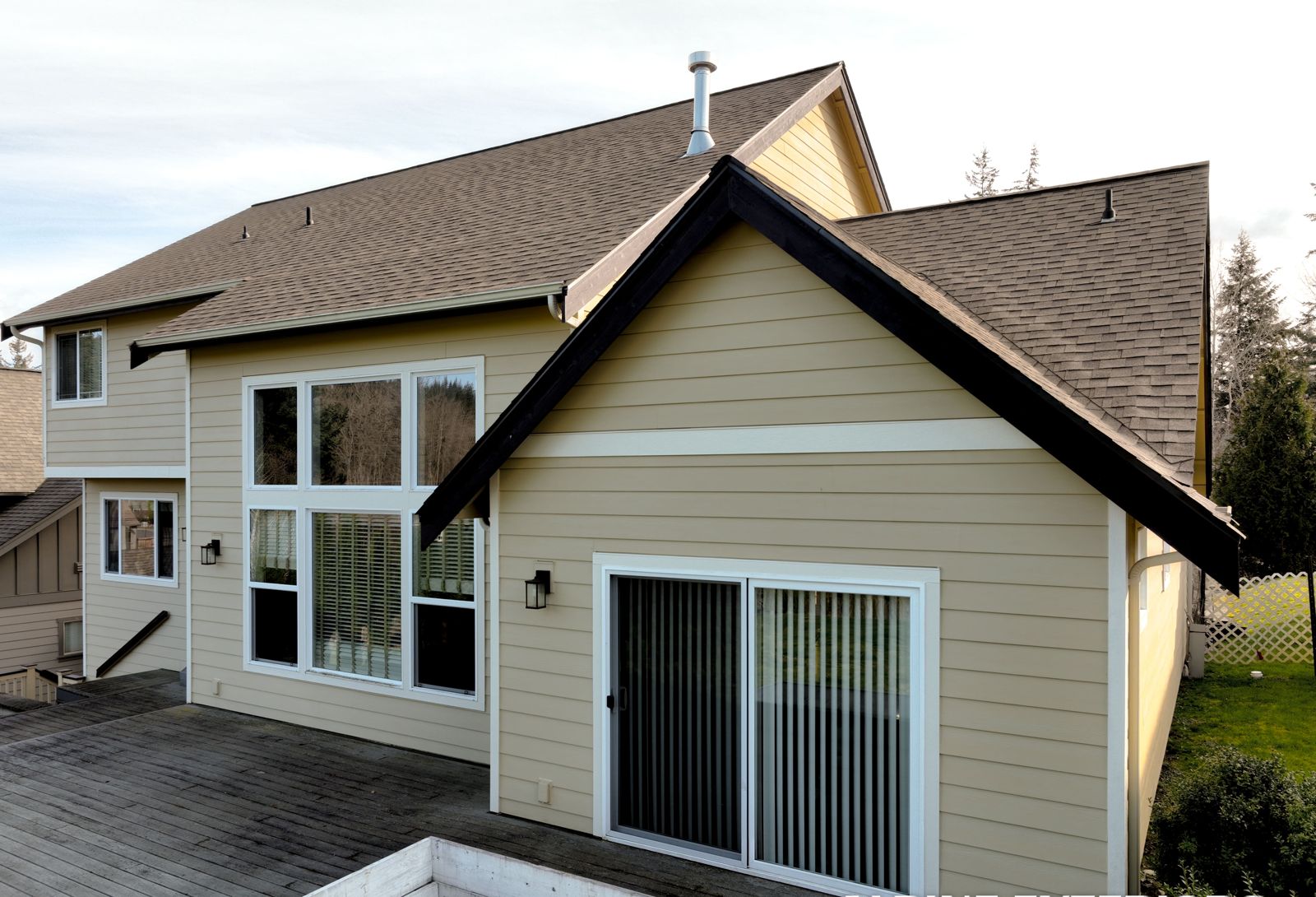
Roosevelt is one of Bellingham's older, tree-shaded neighborhoods, and a lot of its homes are wearing siding that's thirty, forty, even fifty years old. That siding has spent decades absorbing Whatcom County's weather: months of steady drizzle, wind-driven rain that blows in off Bellingham Bay and the Strait of Georgia, moss and algae that never fully dry out under the canopy, and the freeze-thaw cycles that show up on the cold mornings when a marine system meets cold air draining down from the foothills. Eventually, even well-installed siding starts to lose the fight. The hard part is that failure rarely looks dramatic from the street. It looks like a slightly soft spot near a downspout, a patch of paint that won't hold, or a corner trim board that's started to swell. By the time it's obvious, water has usually been getting behind the siding for a while.
This page walks through what to actually look for on a Roosevelt-area home, what's causing it locally, and how to tell the difference between a repair that can wait for drier weather and one that needs attention now. We wrote it as a homeowner's reference, not a sales pitch — some of what's below are things a contractor can't fix and shouldn't try to.
Press a knuckle or the flat of a screwdriver handle against the bottom few feet of siding, especially near hose bibs, downspout outlets, and anywhere a deck or porch roof ties into the wall. If it gives like wet cardboard, that's wood rot, and it means moisture has already worked its way past the outer layer. In Roosevelt this shows up most often on older cedar lap siding and on hardboard or wood composite panels from the 1980s and 90s, both of which absorb water readily once the paint film cracks. Whatcom County's rain isn't heavy in any single storm, but it's persistent — long stretches of low-intensity rain and fog keep wood siding damp for days at a time, which is exactly the condition rot fungus needs. A little softness in one board is a spot repair. Softness that runs along a whole wall section, or that you can push a screwdriver into more than an inch, usually means the sheathing behind it is compromised too.
Every wood-clad house needs repainting eventually, but there's a difference between paint that's simply old and paint that's failing because the substrate underneath is wet. If a wall was repainted in the last few years and it's already peeling, bubbling, or flaking down to bare wood, that's usually moisture pushing out from behind the siding rather than a surface problem. This is common on Roosevelt homes with limited roof overhangs, where wind-driven rain off the bay hits the wall directly during a southwesterly storm and there's no eave to shed it. Paint failure concentrated under windows or below roof valleys is a strong sign of a flashing leak rather than a general siding-condition issue, and those two problems get fixed differently.
Siding that looks rippled or uneven when you sight down the wall has usually taken on moisture and released it unevenly, which distorts wood fibers or composite panels permanently — repainting won't flatten it back out. Vinyl siding can also buckle from heat, but in this climate the more common cause is moisture cycling: panels swell when wet, shrink slightly as they dry, and over enough seasons the fasteners no longer hold them flat. North- and west-facing walls in Roosevelt tend to show this first, since they get less direct sun to dry out between rain events and take the brunt of storms coming off the Strait.
Some moss and green staining is just part of owning a home under Bellingham's tree cover, and it doesn't automatically mean the siding is failing. What matters is whether it comes back fast after cleaning and whether it's concentrated in specific spots. Moss that regrows within a few months in the same location, especially near ground level or under a shaded eave, usually means that section stays damp longer than the rest of the wall — often because grading, gutters, or plant growth are keeping water in contact with the siding. Left long enough, that constant moisture is what turns into rot underneath the growth, so persistent moss is worth treating as an early warning rather than just a cosmetic nuisance.
Look at where siding panels meet trim boards, corner boards, and window and door casings. Caulk that's cracked, shrunk, or missing, and boards that have pulled away enough to see daylight or the house wrap behind them, are direct paths for wind-driven rain to get behind the cladding. This matters more here than it would in a calmer climate because storms off Bellingham Bay and the Strait of Georgia arrive with sustained wind, which drives rain sideways into exactly these gaps rather than letting it run off. A gap that's dry-caulked and monitored can often wait; a gap where you can see stained or dark sheathing behind it means water is already getting in.
Siding is one layer of a wall assembly that's supposed to work together with the water-resistive barrier, insulation, and interior finish to keep the house dry and efficient, consistent with the wall assembly requirements in the Washington State Energy Code. When siding fails and lets moisture into the wall cavity, wet insulation loses much of its R-value, and the furnace has to work harder to hold temperature — that's often the first sign homeowners notice, well before they spot anything wrong outside. A musty smell in a bedroom that backs onto an exterior wall, a cold spot near a window, or visible discoloration on interior drywall are all reasons to go look at the siding on that same wall from outside, even if nothing looks obviously wrong from the street.
Not every sign on this list means drop everything. A general rule that holds up on most Whatcom County homes:
The honest caveat here is that some of this genuinely can't be judged from the ground. A homeowner can spot the obvious cases, but distinguishing "this board is a little swollen from a recent rain" from "this board has been wet for two years" often takes pulling a piece of trim or probing with a moisture meter — that's worth having someone experienced do rather than guessing and either overpaying for a full re-side or ignoring rot that's spreading.
Start with the parts you can actually check yourself: walk the perimeter on a dry day, press on suspect areas, look closely at corners and trim, and note anything on the interior that lines up with an exterior wall. Take photos with a date so you have a record if a section is changing season to season. If you find soft spots, active leaks, or interior moisture, don't just repaint over it — repainting failing wood siding is a common way homeowners lose a year or two before the rot underneath forces a much bigger repair.
From there, get an actual inspection rather than a guess. Alpine Exteriors serves Bellingham, Ferndale, Lynden, Blaine, Birch Bay, Sudden Valley, and the islands, and when we look at a Roosevelt-area home we're checking the sheathing and house wrap behind the siding, not just the visible surface, since that's where the real answer usually is. Sometimes the honest recommendation is a handful of spot repairs and better gutter or grading work around the house, not a full re-side — we'd rather tell you that than sell you more than the house needs. Alpine Exteriors holds Washington contractor license ALPINI751OW, and any siding work we recommend accounts for how the new siding, house wrap, and insulation work together under the Washington State Energy Code, not just how it looks from the curb.
Press on the wood around the peeling area. If it's firm and the peeling is limited to the paint film flaking off in flat chips, that's typically a repaint job. If the wood gives under light pressure, feels spongy, or the paint is bubbling in a way that looks like it's being pushed out from underneath, moisture has gotten into the material itself and repainting alone won't solve it — the source of the moisture needs to be found first.
Light moss that comes and goes with the seasons is mostly cosmetic, but moss that holds on year-round or regrows quickly after cleaning is a sign that section of wall isn't drying out between rains. Over time, that trapped moisture is what leads to rot in wood siding or trim underneath, so it's worth treating recurring moss in the same spot as a clue rather than ignoring it as just a Northwest thing.
Yes. Once water gets past the siding and into the wall cavity, insulation that gets wet loses a significant amount of its ability to resist heat flow, and the wall stops performing the way it was designed to under the Washington State Energy Code. A jump in winter heating costs with no other explanation is a legitimate reason to have the siding and the wall behind it checked, even if nothing looks obviously wrong outside.
It depends entirely on how far the moisture has spread. Isolated rot around a single window or downspout can often be cut out and repaired without touching the rest of the wall. But if multiple walls show the same pattern of failure, or if the underlying house wrap and sheathing are compromised in several places, patch repairs tend to be short-term and a broader re-side ends up being the more honest long-term answer. This is exactly the kind of call that benefits from an in-person look rather than a guess from photos.
If you've noticed any of the signs above on your Roosevelt home, or you're just not sure what you're looking at, Alpine Exteriors can take a closer look and give you a straight read on what's actually happening behind the siding — not just what shows on the surface. We work throughout Bellingham, Ferndale, Lynden, Blaine, Birch Bay, Sudden Valley, and the islands, and we'll tell you plainly whether you're looking at a repair, a partial re-side, or something that can reasonably wait. Reach out to schedule a walk-around inspection before the wet season makes a small problem harder to see.