
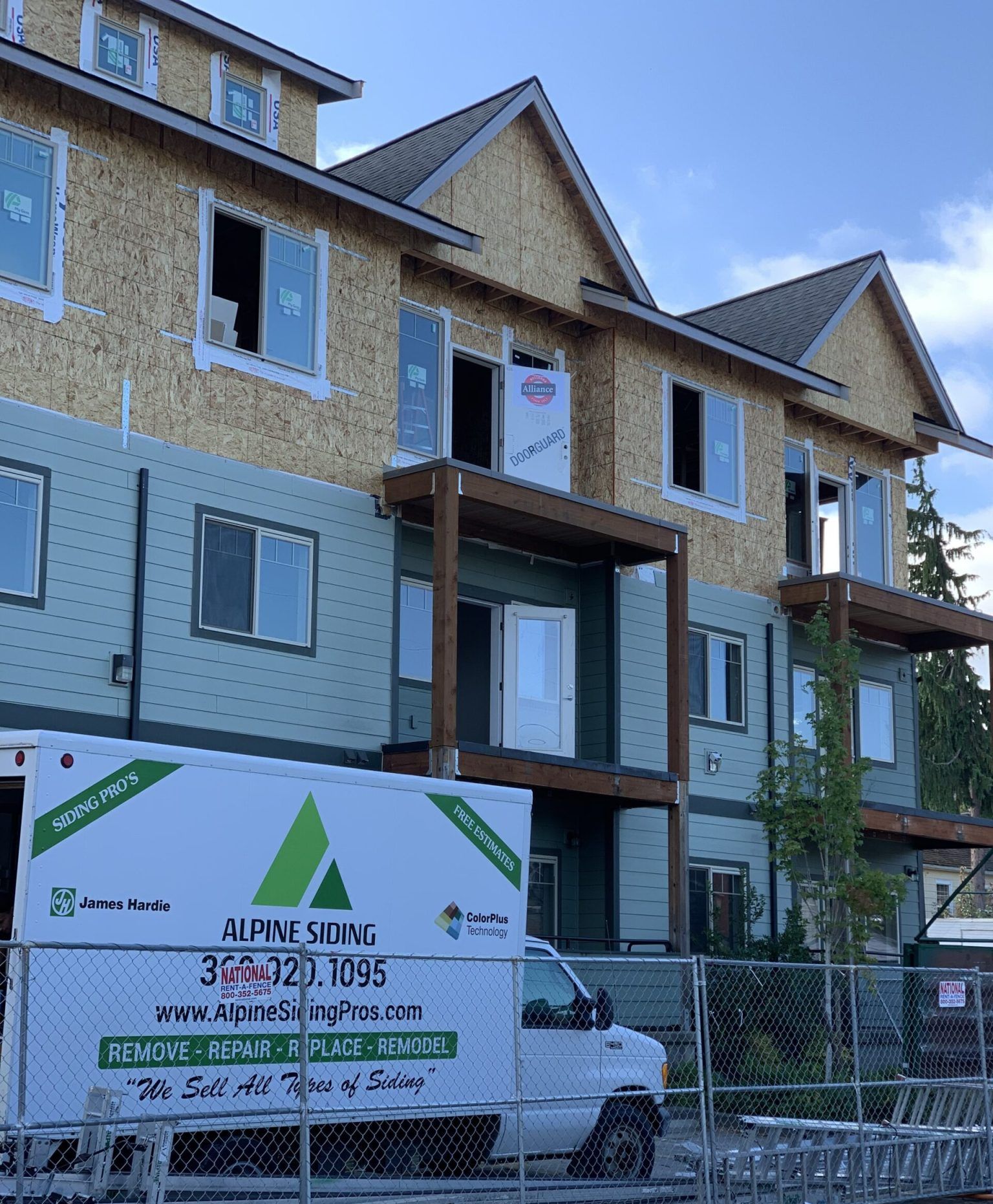
If the damage is limited to a handful of boards or panels and the sheathing behind them is still dry and solid when you check it, repair is usually the right call. Once rot has spread past two or three spots, or the siding is original to a home built more than 20 years ago and is failing in multiple places at once, replacement is almost always the more honest answer, even though it costs more up front.
That's the short version. The real answer depends on what kind of siding is on the house, how long the problem sat hidden before anyone noticed it, and whether a patch will actually blend in or just draw the eye to a mismatched section. The rest of this guide walks through what we actually run into on siding calls in Everson and the surrounding Nooksack lowlands, and how to think through the repair-or-replace decision without guessing.
Wood rot is the damage we see most often on older Everson homes, and it's rarely the siding's fault by itself. Water gets behind a board through a failed caulk joint, a gap at a window trim, or a nail hole that opened up as the wood shrank and swelled over the years, and then it sits there. Wood siding, and even the wood trim around vinyl or fiber cement siding, holds that moisture against the wall for days at a time in our climate, and rot sets in from the inside out. By the time you see soft, discolored, or crumbling wood on the surface, the framing or sheathing behind it may already be affected too.
Moss and algae are more of a cosmetic and long-term problem than an emergency, but they matter. Green or black streaking on the north side of a house, or thick moss buildup where siding meets a roofline or fence line, holds moisture against the surface far longer than open, sun-exposed siding does. Left alone for years, that constant dampness is exactly the condition that lets rot start underneath paint or behind lap joints that would otherwise have shed water fine.
Beyond rot and growth, the other damage patterns we see regularly include:
Everson sits down in the Nooksack River valley, and that low, flat ground behaves differently than the breezier coastal parts of the county. Around Blaine, Birch Bay, and the shoreline stretch near Bellingham Bay, siding takes a beating mainly from wind-driven rain coming off the water — rain that gets pushed sideways into wall assemblies, trim, and corner joints with real force. In Everson, the bigger issue is usually the opposite problem: damp air sits in the valley longer, fog lingers into the morning more than it does closer to the water, and surrounding fields and tree lines keep humidity higher against north- and east-facing walls. The result is less wind-forced water intrusion and more of the slow, sustained dampness that favors moss, algae, and hidden rot.
The Nooksack River corridor also means some Everson properties deal with higher groundwater and periodic flood exposure, which is worth remembering for the bottom courses of siding specifically — the first few feet above grade are more likely to wick moisture up from wet soil after a heavy fall or winter, on top of whatever is coming from above.
Being closer to the foothills than downtown Bellingham also means Everson sees a few more real freeze-thaw cycles through the winter. Water that's worked its way into a crack, a nail hole, or a seam in siding or trim expands when it freezes overnight and contracts as it thaws the next day. Do that repeatedly over a winter and small cracks turn into bigger ones, caulk joints separate, and vinyl becomes more prone to cracking on the coldest mornings. None of this rises to the level of the freeze events some inland parts of the state see, but it's a real factor here that coastal Whatcom County towns deal with less.
Across the whole county, the constant is persistent rain for a good chunk of the year. Whether it's wind-driven along the bay or just steady and gray in the Nooksack lowlands, siding here spends more days wet than dry for months at a time, which is the underlying reason moss, algae, and slow-developing rot show up so much more often than sudden storm damage does.
Start with an honest look, ideally after a few dry days so you're not confusing surface wetness with actual failure. Walk the perimeter and pay particular attention to the bottom two or three courses of siding, the areas under windows, inside corners, and anywhere two different materials meet — those transitions are where water finds a way in more often than anywhere else. Press on any board that looks discolored or stained; if it gives at all or a screwdriver sinks in without much resistance, that's rot, not just a stain that can be pressure-washed away.
From there, the repair-versus-replace decision comes down to three practical questions:
If you're planning anything beyond a small patch, check whether the job needs a permit. Everson is a small city with its own permitting process for exterior work in some cases, and rural parcels just outside city limits fall under Whatcom County jurisdiction instead — it's worth a quick call before work starts rather than finding out afterward. If a project opens up the wall down to the sheathing, it's also worth knowing that the Washington State Energy Code has requirements around continuous insulation and air sealing for exterior wall assemblies once they're exposed for alteration work, not just new construction. A contractor pulling a permit for a substantial re-side should be accounting for that as part of the scope, not treating it as an afterthought.
Alpine Exteriors looks at the sheathing before quoting anything, because guessing at what's underneath is how homeowners end up paying twice — once for a cosmetic patch and again a year later for the rot that patch didn't address. On repair-scale jobs where matching is realistic, we say so. On jobs where a patch would leave an obvious mismatched panel on a visible wall, we'll tell you that too, even when it means recommending a bigger job than you walked in expecting.
Moss and algae staining sits on the surface and generally comes off, at least partially, with gentle cleaning; the wood or panel underneath stays firm when you press on it. Rot changes the material itself — the wood feels soft, spongy, or crumbly, a screwdriver tip sinks in with little resistance, and the discoloration often looks darker or has a slightly different texture than a simple moss stain. If you're not sure which one you're looking at, that uncertainty alone is a good reason to have someone check it before painting over it or pressure-washing it, since either of those can make hidden rot harder to spot later.
Sometimes, but not always, and it's worth being realistic about it upfront. Paint colors can usually be matched closely by a decent paint supplier even on older cedar. Factory-finished vinyl and fiber cement are harder, because sun exposure fades the existing material and manufacturers periodically change colors and profiles, so a "same" product ordered today may not sit flush or read identically next to 15-year-old siding. On a wall that's rarely seen up close, that's usually a non-issue. On a front elevation, it's a real factor in deciding whether a patch is worth doing at all versus re-siding the whole wall for a clean, uniform result.
Small, like-for-like repairs — replacing a few damaged boards or panels — typically don't trigger a permit requirement, but a full re-side of a wall or the whole house often does, and the answer can depend on whether the property is inside Everson city limits or in unincorporated Whatcom County. Rules and thresholds change, so it's worth a quick check with the relevant building department before work starts rather than assuming either way. A licensed contractor pulling permits regularly for the area should be able to tell you which category your project falls into.
Not necessarily. If the damage is contained to one wall or elevation and the rest of the siding is in reasonably good shape, re-siding just that section is a legitimate and common approach — it's the matching question above, not some rule requiring uniformity, that decides whether it's the right call. The exception is when an inspection turns up moisture problems in more than one area, which usually points to a broader issue, like ventilation or a systemic flashing problem, that will keep resurfacing wall by wall if only the most visible damage gets addressed.
If you're seeing soft spots, persistent moss staining, or cracked panels on a home in Everson or anywhere else in Whatcom County, the first step is a real inspection, not a guess from the driveway. Alpine Exteriors is a licensed Washington siding contractor (license ALPINI751OW) working throughout the county, from Everson and Lynden down to Bellingham, Ferndale, Blaine, Birch Bay, Sudden Valley, and the islands. We'll tell you plainly whether a repair will hold up and actually match, or whether you're better off putting the money into a full re-side — reach out for an inspection before small damage turns into a bigger, more expensive fix.