
Most siding damage in Happy Valley can be repaired if it's caught early and stays confined to a small section — a cracked board, a popped nail, a stretch of caulk that's failed at a trim joint. Once rot has traveled behind the siding into the sheathing or wall framing, patching the visible board just hides the problem for another season, and the honest move is to replace that section, or sometimes that whole wall face, down to sound wood. Alpine Exteriors looks at every call in person before recommending either path, because from the sidewalk a nail pop and three years of trapped moisture behind lap siding can look almost identical.
Happy Valley's housing stock runs from early-1900s bungalows near Fairhaven and the WWU campus to mid-century homes on the hillside streets above Boulevard Park, plus newer infill. That mix means the siding problems Alpine Exteriors sees in this neighborhood aren't one thing — they're a handful of recurring failure modes, each with a different fix:
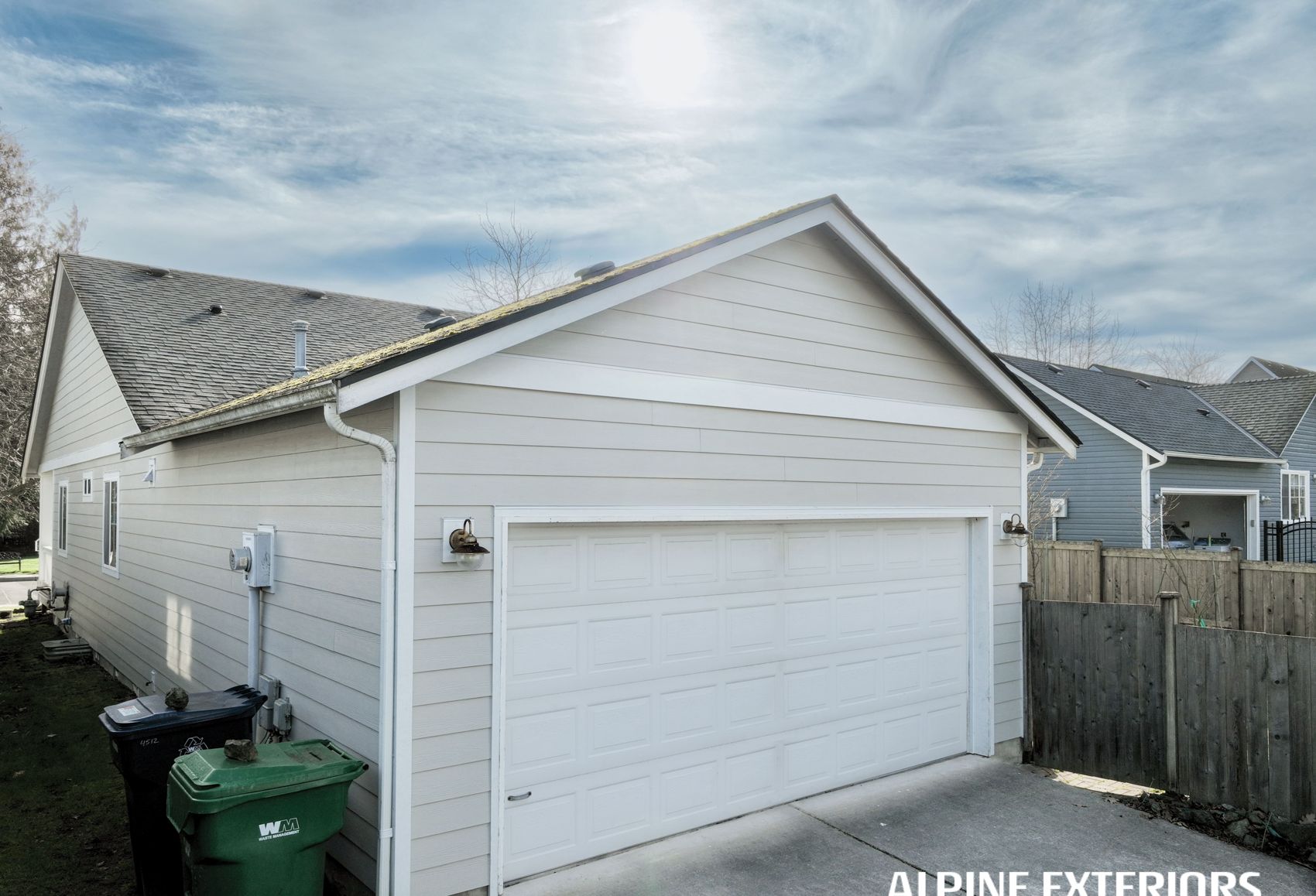
Whatcom County's siding problems are driven by water exposure and duration, not storm intensity. There's no hurricane risk here, and that changes what actually matters for a repair decision. What does matter:
Start with a walk-around after a wet stretch, not on a dry summer afternoon when everything looks fine. Focus on the walls that take the weather: southwest and west exposures for wind-driven rain damage, and shaded north sides for moss buildup. Press on any board that looks discolored or feels soft — a screwdriver handle works fine for this — and check the bottom few courses near grade, decks, and downspout discharge points, since those areas dry out slowest.
From there, get a written scope, not just a verbal estimate. A contractor should tell you specifically which boards or wall sections are being replaced, what's happening with the underlying sheathing and moisture barrier where the wall is opened up, and how the new material will be matched to what's staying. Alpine Exteriors documents this in writing before starting, partly because siding repair scope has a way of growing once a wall is opened — what looked like one bad board is sometimes three, and it's better to know that up front than mid-job.
Matching existing siding is its own decision point. Discontinued profiles, faded paint colors, and older hardboard or cedar products that are no longer manufactured in the same dimensions all make an exact match difficult or impossible. Realistic options are usually: source a close match and accept some visible difference, repaint the whole wall or elevation once the new section is in so the color reads uniform, or in some cases replace a full elevation rather than patch a small area that will always look pieced-in. None of these is free, and a homeowner should weigh the visual result against the budget honestly rather than assume any contractor can make a 20-year-old board disappear.
| Situation | Repair is usually reasonable | Replacement is usually the honest call |
|---|---|---|
| Damage extent | One board, one joint, or a few fasteners | Multiple boards across a wall, or damage found in more than one area |
| Sheathing condition | Sheathing is dry and firm behind the removed board | Sheathing is soft, delaminating, or shows mold |
| Cause | Isolated caulk failure or fastener issue | Ongoing wind-driven rain exposure or chronic moss/moisture on that wall |
| Material | Cedar or fiber cement in otherwise sound condition | Older hardboard already showing swelling on adjacent boards |
| Match | Product and color still available or close enough | Product discontinued and section is large enough that patching would look obviously mismatched |
Moss and algae staining sits on the surface and can usually be treated and cleaned without affecting the board underneath, though it should still be addressed since trapped moisture under growth can eventually contribute to rot. Actual rot shows up as softness you can feel with a screwdriver or fingernail, discoloration that goes beyond a surface stain, or a board that flexes or crumbles under light pressure. When it's unclear, the safest step is to have someone pull the suspect board rather than guess from the outside, since rot that's reached the sheathing won't show clearly on the painted surface.
Sometimes, but not always exactly. Alpine Exteriors will try to source a close match in profile and reveal first; when the original product is truly discontinued, the more honest options are usually repainting the affected wall or elevation for a uniform look, or in some cases replacing a full wall section instead of patching in a way that will always read as a repair. This gets discussed as part of the scope before work starts, not discovered afterward.
Small, like-for-like repairs generally don't trigger a permit, but larger jobs — full wall replacement, work that involves structural sheathing repair, or anything affecting the building envelope more broadly — typically do require permitting through the local jurisdiction, and that work also needs to meet current Washington State Energy Code requirements once a wall is opened up. Requirements vary depending on scope and whether the property is inside Bellingham city limits or unincorporated Whatcom County, so it's worth confirming for your specific project rather than assuming.
Not for a small, contained repair. But when a repair or replacement opens a section of wall down to the sheathing, current work has to align with the Washington State Energy Code's requirements for the water-resistive barrier and insulation at that section — it's not just a cosmetic swap of one board for another. On a larger project this can add cost and time, and a contractor should walk you through that rather than skip it to keep an estimate lower.
Siding damage in Happy Valley rarely gets better on its own, and guessing between a patch and a full replacement from the driveway isn't a great way to spend a repair budget. Alpine Exteriors, WA contractor license ALPINI751OW, serves Happy Valley and the rest of Whatcom County — Bellingham, Ferndale, Lynden, Blaine, Birch Bay, Sudden Valley, and the islands — and will inspect the actual damage, check what's happening behind the siding where it matters, and lay out a written scope before recommending repair or replacement. If you're seeing soft boards, moss buildup, or damage on a wall that takes the weather off the Bay, it's worth getting it looked at before the next wet season adds to it.