
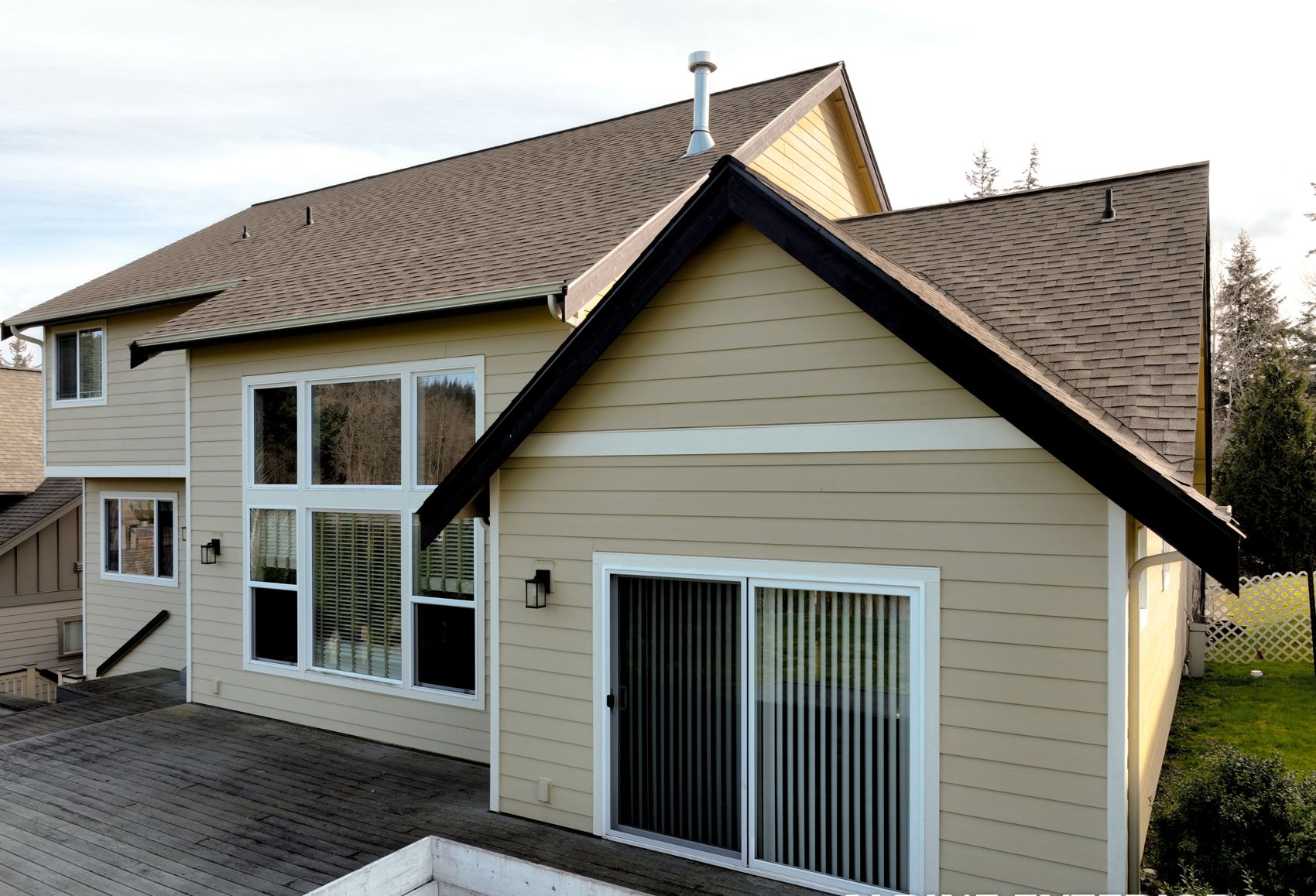
In Whatcom County's wet, marine climate, engineered wood siding that's installed correctly and maintained on a normal schedule typically lasts 30 to 40 years before the substrate itself needs replacing. The finish — paint or factory coating — will need attention well before that, usually starting somewhere in the 7- to 12-year range depending on sun and rain exposure.
That's the honest range. Push installation quality or maintenance in either direction and the number moves with it: a well-flashed, well-drained wall assembly with an owner who keeps paint intact can stretch toward the high end, while a rushed install with caulked-instead-of-flashed trim, or years of deferred repainting, can shorten it by a decade or more. Moisture management, not the product itself, is usually what decides where a given house lands in that range.
Engineered wood siding — the strand-based panel and lap products most homeowners mean when they say "engineered wood" — is made from wood strands bonded with resin under heat and pressure, then treated for fungal and insect resistance and factory-primed or pre-finished. It's more dimensionally stable than solid wood siding and resists cupping and splitting better, which is part of why it's popular in the Pacific Northwest. But it is still a wood-based product, and its long-term performance comes down to a handful of things that have nothing to do with brand:
None of this is unique to engineered wood — it's true of any wood-based cladding — but engineered wood's performance is more sensitive to installation quality than, say, fiber cement, because the strand substrate will swell at cut edges and panel faces if water gets in and stays in. Manufacturers generally back these products with long limited warranties on the substrate, but a warranty doesn't repair a rotted wall — it just tells you the manufacturer expects the product to hold up if it's installed and maintained the way the instructions specify.
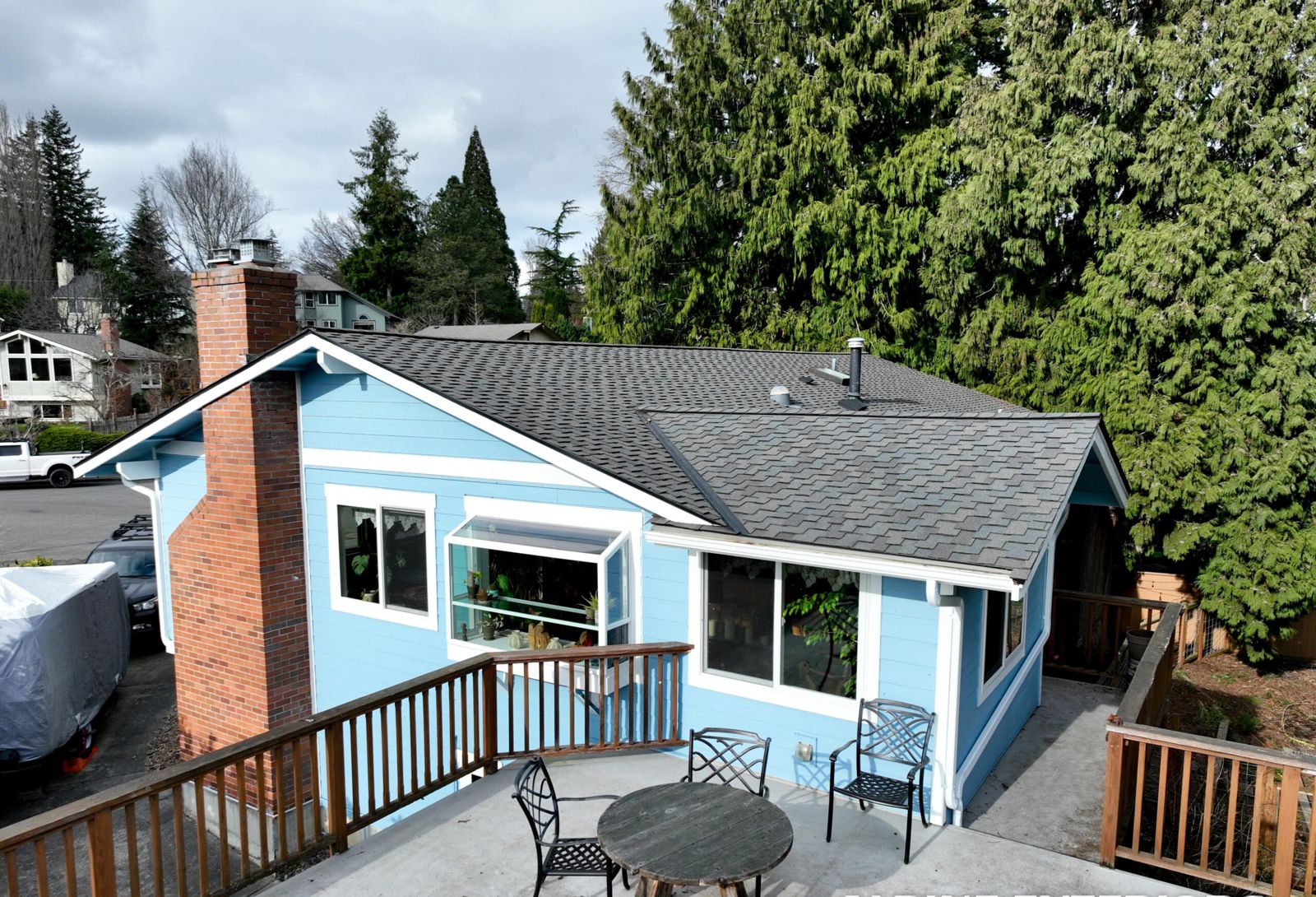
Whatcom County isn't a hard climate to build in, but it's a demanding one for siding, and the reasons are specific to this corner of Washington rather than generic "Pacific Northwest rain" talk.
Rain here is persistent rather than intense. Bellingham, Ferndale, and Lynden don't get short, heavy downpours as often as they get weeks of low-intensity drizzle and overcast skies. That matters for siding because it's dry time, not rainfall totals, that lets wood-based products shed moisture. A wall that never gets a real drying window between October and April is under more sustained moisture load than a wall in a climate with the same annual rainfall delivered in fewer, harder storms.
Wind-driven rain off Bellingham Bay and the Strait of Georgia is a real factor for anything close to the water — Fairhaven, downtown Bellingham, Blaine, Birch Bay, Semiahmoo, and the ferry-served islands all take weather straight off open water, and that wind pushes rain sideways into wall assemblies, not just down onto roofs. Siding on the windward (typically west- and southwest-facing) side of these homes takes measurably more water than the same product on a sheltered elevation, which is why flashing detail at windows, doors, and butt joints matters more here than it would 30 miles inland.
Moss and algae growth is close to constant on shaded, north-facing, or tree-covered walls throughout the county, especially in wooded areas around Lake Whatcom, Sudden Valley, and the rural properties toward Acme and Deming. Moss holds moisture against the siding face longer than bare wood would sit wet, which accelerates coating breakdown and, eventually, substrate softening if it's left unaddressed for years.
Wood rot risk follows directly from the two points above: sustained moisture plus limited drying time is exactly the condition wood decay fungi need. It shows up first at the most predictable spots — bottom courses near grade, under window sills, around deck ledgers, and at any field-cut end that wasn't sealed at installation.
Freeze-thaw cycling is a smaller but real factor in the foothill communities — Kendall, Maple Falls, Glacier, and the higher parts of the Mount Baker corridor — where winter temperatures swing across freezing more often than they do in Bellingham proper. Water that's worked its way into an unsealed cut edge or a coating crack and then freezes will expand and open that damage further, which is a slower version of the same freeze-thaw damage people associate with concrete and roofing in colder climates.
Finally, the Washington State Energy Code shapes how these walls get built in the first place. Current prescriptive requirements generally push toward continuous exterior insulation or equivalent performance on new construction and major re-sides, which means siding is increasingly installed over a layer of rigid insulation and a water-resistive barrier rather than directly over sheathing. Done correctly, that assembly is good news for siding longevity — the added layer, combined with furring strips, naturally creates the drainage gap that lets the wall dry. Done poorly — insulation without proper drainage planes, or flashing details that weren't adjusted for the extra wall thickness — it can trap moisture against the back of the siding instead of venting it, which is the opposite of what the code intends.
Most of what determines whether engineered wood siding hits 15 years or 35 years in this county happens after installation, not during it.
Alpine Exteriors installs and repairs siding across Bellingham, Ferndale, Lynden, Blaine, Birch Bay, and Sudden Valley, and the pattern we see on service calls is consistent: siding failures in this county are almost always moisture-management failures, not product failures. Panels that were flashed, gapped, and painted correctly are still doing their job decades in; panels that weren't are the ones we're replacing early, regardless of brand.
Generally, yes. Engineered wood siding's resin-bonded strand construction resists the cupping, splitting, and knot-related weak points that solid wood siding is prone to, and it typically ships factory-primed or pre-finished for more consistent coverage than field-primed solid wood. It's still a wood-based product, though, so it needs the same core protections — flashing, drainage, and maintained paint — to perform well in a wet climate like this one.
It can be, but wind-exposed waterfront walls are where installation quality matters most. If you're building or re-siding on an exposed elevation, ask specifically about flashing at every penetration and butt joint and about a ventilated drainage gap behind the siding — those details matter more on a wall that regularly takes wind-driven rain than on a sheltered inland wall.
Light surface growth on a shaded wall is mostly cosmetic and worth cleaning for appearance and coating longevity, not an emergency. It becomes a real problem when it's thick enough to stay damp for days after rain stops, or when you notice it concentrated around a spot where the siding also feels soft or the paint has failed — that combination points to trapped moisture rather than a surface issue.
Not usually. Rot in engineered wood siding tends to be localized to the spot where water got in — a bad seal, a missing piece of flashing, a low spot near grade — rather than spreading evenly across a wall. Replacing the affected boards and fixing whatever let water in behind them is usually enough, though it's worth having the surrounding area checked since rot often takes a few years to become visible from the outside.
Every wall in Whatcom County carries different exposure — a Sudden Valley home shaded by trees ages differently than a Blaine house facing open water, and a Lynden property inland from the bay sees less wind-driven rain than either. If you're not sure how your siding is holding up, or you're planning a re-side and want the drainage and flashing details done right the first time, Alpine Exteriors (WA contractor license ALPINI751OW) can take a look and give you a straightforward assessment — no pressure, just what we actually see on your walls.