
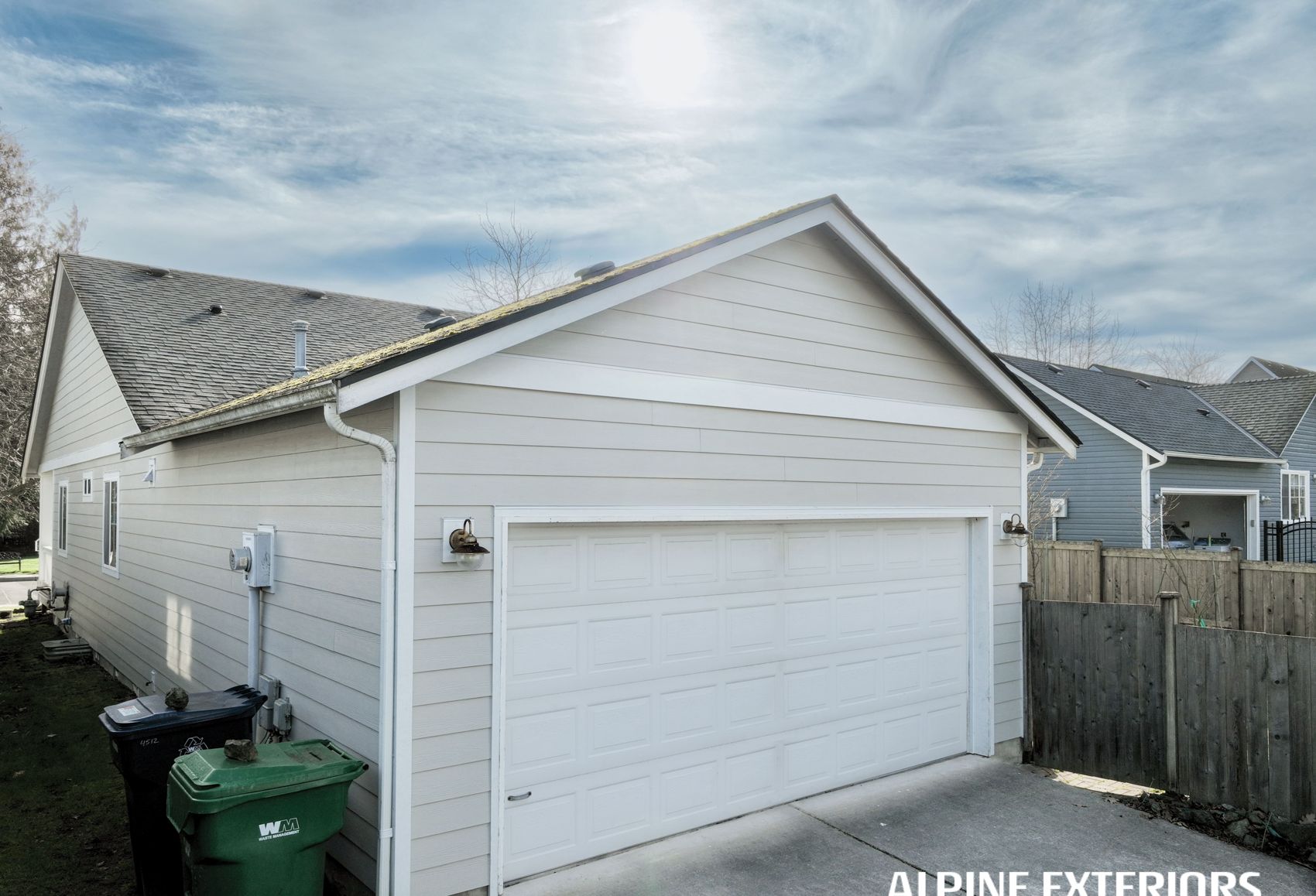
For most homes in Bellingham, Ferndale, Lynden, and the surrounding Whatcom County towns, engineered wood siding is worth it if — and only if — it's installed with rigorous attention to water management, because our climate punishes any product that traps or wicks moisture. It's a strong middle-ground choice for owners who want the look of real cedar without the long-term maintenance burden, but it is not automatically the right fit for every lot, and it demands a contractor who treats flashing and drainage as seriously as the siding itself.
Engineered wood siding — sold under names like LP SmartSide and similar strand-based or composite wood products — is manufactured from wood strands or fibers bonded with resins under heat and pressure, then coated with a factory-applied primer or finish. The manufacturing process is what makes it fundamentally different from the old-growth cedar clapboards you'll still see on some pre-1980s Bellingham homes, and also different from the cheap OSB-based products that gave "engineered wood" a bad reputation in the 1990s. Modern engineered wood siding is treated with zinc borate or similar preservatives during manufacturing, which resists the fungal decay and insect damage that plain wood is vulnerable to.
The honest pros: it holds paint and stain better than solid wood because the substrate is dimensionally stable, it resists cracking and splitting in a way old cedar boards don't after a few decades of expansion and contraction, and it costs meaningfully less than clear-grade cedar while still giving you real wood grain and the ability to route custom trim details. It's also lighter than fiber cement, which can matter on some of the older platform-framed homes around Bellingham Bay where the wall assembly wasn't built with heavy modern cladding in mind.
The honest cons: it is still a wood-based product, which means it is not immune to moisture damage — it is more resistant than solid wood, not waterproof. If water gets behind it or sits against a cut edge for an extended period, the strands can swell, and repeated wet-dry cycling will eventually break down the resin bond at that spot. Engineered wood siding also requires more diligent field cutting and sealing than fiber cement or vinyl; every field-cut edge, whether at a window return or a corner miter, needs to be sealed with the manufacturer-specified sealant or primer, and skipping that step is the single most common reason we see early failures on this product in wetter climates. It also needs repainting on a maintenance cycle, typically longer than solid cedar but shorter than fiber cement, so it's not a true "install and forget" product the way some manufacturers imply.
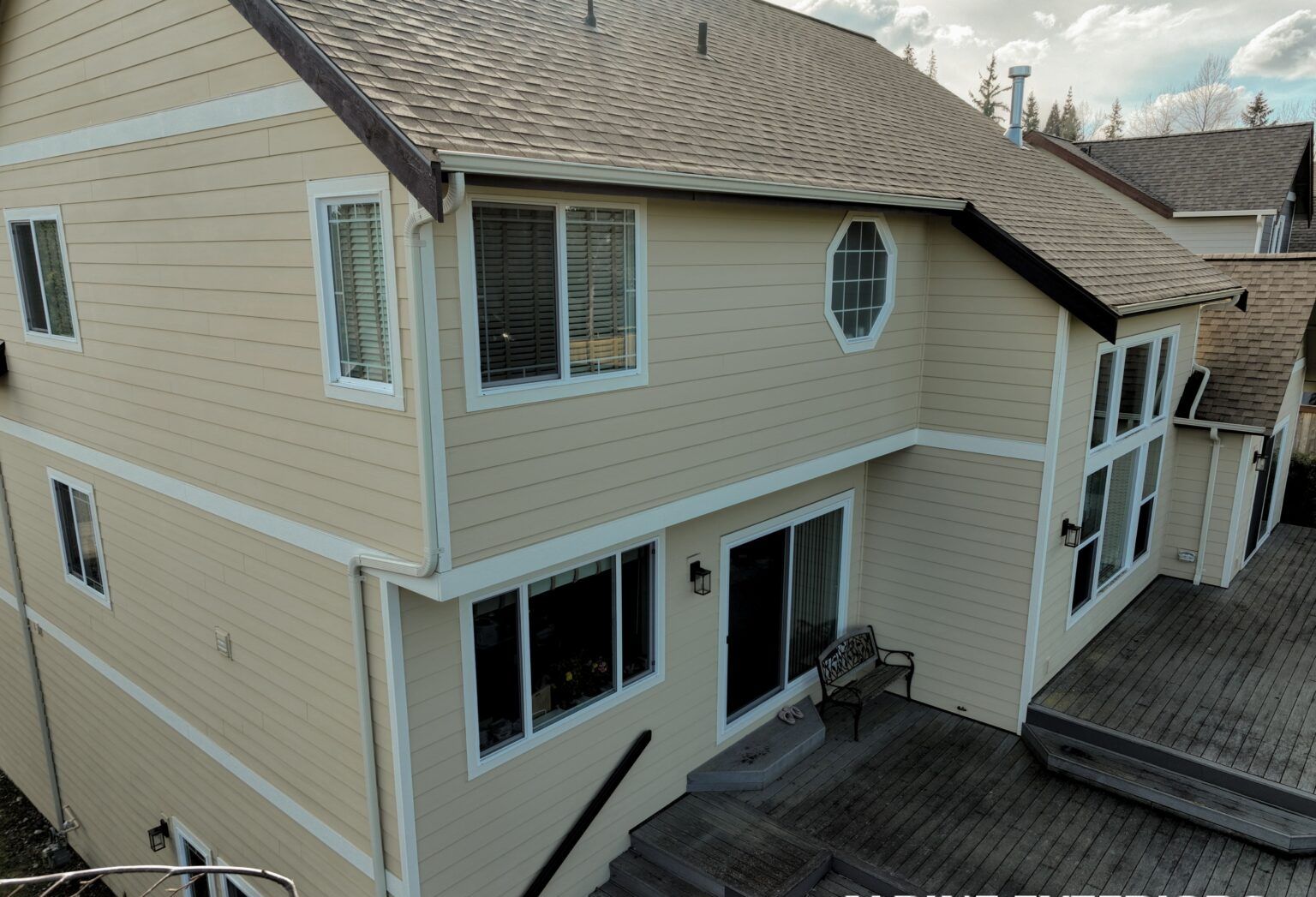
Whatcom County's climate is the deciding factor in whether engineered wood siding performs well or fails early, and it's a different set of stresses than what a siding product faces in most of the country. We don't get anything like a hurricane here, but we get something arguably harder on wood-based siding day in and day out: long stretches of persistent, low-intensity rain from October through April, punctuated by wind-driven rain off Bellingham Bay and the Strait of Juan de Fuca that drives moisture sideways into wall assemblies rather than letting it simply run off a vertical surface. Homes in exposed spots — Birch Bay, Blaine's waterfront, the west-facing walls in Sudden Valley, and several of the island properties — take this wind-driven rain directly, and that's exactly the condition engineered wood siding is least forgiving of if the flashing details aren't right.
Moss and algae growth is the other big regional factor. Whatcom County's combination of shade, humidity, and mild temperatures is close to ideal for moss and algae colonization on north-facing walls, under eaves, and anywhere airflow is restricted by landscaping or fencing. On engineered wood siding, moss isn't just cosmetic — it holds moisture against the surface far longer than the coating was designed to tolerate, and it can work into seams and butt joints over time. We see this constantly on homes in Ferndale and Lynden with mature landscaping close to the walls, and it's a maintenance item that owners considering this product need to plan for from day one, not discover five years in.
Freeze-thaw cycling in the foothill areas east of Deming and up toward Mount Baker adds a secondary stress that coastal Whatcom County doesn't see as much. When moisture has already gotten into a compromised edge or seam, repeated freezing and thawing through the winter accelerates the damage — ice expands in whatever gap the water found, and that gap gets a little bigger each cycle. It's not the primary driver of failure here the way it might be in a harsher inland climate, but on foothill properties it's a real accelerant for any water intrusion problem that already exists.
Finally, the Washington State Energy Code shapes how any siding — engineered wood included — gets installed as part of the wall assembly. Current code requires specific approaches to the water-resistive barrier, air sealing, and in many cases continuous exterior insulation depending on the wall assembly type and climate zone, and Whatcom County falls into Climate Zone 5 under the code's zone map. That means the siding isn't just a finish layer; it's one component in a wall system that has to manage both energy performance and moisture control together, and an installer who treats it as purely a cosmetic upgrade is missing half the job.
Start by being honest about your site conditions before falling in love with a product. A south-facing wall on a sunny Lynden lot with good roof overhangs is a very different risk profile than a north-facing wall in Sudden Valley that stays shaded and damp most of the year. If your home has multiple wind-exposed elevations facing the bay or the Strait, ask your contractor directly how they plan to detail the flashing at every window, door, and butt joint on those walls — a vague answer is a red flag, and a specific answer referencing manufacturer flashing details is what you want to hear.
Ask about the trim, not just the field siding. Corner boards, window casings, and fascia are usually where engineered wood products fail first, because they take the most direct weather exposure and the most field cutting. A well-detailed installation uses factory-primed or pre-finished trim, seals every cut end, and keeps the bottom edge of the siding a proper distance off any hard surface, deck ledger, or grade line so it never sits in standing water or gets splashed continuously by a sprinkler or downspout.
Get a real maintenance plan in writing before you commit, not a vague promise. That should include a repainting or recoating interval, guidance on keeping landscaping and fencing pulled back from the walls to preserve airflow, and a plan for cleaning moss and algae off north-facing and shaded elevations before it builds up. If a contractor can't tell you what your maintenance schedule looks like five and ten years out, that's worth asking about directly.
Compare engineered wood honestly against fiber cement and quality vinyl for your specific walls, rather than assuming one product is right for the whole house. It's common on Whatcom County homes to see engineered wood used on protected, low-exposure elevations where its warmth and detailing show off, while fiber cement handles the wind-driven, high-exposure walls facing the water. That mixed approach isn't a compromise — for a lot of properties around Bellingham Bay, it's the more durable answer than forcing one material to do every job. Alpine Exteriors walks homeowners through that elevation-by-elevation comparison rather than defaulting to whatever's easiest to sell, building every installation around the wall assembly requirements in the Washington State Energy Code as a Washington-licensed contractor (license ALPINI751OW), not just recommending whichever product carries the best margin.
It's not automatically a bad choice, but those locations take the most direct wind-driven rain in the county, so they demand the most rigorous flashing and sealing detail of any siding product, including engineered wood. Some waterfront owners choose fiber cement for their most exposed elevation and use engineered wood on protected walls instead, which is a reasonable way to manage the risk without giving up the look entirely.
It varies with sun exposure, elevation, and the quality of the original finish, but engineered wood siding in Whatcom County's rain and humidity generally needs recoating more often than fiber cement and less often than solid cedar. Shaded, moss-prone elevations typically need attention sooner than sunny, well-ventilated ones, which is why a per-elevation maintenance plan matters more than a single blanket number.
Engineered wood siding generally lands between vinyl and fiber cement on material cost, and often comes in below clear-grade cedar, though exact pricing depends heavily on the specific product line, trim package, and how much of the house you're covering. Rather than quoting a number that won't hold up across different homes, Alpine Exteriors provides a written estimate specific to each property's square footage, elevation exposure, and trim complexity.
Sometimes, but it depends on the condition of the existing wall assembly, whether the old siding and any sheathing behind it are sound and dry, and whether the water-resistive barrier can be brought up to current standards during the work. On older homes — especially ones with a history of moisture intrusion — a full tear-off is often the safer route so the crew can inspect and correct the sheathing and barrier before anything new goes up.
If you're weighing engineered wood siding against fiber cement or another material for a home in Bellingham, Ferndale, Lynden, Blaine, Birch Bay, Sudden Valley, or the islands, Alpine Exteriors can walk your property elevation by elevation and give you a straightforward recommendation based on your actual exposure, not a one-size-fits-all pitch. Reach out for an on-site assessment and a written estimate tailored to your home.