
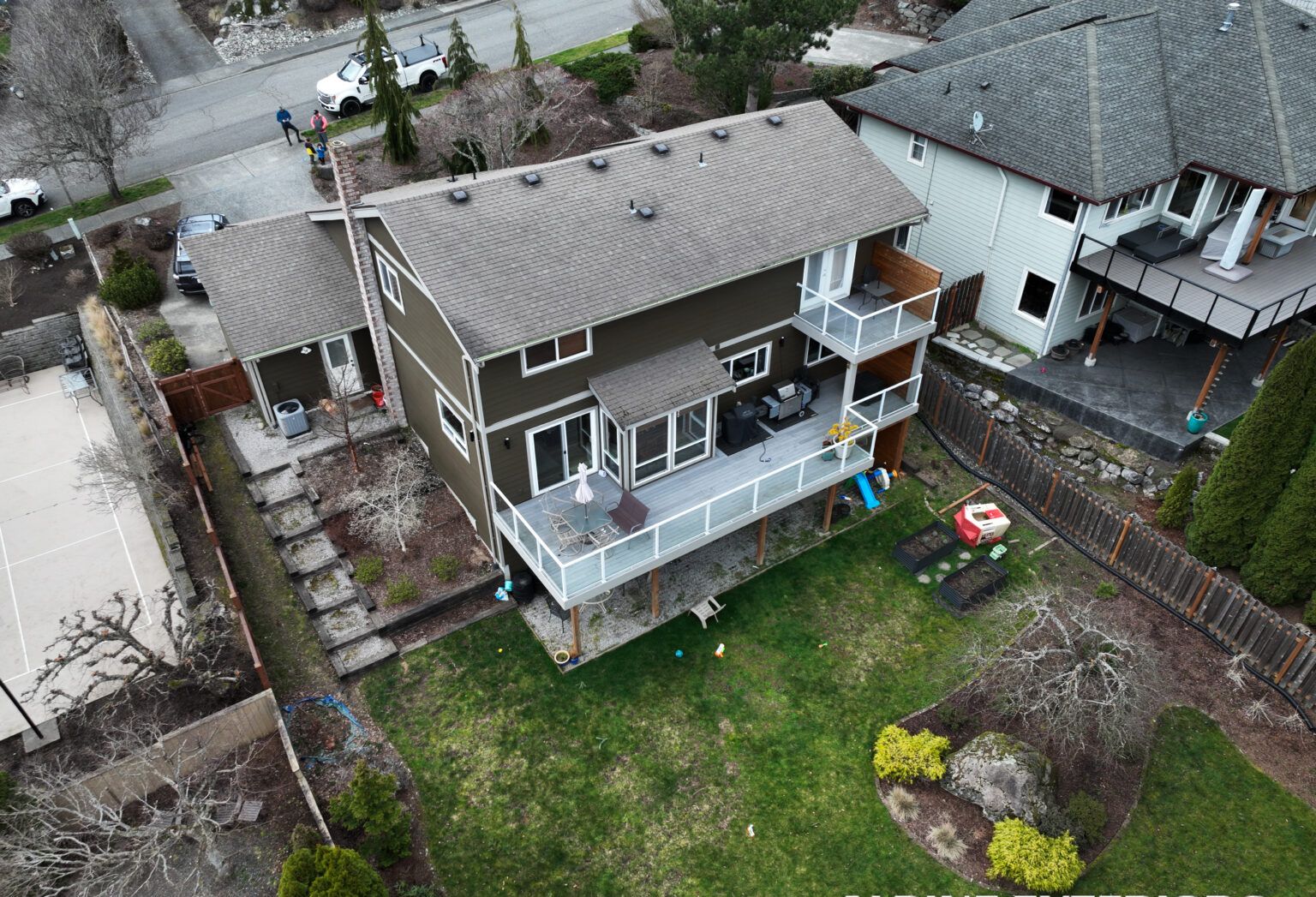
Most siding problems in Maple Falls come down to trapped moisture, not old age — wood rot at butt joints, corner boards, and low clearances is the damage we see most, followed by moss and algae staining on north-facing walls under the tree canopy. Small, isolated damage is almost always worth repairing; widespread rot, warping across multiple courses, or siding installed more than 20-25 years ago usually points toward replacement instead.
Maple Falls sits up in the Nooksack River valley on the way to Mt. Baker, and that setting shapes how siding fails here. Homes are often tucked under second-growth fir and cedar, which means less direct sun, longer drying times after rain, and a steady drip of needles, moss spores, and organic debris onto walls and into gaps. On wood and engineered wood lap siding, that moisture shows up first as soft, spongy boards near the bottom courses, around window sills, and at any spot where a deck, porch roof, or downspout dumps water against the wall. Paint failure — bubbling, peeling, or a chalky surface — is usually the visible warning sign before the wood underneath actually softens.
On vinyl siding, the common issues are different: panels that have cracked or gone brittle from repeated freeze-thaw cycling, and panels that have popped out of their track after years of expansion and contraction. Fiber cement (Hardie-type) siding holds up well against rot but is not immune to problems — caulking at joints and trim fails over time, and improperly sealed cut edges can wick moisture and eventually delaminate. Whatever the material, the pattern is consistent: damage concentrates where water is directed at the wall or where it can't drain and dry — under decks, behind shrubs planted too close to the foundation, at inside corners, and on the shaded, moss-prone north and east elevations that never get a full afternoon of sun.
Deciding between repair and replacement comes down to how far the damage has spread and what's underneath it. If rot is confined to a section behind a downspout or around one window, a competent contractor can cut out the damaged boards, address the water source, and replace just that section — provided a reasonable material match exists (more on that below). But if you pull a board and find rot has already worked into the sheathing or framing, or if soft spots show up in multiple, unrelated areas of the house, that's a sign the whole wall system has been wet longer than a single leak would explain, and patch repairs will just be chasing the same problem in a new spot next year. At that point full or partial re-siding, done alongside a proper weather-resistive barrier, is usually the more honest answer even though it costs more up front. It's also worth asking whether the original installation used adequate flashing at windows and trim, since a lot of the rot we find traces back to a flashing detail that was skipped or done poorly decades ago, long before the current owner bought the house.
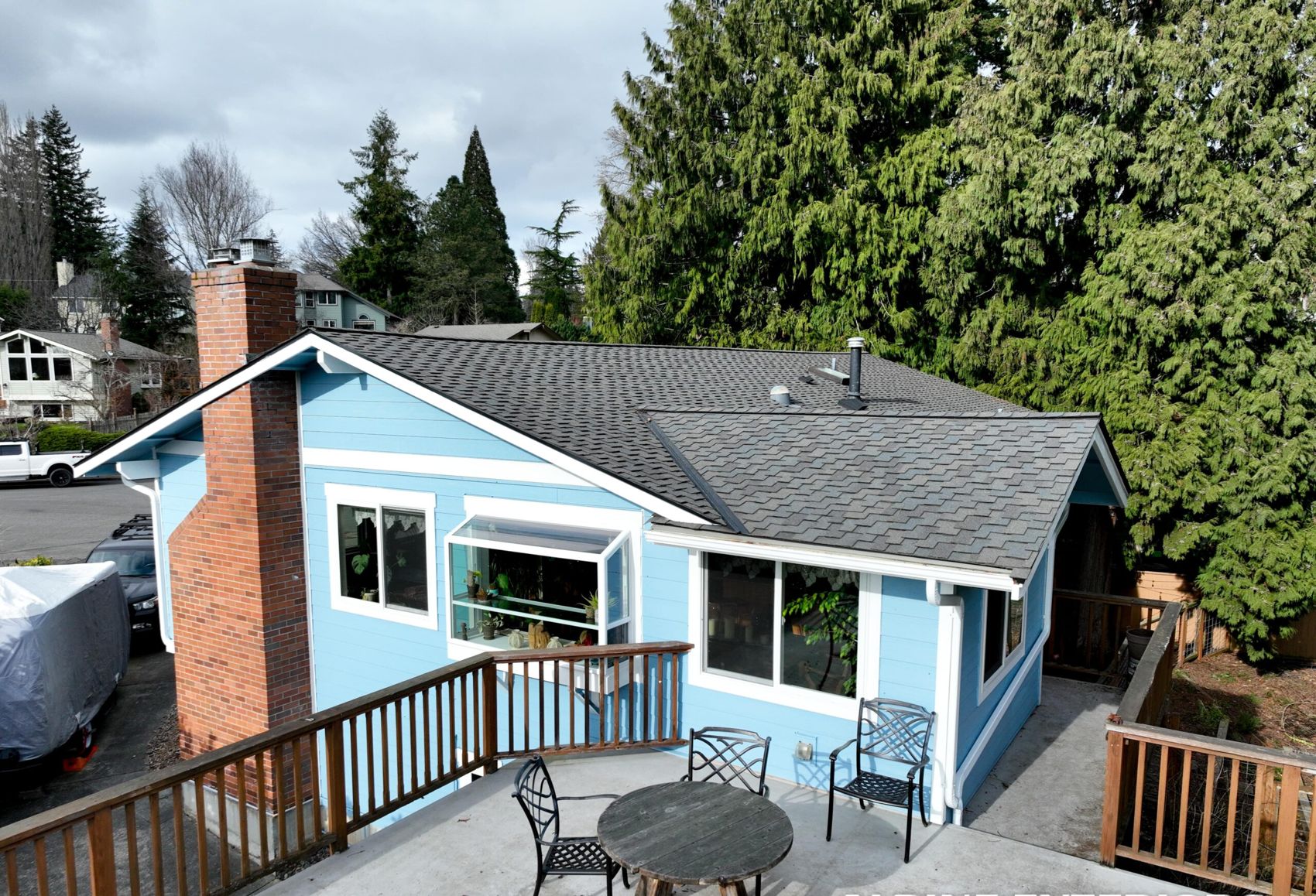
Whatcom County doesn't get hurricanes or hail the way other parts of the country do, but it makes up for it with sheer persistence. Bellingham and the lowlands closer to the Strait of Georgia see a lot of wind-driven rain off Bellingham Bay, which pushes moisture sideways into siding laps and trim joints rather than just falling straight down — that's less of a factor up in Maple Falls, which is more sheltered by terrain and tree cover, but the tradeoff is elevation. Sitting several hundred feet higher and closer to the foothills, Maple Falls sees more freeze-thaw cycling through the winter than Bellingham does at sea level. Water that gets into a crack, seam, or fastener hole and then freezes expands and works that opening wider; a few dozen freeze-thaw cycles over a winter can turn a hairline gap into a real entry point for moisture.
The tree cover that makes Maple Falls attractive also keeps walls damp longer after every rain, which is most of the year here. That extended dampness is exactly what moss and algae need to establish themselves, and once a colony of moss takes hold on a wall or roofline runoff path, it holds even more water against the siding surface — it's a feedback loop that accelerates rot in wood siding and can stain fiber cement and vinyl even without causing structural damage. Homes on Sudden Valley's wooded lots, along the Silver Lake corridor, and out toward Kendall see the same pattern for the same reason, and even homes closer to Bellingham on heavily landscaped lots with mature trees aren't immune to it.
Any repair or replacement work also has to account for the Washington State Energy Code. If a wall assembly gets opened up for a repair, or if you're re-siding a section, that's an opportunity — sometimes a code-triggered requirement, depending on the scope — to bring insulation and the weather-resistive barrier up to current standards rather than just closing the wall back up the way it was. Skipping that step to save money on a repair often means paying for the same fix again sooner, since the underlying moisture and heat-loss pathway hasn't actually changed. This matters more in the foothills than it might in a milder microclimate, since a wall assembly that's marginal on insulation also tends to run cooler on its interior face, which can encourage condensation inside the wall cavity during cold snaps and add yet another moisture source that has nothing to do with rain at all.
Start with a walk around the house, ideally after a stretch of dry weather so you're not misjudging normal wetness for damage. Press on siding near the bottom of the wall, around window and door trim, and anywhere a roofline, deck, or downspout discharges onto or near the wall. Soft, spongy, or visibly warped boards need attention; a light film of green algae on an otherwise firm wall is a cosmetic and maintenance issue, not a structural one, though left alone long enough it can contribute to problems.
From there, a few things make a real difference in how the project turns out:
Alpine Exteriors works throughout Whatcom County, including Maple Falls and the surrounding foothill communities, and licensed contractors carry Washington L&I coverage for a reason — an inspection that actually opens up suspect areas, rather than one done entirely from the ground with binoculars, is the only way to know whether you're looking at a repair or a replacement. Alpine Exteriors holds Washington contractor license ALPINI751OW, and can walk a homeowner through both the wall inspection and the material-matching conversation before any work starts, including an honest opinion on whether a partial repair will actually hold up or whether it's better to plan for a larger project now rather than in two winters.
Isolated soft spots, cracked panels, or damage confined to one section of wall are usually repairable once the moisture source is fixed. Widespread softness, rot that's reached the sheathing, or damage showing up in several unrelated areas of the house point toward replacement, because at that stage the underlying wall system has likely been compromised longer than any single repair will address.
Left alone, it's more than cosmetic. Moss holds moisture against the wall surface far longer than bare siding would dry on its own, and that sustained dampness is a major contributor to wood rot underneath paint or trim. On vinyl and fiber cement it's less likely to cause structural harm, but it still stains the surface and traps debris in seams and laps, and it's worth removing well before it spreads across an entire elevation.
It depends on the material and how long ago it was installed. Newer fiber cement products often have documented color and profile matches available, while older wood siding or discontinued vinyl profiles can be difficult or impossible to match exactly — in those cases, matching a full wall section or elevation, rather than patching a small area, usually gives a cleaner result.
Depending on the scope of work, opening up a wall assembly can bring Washington State Energy Code insulation and moisture-barrier standards into play. It's worth asking your contractor upfront how much of the wall will be exposed and whether that scope crosses a threshold that requires bringing the assembly up to current code, since that affects both the cost and the long-term performance of the repair.
If you're seeing soft spots, moss buildup, or cracked panels on a home in Maple Falls or anywhere else in Whatcom County, the fastest way to know what you're dealing with is to have someone open it up and look rather than guess from the driveway. Alpine Exteriors serves Maple Falls, Bellingham, Ferndale, Lynden, Blaine, Birch Bay, Sudden Valley, and the surrounding areas, and can give you a straight answer on repair versus replacement before any work begins — reach out to schedule an inspection.