
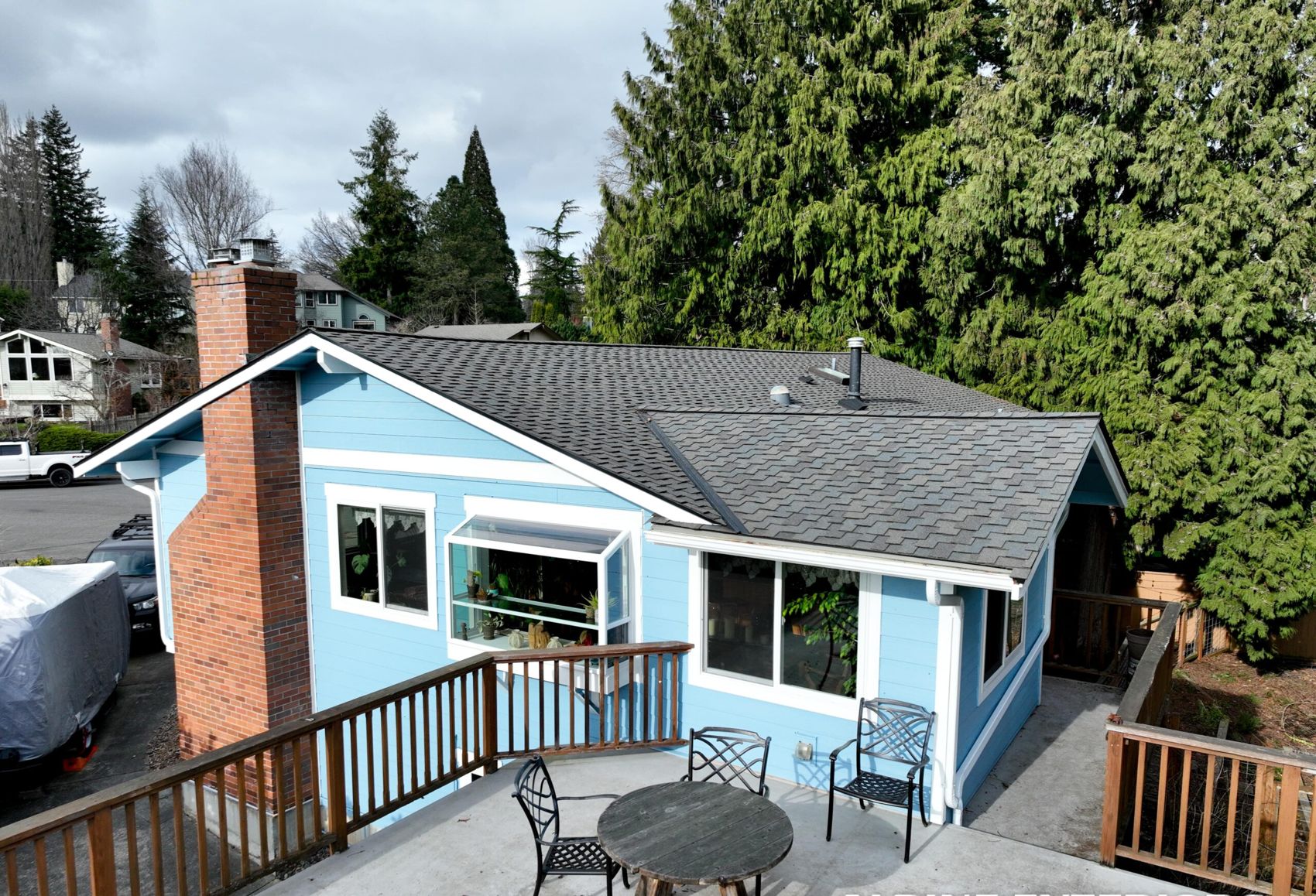
Most siding damage in North Bellingham can be repaired if it's caught early and confined to a section or two of wall — but once rot, moisture, or moss staining has spread past a single panel or board, patch repairs usually cost more over time than replacing that wall section outright. The honest starting point is a close look at how much of the wall is actually compromised, not just where the damage happens to be visible.
In North Bellingham neighborhoods like the areas around Cornwall Park, Puget, and up toward Meridian, we see the same handful of failure patterns over and over. Cedar lap siding on homes built in the 1970s through 1990s develops cupping, splitting, and soft spots where paint has failed and water has been sitting against the wood for one too many wet seasons. Hardboard siding — LP-style panel or lap product common on additions and remodels from the 1990s and early 2000s — swells at butt joints and along the bottom edge where it wicks moisture and never fully dries out between storms. Vinyl siding cracks and buckles from age, impact, or improper nailing, and while it doesn't rot, a cracked panel is an open door for water to reach the wall assembly behind it. T1-11 plywood siding, still common on garages, shops, and older ranch homes throughout Whatcom County, delaminates and rots at the bottom few feet where it sits closest to grade and splashback.
The damage you can see — a stained board, a bulging panel, a patch of black-green growth — is often smaller than the damage you can't see. Wood siding that looks merely discolored can be soft to the touch a few inches away from where it looks worst, because water travels sideways under laps and behind seams before it ever shows on the surface. That's the single biggest reason DIY patch jobs and quick caulk-and-paint fixes fail within a season or two: they treat the visible symptom without checking how far the moisture has actually traveled.
Repair vs. replace usually comes down to three questions: how much wall area is affected, whether the sheathing or framing behind the siding has been reached by the rot, and whether the existing siding is still being manufactured or is close enough to match. A single split cedar board can be cut out and replaced in an afternoon. A whole elevation with soft siding at multiple points, especially anywhere framing has gone gray and punky under a screwdriver test, is telling you the repair has already become a replacement — the only question is how much of the house.
This region is hard on siding in ways that a lot of national repair advice doesn't account for. Whatcom County gets a long, low-intensity wet season rather than occasional heavy downpours — siding here isn't dealing with brief deluges so much as months of near-constant dampness that never fully dries between rain events. That persistent moisture is what drives wood rot at butt joints, nail penetrations, and anywhere caulk has shrunk or failed, and it's why paint and caulk maintenance schedules that work in drier climates fall short here.
Moss and algae growth is another local reality that homeowners in drier parts of the country simply don't deal with. North-facing walls, shaded elevations under mature trees, and anywhere siding stays damp longest will grow a greenish-black film that isn't just cosmetic — it holds moisture against the siding surface and accelerates the rot process underneath. Pressure washing removes the surface growth but doesn't address what's happening in the wood itself, and washing too aggressively can force water further into seams and joints that are already compromised.
Homes closer to Bellingham Bay and out toward Birch Bay and Blaine take a different kind of hit: wind-driven rain off the water pushes moisture sideways into siding laps and window trim with more force than still-air rain does. That horizontal driving rain is what finds the gaps a standard lap-siding installation might tolerate inland — a slightly proud nail, a lap that's an eighth of an inch short, a caulk joint that's just starting to crack — and turns them into active leak points. We see this pattern most on west- and southwest-facing walls of homes with direct exposure toward the water.
Up in the foothills — Sudden Valley, the areas heading toward Deming and the base of Mt. Baker — freeze-thaw cycling adds a mechanical stress that flat-ground Bellingham homes don't experience as much. Water that gets into a crack or seam during a wet spell and then freezes expands and widens that crack; a few cycles of that over a winter can turn a hairline split into a board that's cracked clean through. It also loosens fasteners and works caulk joints apart faster than steady rain alone would.
Any siding repair or replacement in Washington also has to account for the Washington State Energy Code, which governs the wall assembly's insulation and air-sealing requirements — not just the siding's appearance. Replacing a wall section isn't just swapping boards; house wrap, flashing details around windows and penetrations, and insulation continuity all have to be addressed correctly for the repair to actually hold up and for the wall to perform the way current code expects. This matters more on additions or larger replacement sections than on a single-board patch, but it's worth asking about on any project bigger than a spot repair.
Start with a physical inspection, not just a visual one. Walk the exterior and press a screwdriver or your thumb into any board or panel that looks stained, swollen, or discolored — sound wood resists; rotten wood gives. Pay particular attention to the bottom few feet of walls near grade, under windows, around hose bibs and dryer vents, and at any inside corner where two walls meet, since these are where water collects and lingers longest.
Get a professional opinion before deciding between repair and replacement, especially if the damage shows up in more than one spot on the same wall. A contractor who's dealt with siding failure patterns in this specific climate can usually tell within a short inspection whether moisture has stayed localized or has started migrating under adjacent boards — something that's genuinely hard to judge from the ground looking up. Alpine Exteriors inspects the sheathing and framing behind damaged siding whenever it's accessible, because a repair that only replaces the visible board without addressing what's underneath tends to fail again within a year or two.
When it comes to matching existing siding, be realistic about what's possible. Cedar and fiber cement can often be sourced in matching profiles even years after the original installation, though color and weathering will differ until the new material ages in. Hardboard siding is a tougher match — many older LP-style profiles have been discontinued or changed dimensions over the years, so an exact match sometimes isn't available and the more practical path is replacing a full elevation rather than patching in a visibly different board. Vinyl siding faces the same problem in an even more visible way, since sun-faded panels next to a factory-fresh replacement piece can look mismatched even when the profile is technically identical. In any of these cases, it's worth discussing upfront whether a partial repair will look acceptable or whether replacing a full wall section is the better long-term call, even if it costs more now.
On cost: a small, localized repair — a few boards or a section of panel — typically runs from a few hundred dollars up to around a couple thousand, depending on access, siding type, and how much of the wall assembly needs to be opened up. A full wall or elevation replacement is a different scale of project, generally running several thousand dollars and up once you factor in house wrap, flashing, trim, and code-compliant insulation work. These are broad ranges, not quotes — the only way to get an accurate number is a hands-on inspection of your specific siding and the extent of the damage.
Don't ignore small damage waiting for it to become a bigger, more obviously worthwhile project. A single soft board caught early is a straightforward repair; the same spot left through two or three more wet seasons can spread into the sheathing and framing, turning a modest repair into a much larger structural fix. In a climate that stays damp as long as Whatcom County's does, the gap between "small repair" and "major replacement" closes faster than homeowners expect.
Check how far the damage spreads and whether it's isolated to one or two boards versus showing up in multiple spots across the same wall. Press on suspect areas with a screwdriver — if the wood gives or feels spongy rather than resisting, moisture has likely reached the framing behind it, which usually pushes the project from a patch repair toward a fuller wall section replacement.
It's not purely cosmetic. Moss and algae hold moisture against the siding surface longer than bare siding would dry on its own, which accelerates wood rot underneath and can shorten the life of paint and caulk. It's worth having growth checked rather than assuming it's a one-time pressure-washing job, especially on shaded, north-facing walls that stay damp the longest.
Sometimes, and it depends heavily on the siding type — cedar and fiber cement are usually the easiest to match even years later, while older hardboard and vinyl profiles are more likely to have been discontinued or changed. When an exact match isn't available, the more honest recommendation is often replacing a full wall section rather than patching in a visibly different board, and we'll tell you which situation you're in before any work starts.
Anything beyond a small spot repair — particularly a full wall section or an addition — needs to account for the Washington State Energy Code's requirements around insulation continuity and air sealing in the wall assembly, not just the visible siding. A single-board patch generally doesn't trigger the same scrutiny, but it's a fair question to ask on any project larger than that.
If you're looking at damaged, stained, or soft siding anywhere in North Bellingham or elsewhere in Whatcom County — Ferndale, Lynden, Blaine, Birch Bay, Sudden Valley, or the islands — Alpine Exteriors can take a look and give you a clear, honest read on whether it's a repair or a replacement, with real cost ranges before any work begins. Alpine Exteriors is licensed in Washington under contractor license ALPINI751OW and works throughout the county's varied conditions, from bay-front wind exposure to foothill freeze-thaw. Reach out to schedule an inspection and get a straightforward assessment of what your siding actually needs.