
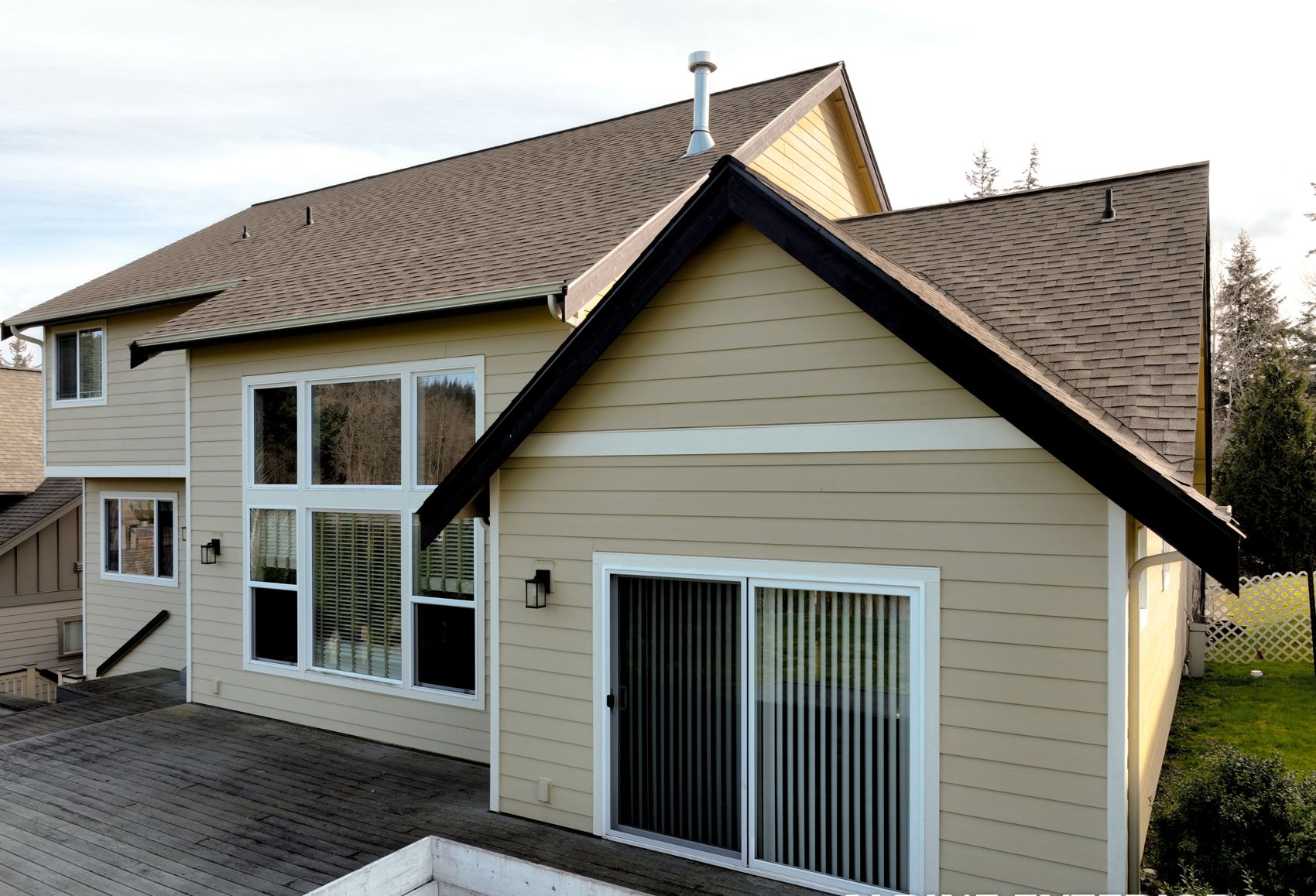
If a windstorm just rolled through Semiahmoo, the siding on the ocean-facing and southwest walls of your house is the part most likely to have taken damage. Loose or lifted panels, cracked corner trim, and water staining at the bottom courses are the three things to check first, because they're also the three that let water get behind the wall before you notice a problem.
Beyond those three, look for anything that's changed color or texture since the last time you looked closely — a streak of green-black growth, a soft patch of trim, a gap that wasn't there before. In this climate, small openings don't stay small for long.
Semiahmoo sits on a spit between Drayton Harbor and Semiahmoo Bay, which means it catches wind off open water from more directions than most Whatcom County neighborhoods. A typical Pacific frontal system moving through in the fall or winter doesn't need to be a named storm to do damage here — sustained wind in the 30 to 45 mph range, combined with driving rain, is enough to work water into any gap in a siding system that was already marginal. The failure sequence is almost always the same. Wind pressure flexes a panel or lifts a piece of lap siding at a weak fastening point. Rain, pushed sideways rather than falling straight down, gets behind that lifted edge. The house wrap or building paper behind the siding is supposed to shed that water back out, but at seams, nail penetrations, and old caulk joints it often doesn't, especially on houses that are 15 to 30 years old and were built to the code standards of their era rather than current ones. Once water is behind the cladding, it doesn't evaporate quickly in this climate. Whatcom County averages far more rain days per year than sun days in the winter half of the year, so trapped moisture has weeks, not hours, to do its work. That's when you start seeing soft trim, delaminating sheathing, and the black-green streaking of algae and moss that shows up on any north- or west-facing wall that stays damp longer than it dries.
Wind is only half of it. The other half is what sits on top of siding that's already wet: moss and algae growth that holds moisture against the surface long after a storm passes, and that can work into hairline cracks in fiber cement or lap siding and widen them over a winter. On older wood siding and trim, especially cedar, this combination of wind-driven rain and prolonged dampness is what turns a small paint failure into visible rot at butt joints and window returns within a season or two. In the foothill areas east of Bellingham — toward Sudden Valley and the base of the mountains — there's an added freeze-thaw cycle in play: water that's worked into a crack during a wet spell can freeze on a cold night and expand, widening the crack before the next storm pushes more water in. Along the water in Semiahmoo, Blaine, and Birch Bay you get less hard freeze but more direct wind exposure; inland toward Lynden and Sudden Valley you get more freeze-thaw and less wind, but the underlying problem — trapped moisture with nowhere to go — is the same everywhere in the county.
Contractors who mostly work drier or more sheltered markets tend to underbuild for two things that matter constantly here: sustained damp exposure and wind-driven rain, not one-time catastrophic wind. This isn't hurricane country, and there's no wind mitigation inspection or storm-shutter requirement the way there would be on a coastline that gets tropical systems. What Whatcom County does have is the Washington State Energy Code, which governs the wall assembly behind the siding — the water-resistive barrier, insulation, and air-sealing details that determine whether incidental moisture gets managed or trapped. A siding replacement done to current code, with a properly lapped and taped weather-resistive barrier, a drained cavity behind the cladding where called for, and correctly flashed windows and penetrations, tolerates the wind-driven rain typical of a Semiahmoo storm far better than a repair that just swaps panels without addressing what's behind them. A lot of what gets called "storm damage" isn't something a storm broke on its own — it's a pre-existing weak point, like a missed flashing detail or a caulk joint that failed years ago, that a storm simply exposed.
The other regional factor is exposure. A house on the open water side of Semiahmoo, or on a bluff facing Semiahmoo Bay or the Strait, takes direct wind-driven rain that a house three streets back, or one tucked into trees in Lynden, simply doesn't see. That's why two houses built the same year, with the same siding product, can age completely differently — one develops soft trim and moss streaking within a decade, the other looks fine at twenty years. If your home is on or near the water in Semiahmoo, Blaine, or Birch Bay, it's worth treating your siding maintenance schedule as more aggressive than the manufacturer's general recommendation, because your actual exposure is more severe than what that recommendation assumes.
After a windstorm, or once or twice a year as routine maintenance regardless of storms, walk the exterior and look specifically at the walls facing water or open exposure — for most Semiahmoo properties that's the south and west sides. Here's what actually matters to check:
None of this requires climbing on a ladder in bad weather — most of it is visible from the ground with binoculars or a short walk around the property between storms. If you find soft trim, active leaks, or siding that's come loose enough to flap in wind, that's worth a professional look before the next storm rather than after it, since the damage compounds with every additional wet cycle.
On the insurance side, most standard homeowners policies in Washington cover sudden, storm-caused damage — a panel torn off by wind, a tree limb through the wall — but they typically exclude damage attributed to long-term neglect, gradual water intrusion, or rot that developed over years. That distinction matters more than most homeowners realize, because an adjuster looking at rotted trim after a storm may reasonably conclude the rot predates the storm and deny that portion of the claim, even if the storm is what made it visible. Photograph damage as soon as you find it, before any cleanup, and get dates on those photos. If you already have "before" photos from a prior inspection or routine home photos, those help establish that damage is new rather than longstanding. A written inspection report from a licensed contractor that separates storm-caused damage from pre-existing wear can also be the difference between a claim getting paid and getting disputed. It's also reasonable to get a second opinion if an adjuster's assessment doesn't match what you're seeing on the wall.
Cost to repair storm-damaged siding varies enormously depending on scope — patching a few damaged panels and resealing trim can run a few hundred to a couple thousand dollars, while a wall section with rotted sheathing behind the cladding, which requires opening the wall up, replacing sheathing and house wrap, and reinstalling siding correctly, can run several thousand per affected wall. There's no honest way to quote an exact number without seeing the damage, and any bid you get before an inspection should be treated as a rough placeholder, not a final price.
If it's a single cracked panel with no soft wood underneath and no interior staining, a careful DIY patch can hold for a while. Once you find soft or spongy wood at trim or butt joints, staining spread across more than a small area, or any sign of water on an interior wall near an exterior corner, that usually means moisture is already behind the siding — and what's behind the siding, not the siding itself, is the part that needs a trained eye to assess correctly.
Most standard Washington homeowners policies cover sudden, storm-caused damage, but they generally exclude damage from gradual water intrusion or long-term neglect, and adjusters will sometimes attribute rot to the latter even after a storm event. Photographing the damage immediately, keeping any prior "before" photos, and getting a written contractor assessment that documents what's storm-related versus pre-existing all improve your odds with a claim — but coverage specifics always depend on your individual policy, so confirming with your carrier is the only way to know for certain.
Most siding warranties are written around a national average climate, not the specific combination of frequent rain days, filtered sun, and wind-driven moisture that Whatcom County's coastline gets, especially in Semiahmoo and Birch Bay. Walls facing water or shaded by trees stay damp longer between rain events than the warranty's assumed drying time, which is exactly the condition moss and algae need to establish. It's a maintenance issue more than a product defect, but it means cleaning and inspection need to happen more often than the manufacturer's general schedule suggests.
The Washington State Energy Code governs the wall assembly you can't see once siding is back on — things like the water-resistive barrier, insulation levels, and air-sealing at penetrations — rather than the siding material itself. When a repair or replacement opens up a wall, that's the point where it's worth making sure the assembly behind the new siding actually meets current code rather than just replicating what was there before, since that's what determines how well the wall handles the next storm.
If you're looking at storm-damaged siding in Semiahmoo, Blaine, Birch Bay, or anywhere else in Whatcom County and aren't sure whether it's a quick patch or something more involved, Alpine Exteriors can walk the exterior with you and tell you plainly what's storm damage, what's pre-existing wear, and what it would take to fix either one correctly. Alpine Exteriors holds Washington contractor license ALPINI751OW and works throughout Whatcom County, from Bellingham and Ferndale to Lynden, Sudden Valley, and the islands, so the assessment you get accounts for how your specific exposure — waterfront, foothill, or in-between — actually behaves in local storms. Reach out for an inspection before your next wet-season storm rolls through, not after, and get a straight answer about what your siding actually needs.