
In Sunnyland and the rest of Whatcom County, siding installation is governed by the Washington State Building Code (Washington's adoption of the International Residential Code) and the Washington State Energy Code, and it has to be fastened according to the manufacturer's tested installation instructions for the wind exposure at your address. Washington doesn't run a statewide product-approval list the way some coastal states do; instead, the code leans on the siding manufacturer's ICC-ES evaluation report, and the City of Bellingham or Whatcom County building inspector checks that what actually went on the wall matches what's printed in that document, not just what looks reasonable.
Every siding product sold for exterior use in Washington — vinyl, fiber cement, engineered wood, or metal — has been tested and rated by its manufacturer for wind resistance and water penetration, and that rating is documented in an ICC-ES (International Code Council Evaluation Service) report. That report spells out the nailing pattern, fastener type and spacing, minimum sheathing thickness, and how far apart the studs can be for the product to perform as tested. The building code doesn't reinvent those numbers; it requires the installer to follow them. That's the part inspectors actually check on a siding job: fastener spacing, whether the crew face-nailed panels too tight (which cracks vinyl siding as it expands and contracts with temperature), whether corrosion-resistant fasteners were used, and whether a water-resistive barrier (house wrap or building paper) and proper flashing were installed at every window, door, and penetration before the siding went on.
The Washington State Energy Code adds another layer that a lot of homeowners don't expect. If a re-side project involves adding continuous rigid insulation over the sheathing — common on older Sunnyland homes trying to hit current energy targets — the fastener length and the furring-strip layout both change, because the fasteners now have to reach through the foam and bite far enough into solid framing to hold the siding through wind gusts. A crew that just grabs the same nail length they always use on a direct-to-sheathing job is skipping a step the code actually cares about. It's a detail that rarely shows up on a sales estimate but shows up fast on a failed inspection, and it's exactly the kind of thing an experienced local crew should already be pricing into the job rather than discovering midway through.
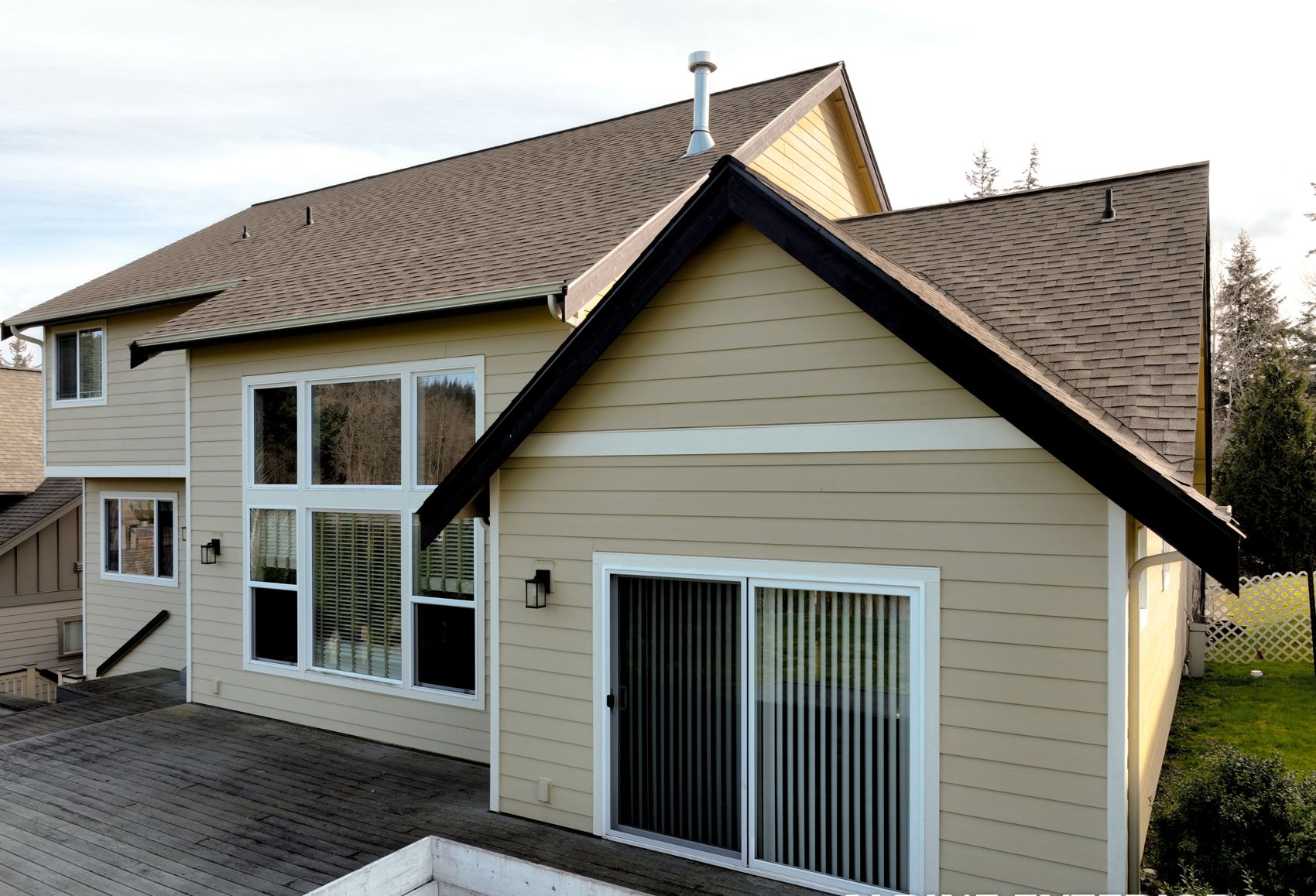
Sunnyland sits close to Whatcom Falls Park on Bellingham's east side, under a fair amount of mature tree canopy, but it's still only a few miles from Bellingham Bay, and the wind that funnels down the Strait of Georgia and Bellingham Bay during fall and winter storms reaches this neighborhood as gusting, wind-driven rain rather than a steady breeze. This isn't hurricane country and the code here isn't written around hurricane wind zones — but Whatcom County does see winter windstorms strong enough to drive rain sideways under poorly lapped siding or through a gap where flashing was skipped, and that's the failure mode that actually shows up on service calls here, not blown-off panels.
The bigger everyday enemy is moisture. Whatcom County gets rain across most of the year, and north- and east-facing walls in tree-shaded neighborhoods like Sunnyland stay damp long enough to grow moss and algae, especially on lap siding with tight seams or a shaded eave. Left alone, that moisture holds against the wall longer than the siding or the wood behind it was designed for, and that's how rot starts at the bottom courses, around trim, and behind poorly flashed windows — not from a single storm, but from years of a wall that never fully dries between rains. Up toward the Lake Whatcom foothills and Sudden Valley, freeze-thaw cycling adds a second stress: siding and trim joints expand and contract more aggressively through repeated freezing nights and thawing days than they do down in town, which is exactly why the expansion gap called for at panel ends and around fasteners matters more here than the installer might assume. And out toward Blaine, Birch Bay, and the islands, the salt content in wind-driven rain off the Strait accelerates corrosion on any fastener that isn't actually rated for exterior, coastal-adjacent exposure, even though those areas see nothing like storm-surge conditions.
Most siding failures we get called out for in Whatcom County trace back to installation shortcuts, not a bad product. A few things worth insisting on before work starts:
Alpine Exteriors works from the manufacturer's tested fastening schedule on every siding job in Whatcom County, and we'll show a homeowner the actual installation instructions for their product before the crew starts, not after an inspector asks. We hold Washington contractor license ALPINI751OW, and part of that license is standing behind work that has to pass inspection, not just look finished from the curb.
None of this is about scaring anyone into a full re-side. A well-installed, well-flashed siding job on a Sunnyland home can go decades between major service calls. The honest tradeoff is that a cheaper install that skips the rainscreen gap, uses the wrong fastener, or under-flashes a window opening might look identical on day one and start showing rot or moss staining within a few wet seasons — the visible siding is rarely where the real problem starts.
In most cases, yes, particularly when the work exposes the sheathing, alters the water-resistive barrier, or adds continuous insulation. A straightforward panel swap over intact, undisturbed siding sometimes falls outside permit requirements, but that determination is made by the local building department, not by the contractor, so it's worth confirming with the City of Bellingham or Whatcom County permit office before work starts rather than assuming either way.
Washington's building code sets design wind speeds by location using the same national wind-speed maps referenced in the structural provisions of the International Residential Code, and Whatcom County's rating is well below the wind zones used in hurricane-prone states. Siding manufacturers separately test and rate their products for wind resistance, and the fastening schedule in that manufacturer's ICC-ES report is what determines whether a given product and installation method are appropriate for a specific exposure, rather than a single county-wide number.
It starts as cosmetic but doesn't stay that way. Moss and algae themselves don't damage most siding materials directly, but they hold moisture against the wall surface long after the rest of the house has dried out, and that prolonged dampness is what eventually leads to rot in wood trim, staining that won't pressure-wash out, and, in the worst cases, moisture working its way behind the siding at compromised seams or flashing. Shaded, north-facing walls in tree-covered neighborhoods like Sunnyland are the most common spot for this to show up first.
Re-siding itself doesn't automatically trigger a full code upgrade, but any work that's permitted has to meet current code for the scope of work being done — which is where the Washington State Energy Code often comes into play if insulation is being added, and where flashing and water-resistive barrier requirements apply regardless of how the original home was built decades ago. It's common for an older Sunnyland home to have no house wrap at all behind the original siding, and a re-side project is usually the right time to add it correctly rather than treating it as optional.
If you're weighing a re-side in Sunnyland, Bellingham, or anywhere else in Whatcom County, Alpine Exteriors can walk your home, show you where moisture and wind exposure are actually working against your current siding, and lay out a fastening and flashing plan that will pass inspection the first time. Reach out for an on-site look and a straight answer about what your home actually needs.