
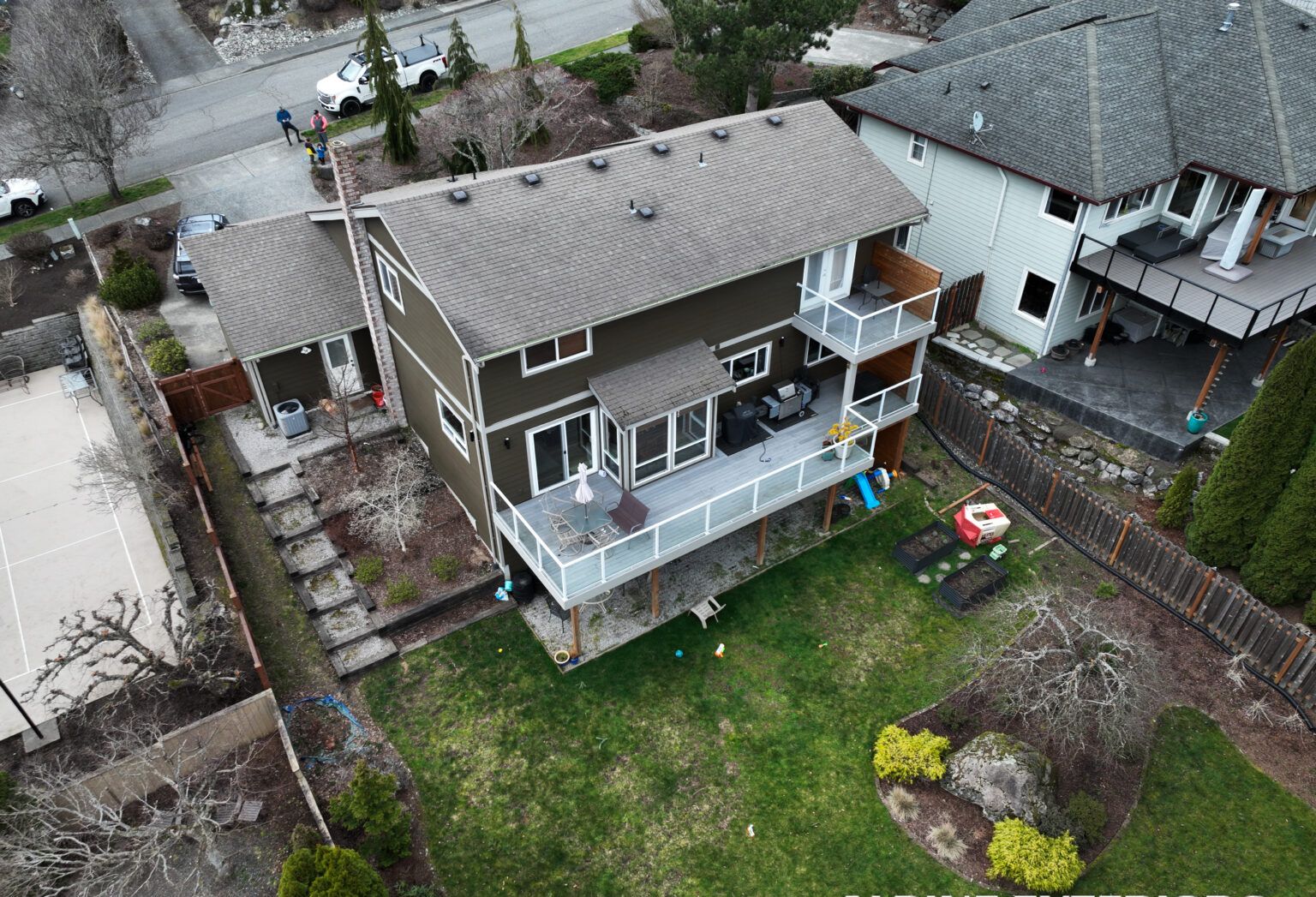
Meridian sits in unincorporated Whatcom County between Bellingham and Ferndale, and the houses here take a particular kind of weathering: long stretches of drizzle, moss and algae that creep up north-facing walls, and wind-driven rain that pushes moisture sideways into siding laps during storms off Bellingham Bay and the Strait of Georgia. A siding replacement in this area isn't just a cosmetic swap — it's a chance to fix whatever the old assembly let through. This page walks through what actually happens, in order, so you know what to expect before Alpine Exteriors' crew shows up and after they leave.
For a typical single-family home in the Meridian area — say 1,800 to 3,000 square feet with one or two stories — the hands-on labor for a full siding replacement usually runs somewhere between five and ten working days. That's the honest range; a small rambler with simple walls can move faster, and a home with a lot of dormers, trim detail, or hidden rot repair can run longer. What throws off the calendar in Whatcom County isn't the labor itself, it's the weather. Fiber cement and most lap siding products can't be installed safely in active rain, and the underlying weather-resistive barrier needs to stay dry while it's exposed. Crews plan around forecast windows, which means a project quoted at eight working days can stretch across two or three calendar weeks once you add rain holds, especially between October and April. Summer and early fall bookings tend to move more predictably, which is also why that window fills up early with area homeowners.
It's worth saying plainly: nobody can promise an exact finish date on a Whatcom County exterior project scheduled months in advance. A realistic contractor gives you a labor-day estimate and an honest caveat about weather, not a guaranteed calendar date.
Most straightforward siding replacements — same footprint, no structural changes — fall under Whatcom County's building permit requirements, and the county reviews and issues these before any tear-off begins. If your home sits inside Bellingham or Ferndale city limits rather than the unincorporated county, the permit runs through that city's building department instead; Alpine Exteriors confirms jurisdiction by address before submitting anything, since the two processes have different timelines and fee schedules. Either way, plan for a review period before your start date is locked in — this is not something that gets skipped to save a week.
If your property is part of a homeowners' association — several of the newer developments around Meridian and Cordata have design review committees — you'll likely need to submit the proposed siding color and material for HOA approval before ordering. That approval step should happen in parallel with permitting, not after, because waiting on it after materials are already on order can mean re-ordering in a different color at real cost and delay.
Material lead time is the other piece that catches homeowners off guard. Fiber cement siding, which holds up well against this region's rot pressure, is often special-order by color and profile, and lead times of four to eight weeks from manufacturer to jobsite are common, longer if a color needs custom factory finishing. Vinyl and engineered wood products can sometimes move faster, but availability shifts with the season. The takeaway: the contract date and the start date are not the same thing, and a contractor who tells you materials are already confirmed and staged before demolition begins is doing it the right way.
Once permits are in hand and materials are on site, the work itself follows a fairly fixed sequence:
Crews generally complete one elevation of the house before opening up the next, rather than stripping every wall simultaneously, which limits how much of the structure is ever exposed to weather at once.
A little prep on your end keeps the project moving and protects your belongings:
Depending on the scope and jurisdiction, the county or city inspector typically needs to sign off on the weather-resistive barrier and flashing before the new siding closes it in — this is a scheduled inspection call, not a step that gets skipped, since it's the one point where the moisture management layer is actually visible. A final inspection after siding installation is also standard for permitted work.
Daily cleanup matters more on a siding job than people expect, mostly because of nails and cut-offs. Crews should be sweeping debris and running a magnetic nail sweep across the yard and driveway at the end of each work day, not just at the very end of the project, since loose nails and staples are a real hazard for bare feet, pets, and lawn mowers. At project completion, a full walkthrough should cover every elevation with you present — checking caulk lines, paint touch-up, that all fixtures and gutters are reinstalled correctly, and that the site has been cleared of scrap siding, packaging, and any staging materials.
New siding in this climate still needs some homeowner attention. Moss and algae growth on north- and west-facing walls is close to inevitable given the rainfall and shade patterns common around Meridian, and periodic gentle washing (never high-pressure blasting directly at seams and laps) keeps it from taking hold and staining the finish. Caulk joints and trim seals are worth a visual check once a year, since UV exposure and seasonal movement can open small gaps over time, and catching that early is far cheaper than a rot repair later. Keeping gutters clear so water isn't overflowing directly down the wall face is one of the simplest things a homeowner can do to protect a new siding job long-term.
On the coverage side, expect two separate warranties: a manufacturer's material warranty on the siding product itself (fiber cement products commonly carry decades-long non-prorated coverage, though terms vary by manufacturer and should be read directly, not assumed), and a workmanship warranty from the contractor covering the installation. Alpine Exteriors holds Washington contractor license ALPINI751OW and stands behind its installation work separately from whatever the manufacturer covers — ask for both documents in writing before the project closes out, and keep them with your home records.
Labor typically runs five to ten working days for a mid-size single-family home, but the calendar time is usually longer because of rain holds, especially outside the summer and early fall months. A contractor who gives you a labor-day range plus a weather caveat, rather than one hard finish date, is being realistic about how projects actually run in Whatcom County.
In most cases yes, whether your property falls under Whatcom County's jurisdiction or inside Bellingham or Ferndale city limits, and the specific department depends on your address. Permitting should be handled and approved before tear-off starts, not applied for after the fact.
Some prep work can happen in wetter months, but the actual siding installation needs dry conditions, since most products and the weather-resistive barrier beneath them shouldn't be installed or left exposed in active rain. Projects scheduled for late fall through winter should expect more weather-related rescheduling than a summer project would.
Persistent rain, wind-driven moisture off the Bay and the Strait, and small flashing failures around windows, doors, and deck ledgers are the usual culprits over years of exposure. Once the old siding is off, any soft or delaminated sheathing and framing is cut out and replaced before the new weather-resistive barrier and siding go on — this is discovered and addressed at tear-off, not guessed at from the outside beforehand.
If you're weighing a siding replacement on a Meridian, Bellingham, Ferndale, or Whatcom County home, Alpine Exteriors can walk your property, look at what the current siding and sheathing are actually dealing with, and put together a realistic scope and timeline before anything is ordered. Reach out to schedule a walkthrough and get a written estimate that accounts for your specific walls, not a generic square-footage guess.