
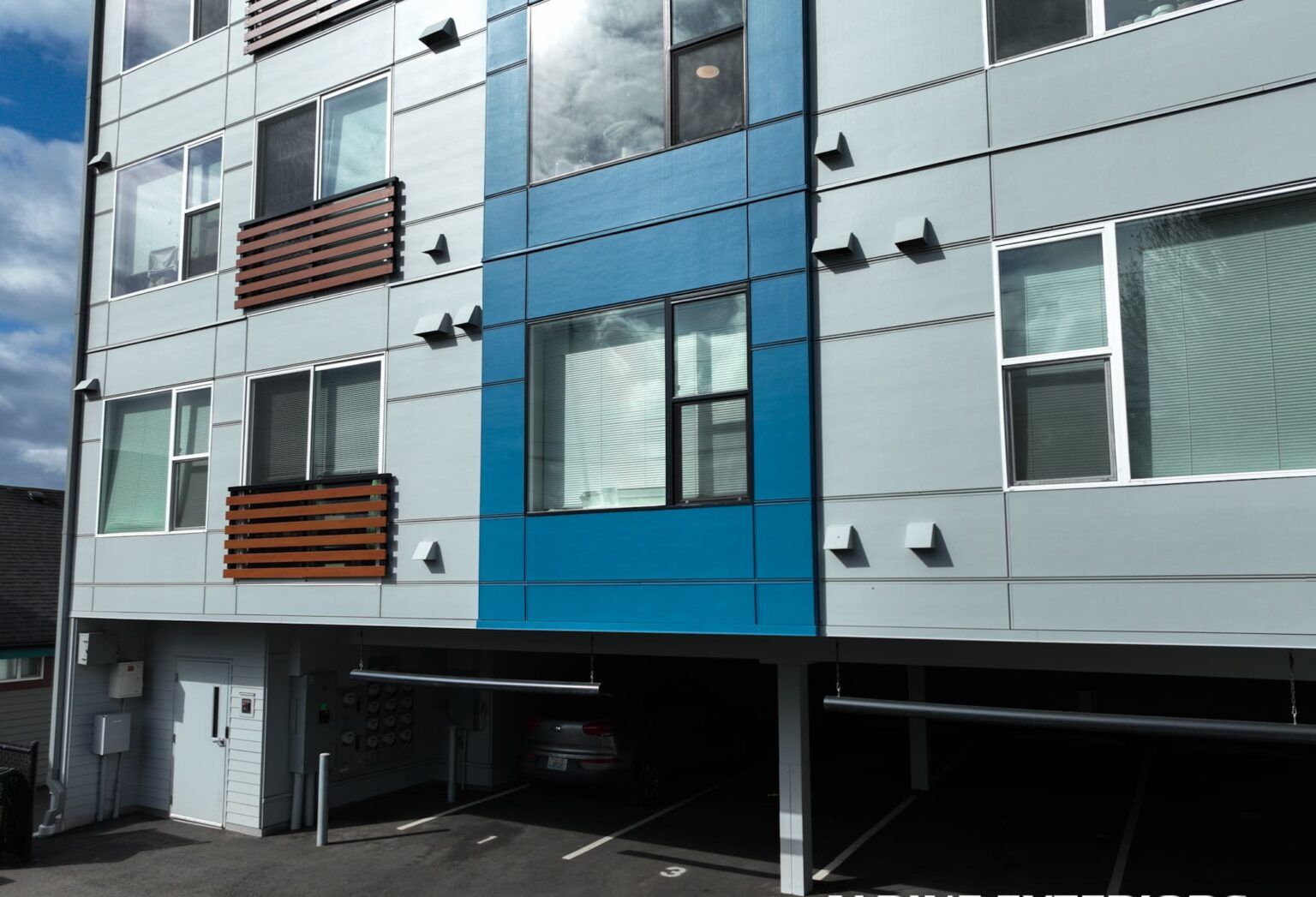
Most siding damage in Silver Beach comes from moisture, not impact: wood rot at the bottom courses, moss and algae growth in shaded corners, and wind-driven rain finding gaps around trim and windows. Small, isolated damage can usually be repaired if it's caught early, but once rot has spread behind the siding or a product line has been discontinued, full replacement of that wall (or the whole exterior) is the more honest recommendation.
Silver Beach sits right on Bellingham Bay, which means the neighborhood absorbs more wind-driven rain than inland Whatcom County streets just a mile or two east. Water doesn't need a storm to get behind siding here — a steady onshore breeze during a normal winter rain is enough to push moisture sideways into seams, nail holes, and butt joints that would stay dry on a more sheltered lot. Over months and years, that moisture works its way behind lap siding and around window and door trim, and it's the wood framing and sheathing underneath — not the siding face itself — that usually fails first.
Wood rot is the damage we see most often on Silver Beach homes, particularly at the bottom few courses near grade, around deck ledger boards, and beneath window sills where caulking has failed. Once you can push a screwdriver into a board with light pressure, or the paint is bubbling and soft rather than just peeling, the wood behind it is compromised and painting over the problem won't stop it. Fiber cement and engineered wood siding resist rot far better than solid wood, but they're not immune — fiber cement can still spall or crack at cut edges that were never sealed, and any siding type will fail if the water-resistive barrier behind it has torn or the flashing above a window was installed wrong from day one.
Moss and algae are the other constant here. Silver Beach's tree cover and the Bay's humidity keep north- and west-facing walls damp for long stretches, especially through the fall and winter when the sun barely clears the treeline. A green or black film on siding is mostly cosmetic and can often be washed off with a low-pressure rinse and the right cleaner, but moss that's been left to grow thick enough to hold water against the siding for months at a time is a different story — it traps moisture right at the surface and accelerates rot underneath, especially on wood and OSB-backed products.
Freeze-thaw cycling is a smaller factor here than in the foothills around Sudden Valley or up toward Mount Baker, but Silver Beach still sees enough cold snaps most winters that trapped water in a cracked board or a failed caulk joint can freeze, expand, and widen the damage overnight. It's not the dominant driver of failure on the waterfront, but it's often what turns a hairline crack into a visible split by spring.
Silver Beach isn't like a siding job in Lynden or Ferndale a few miles inland. The direct exposure to Bellingham Bay means wind-driven rain hits west- and south-facing walls at an angle that pushes water into laps and seams that would stay dry on a more sheltered inland lot. Homes closer to the water also tend to have more mature landscaping and tree canopy that keeps siding shaded and slow to dry, which is exactly the combination — persistent moisture plus limited sun exposure — that lets moss and rot take hold faster than they would on an open, inland site.
Older homes in this neighborhood were often built or re-sided before the current Washington State Energy Code's insulation and air-sealing requirements existed, so when we open up a wall for a repair, we frequently find little or no house wrap, thin or missing insulation, and flashing details that don't meet what's required for new work today. That's not a knock on the original builder — it's just what standard practice looked like decades ago. It does mean that any repair or re-side project touching more than a small patch of wall should bring that section up to current energy code requirements for insulation and air barriers, not just replace the visible siding.
Salt-laden air off the Bay is also a factor for fasteners and trim. Galvanized nails and lower-grade hardware corrode faster this close to saltwater than they would inland, and corroded fasteners are one of the quieter causes of siding coming loose or pulling away from the wall. It's a detail that's easy to overlook but worth asking about if you're getting repair work done — stainless or coated fasteners rated for coastal exposure cost more up front and hold up considerably longer here.
Start with a close visual inspection, ideally after a stretch of dry weather so you're not looking at wet, discolored wood and confusing it with rot. Walk the perimeter and look specifically at the bottom courses near grade, anywhere a deck or porch roof meets the wall, under every window sill, and around any spot where a previous owner added trim, a light fixture, or a vent. Press on suspect areas with your thumb or a flathead screwdriver — solid wood should feel firm, not spongy.
Repair is usually the right call when damage is limited to a small, well-defined area: a single cracked or split board, a section of trim with failed caulk, or moss buildup that hasn't yet caused visible softening underneath. In those cases, a contractor can cut out the damaged section, check the sheathing and house wrap behind it, replace what's needed, and blend the new material in. This is the more affordable path, generally landing in the low thousands of dollars depending on how much of the wall has to be opened up and whether hidden rot turns up once the old siding comes off.
Replacement — of a single wall or the whole exterior — makes more sense when rot has spread along multiple courses or wrapped around a corner, when the siding product is old enough that matching pieces are no longer manufactured, or when repeated patch repairs on the same wall suggest an underlying moisture problem (bad flashing, missing house wrap, poor grading) that piecemeal fixes won't solve. Whole-house siding replacement costs considerably more than a targeted repair, but it also gives you the chance to correct the underlying issues — add proper house wrap, upgrade insulation to meet current Washington State Energy Code targets, and use fasteners and flashing details suited to a waterfront lot — instead of repeating the same failure in five years.
Matching existing siding is its own challenge on a home that's more than ten or fifteen years old. Manufacturers change product lines, discontinue colors, and adjust panel profiles regularly, so a lap siding style installed in the early 2010s may simply not be available anymore in the same width, texture, or shade. When an exact match isn't possible, homeowners generally have three realistic options: source reclaimed or discontinued stock through a supplier (slow and not always successful), accept a close-but-not-identical match on a less visible wall, or re-side an entire elevation — sometimes the entire house — so the mismatch isn't an issue at all. We always tell Silver Beach homeowners to get an honest answer about matchability before committing to a small repair, because finding out three boards in that the product line was discontinued five years ago is a frustrating and avoidable surprise.
Alpine Exteriors has repaired and re-sided homes throughout Whatcom County, including waterfront properties in Silver Beach, and we typically start with a no-obligation inspection so you know whether you're looking at a patch repair or a larger project before any work begins. As a licensed Washington contractor (ALPINI751OW), we also make a point of checking what's happening behind the siding — insulation, house wrap, flashing — rather than just replacing what's visible on the surface.
The clearest test is how far the damage has spread. If it's confined to one or two boards, a section of trim, or a single spot of moss and discoloration with no soft wood underneath, a targeted repair is usually enough. If you find rot along multiple courses, around a corner, or in more than one area of the house, that's typically a sign of a systemic moisture problem — often failed flashing or missing house wrap — that a small patch won't fix, and replacement of that wall or elevation is the more durable answer.
Silver Beach's proximity to Bellingham Bay keeps humidity higher and, combined with mature tree cover common in the neighborhood, north- and west-facing walls often stay damp for long stretches through fall and winter. That persistent moisture, plus limited direct sun to dry the surface, is exactly the environment moss and algae need to establish. Inland homes with more sun exposure and less shade typically dry out faster after rain, which slows growth even under similar total rainfall.
A small, isolated repair generally doesn't trigger a full code upgrade. But once a project involves re-siding a full wall or the whole house, that's the point where it makes sense — and is often required — to bring the insulation and air-sealing behind the new siding up to Washington State Energy Code standards, rather than reinstalling siding over the same thin or missing insulation that was there before.
Sometimes, but not always. If your siding is a current product line, an exact match is usually possible. On older homes, the specific profile, texture, or color may have been discontinued, in which case your contractor should tell you that honestly before starting a small repair, so you can decide between a close match on a less visible wall, sourcing reclaimed material, or re-siding a full elevation to avoid a visible seam between old and new.
If you're seeing soft spots, moss buildup, or cracked boards on a Silver Beach home, it's worth getting a professional look before the damage spreads further into the wall assembly. Alpine Exteriors serves Silver Beach and the rest of Whatcom County — Bellingham, Ferndale, Lynden, Blaine, Birch Bay, Sudden Valley, and the islands — and can tell you plainly whether you're looking at a straightforward repair or a larger replacement, with no pressure either way. Contact Alpine Exteriors for an inspection and a clear, written assessment of what your siding actually needs.