
Yes — even an ordinary fall or winter storm moving through Sunnyland and the rest of Bellingham can crack, lift, or soak siding, especially on walls that take wind-driven rain head-on or where moss has already loosened the material underneath. The damage is rarely dramatic, like a panel torn off in one piece. More often it's water finding a way behind trim, fascia boards, or lap seams that were already weakened by months of damp weather before the storm ever arrived.
That distinction matters because it changes what a homeowner should be looking for. A storm in this part of Whatcom County is usually the event that finishes off siding that was already failing quietly, not the sole cause of the problem. Understanding that helps explain why two houses on the same Sunnyland block can come through the same windstorm with very different results — one with a few loose boards, the other with water stains spreading across an interior wall a week later.
Sunnyland sits close to Whatcom Creek and just north of Sehome Hill, in a neighborhood built mostly with older wood-frame homes, many still carrying original wood lap or cedar shingle siding under later paint jobs, alongside newer infill with vinyl or fiber cement. Each of those materials fails differently in a storm, and each failure mode has a lot to do with what the siding has already been through in the months leading up to it.
Wood and cedar siding in this area rarely fails from wind alone. It fails because persistent, low-intensity rain — the kind Whatcom County gets far more of than any single big storm — keeps the wood damp for days at a time, especially on north- and west-facing walls that never get direct sun to dry out. That moisture feeds moss and algae, which take hold in the grain and under lapped boards, holding water against the wood and slowly breaking down the paint film that was supposed to shed it. By the time a storm brings sideways rain and gusts off the water, the wood underneath the moss may already be softened. The storm doesn't create the rot; it just drives water into cracks and seams that moss and chronic dampness had already opened up, and it can snap boards that have gone spongy at the nail line.
Fiber cement holds up better against rot but isn't immune to storm-related trouble. Its main failure point is the caulking and flashing at butt joints, window trim, and corners. Sun exposure is limited here, but the freeze-thaw cycling that shows up in colder snaps — particularly in the foothill-adjacent parts of the county — makes caulk brittle over a few winters. A storm with sustained wind then works water into those hardened, cracked joints, and it can travel a surprising distance behind the panel before it ever shows up as a stain indoors.
Vinyl siding, common on homes built or re-sided in the last couple of decades, tends to show the most visibly obvious storm damage: cracked or bowed panels, and pieces that pop loose from their nailing hem in a hard gust. Vinyl is more forgiving of routine rain since it doesn't rot, but it's also more likely to crack outright in a sharp temperature drop right after a storm, which does happen here when a cold front follows a wet, mild stretch.
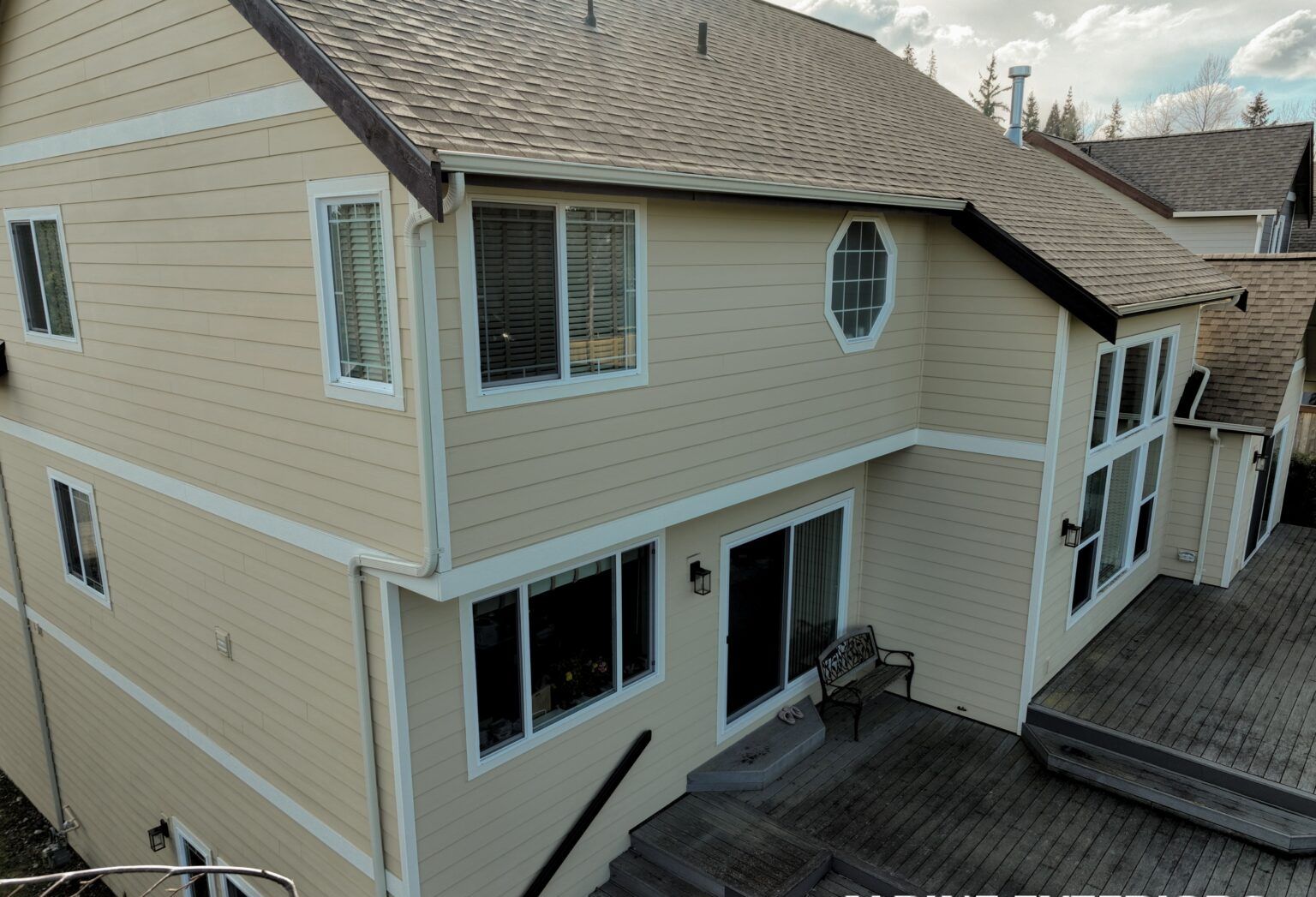
It's worth being specific about what kind of weather actually causes this, because Whatcom County's siding problems come from a very different pattern than what siding contractors deal with in most of the country. There's no hurricane risk here, and homeowners researching storm damage online will find a lot of advice written for wind speeds and storm surge that simply don't apply to Bellingham. What does apply is something quieter and, in some ways, more damaging over time: months of persistent, low-grade rain punctuated by a handful of windier systems each year.
The most useful thing to do in the days right after a storm is a calm, methodical walk around the exterior — not a panic call to the first contractor who advertises storm response. Start from the ground and look up, since most of what matters is visible without a ladder.
If you find clear physical damage — a cracked panel, a hole, boards knocked loose — contact your homeowners insurer promptly and ask specifically whether the policy covers wind-driven rain intrusion, not just visible exterior damage, since that distinction trips up a lot of claims in this region. Washington insurers generally handle sudden storm damage differently than gradual water damage from long-term neglect or maintenance failure, and an adjuster may look closely at how much of what they're seeing is storm-caused versus pre-existing moss and rot. That's not a reason to avoid filing a claim; it's a reason to document what you see honestly and get an independent read on the damage before you talk through coverage specifics.
This is where a straightforward inspection from a local siding contractor is worth more than it might seem. Alpine Exteriors inspects storm-affected homes throughout Whatcom County, including Sunnyland, Ferndale, Lynden, Blaine, Birch Bay, and Sudden Valley, and can tell you plainly whether what you're looking at is storm damage, longstanding moisture and moss damage, or some of both — which is the honest answer more often than not. A good inspection should also flag areas that are heading toward failure even if they didn't fail in this particular storm, since in this climate that's usually only a matter of time. Be wary of anyone who shows up after a storm promising a full insurance-covered replacement before they've actually looked at the wall assembly; that's a sales pattern, not an inspection.
It's also fair to say plainly that not every fix after a storm needs to be a full re-side. Spot repairs, recaulking, and replacing a handful of damaged boards or panels is often the right, less expensive answer, and a contractor who only offers full replacement quotes isn't giving you the full picture. Alpine Exteriors, licensed in Washington under contractor license ALPINI751OW, will generally recommend targeted repair where the underlying wall assembly is sound, and reserve full replacement for cases where moss, rot, or years of moisture have compromised enough of the wall that patching it wouldn't hold up through the next wet season.
It depends on the policy and the cause. Most Washington homeowners policies cover sudden, storm-related damage like wind-torn panels or a tree limb strike, but they typically exclude damage attributed to long-term neglect, gradual water intrusion, or existing rot and moss that simply got exposed by the storm rather than caused by it. Because Whatcom County's climate makes it common for storm damage and pre-existing moisture damage to overlap on the same wall, it's worth getting an independent inspection before or alongside the insurance adjuster's visit so you have your own documentation of what condition the siding was actually in.
Light surface moss on a shaded roofline or the north side of a fence is usually cosmetic. Moss becomes a damage concern when it's thick enough to hold visible moisture against the siding, when it's growing in the seams between boards or panels rather than just on the surface, or when the material underneath feels soft, spongy, or crumbles slightly when pressed. If you can slide a fingernail or a flat tool under the edge of a board and it lifts easily, or if paint is bubbling or peeling in the same areas as heavy moss, that's a sign moisture has already gotten into the material rather than just sitting on top of it.
Wind damage tends to be sudden and mechanical — a panel cracked or torn where wind caught an edge, a board knocked loose from its fasteners, debris impact marks. Long-term moisture damage is slower and shows up as soft or rotted wood, peeling or bubbling paint, staining that follows a pattern of water flow rather than a single impact point, and moss or algae buildup. In practice, a lot of what gets discovered after a Whatcom County storm is really long-term moisture damage that the storm's wind and rain simply exposed or worsened, which is why an honest inspection distinguishes between the two rather than labeling everything storm damage.
Within a few days is reasonable for a visual walk-around of your own, and sooner if you've noticed interior staining, a draft, or visible exterior damage. There's no need to rush a professional inspection the same day unless the damage looks significant enough to let water into the wall assembly during the next rain, which is common enough here that it's worth taking seriously. Waiting weeks or months, though, gives ongoing rain time to work into any openings the storm created, so it's better to get eyes on it — yours or a contractor's — before the next system rolls through.
If a recent storm has you wondering whether your siding in Sunnyland or elsewhere in Whatcom County held up, or if you've spotted moss, soft boards, or loose panels that predate any particular storm, Alpine Exteriors can walk the exterior with you and give a straight assessment of what's storm damage, what's long-term moisture wear, and what actually needs to happen next. Licensed in Washington under contractor license ALPINI751OW, Alpine Exteriors serves Bellingham, Ferndale, Lynden, Blaine, Birch Bay, Sudden Valley, and the surrounding islands, and can scope anything from a targeted repair to a full re-side depending on what the wall assembly actually needs — not what sells the biggest job. Reach out to schedule an inspection before the next wet system moves in off the Strait.