
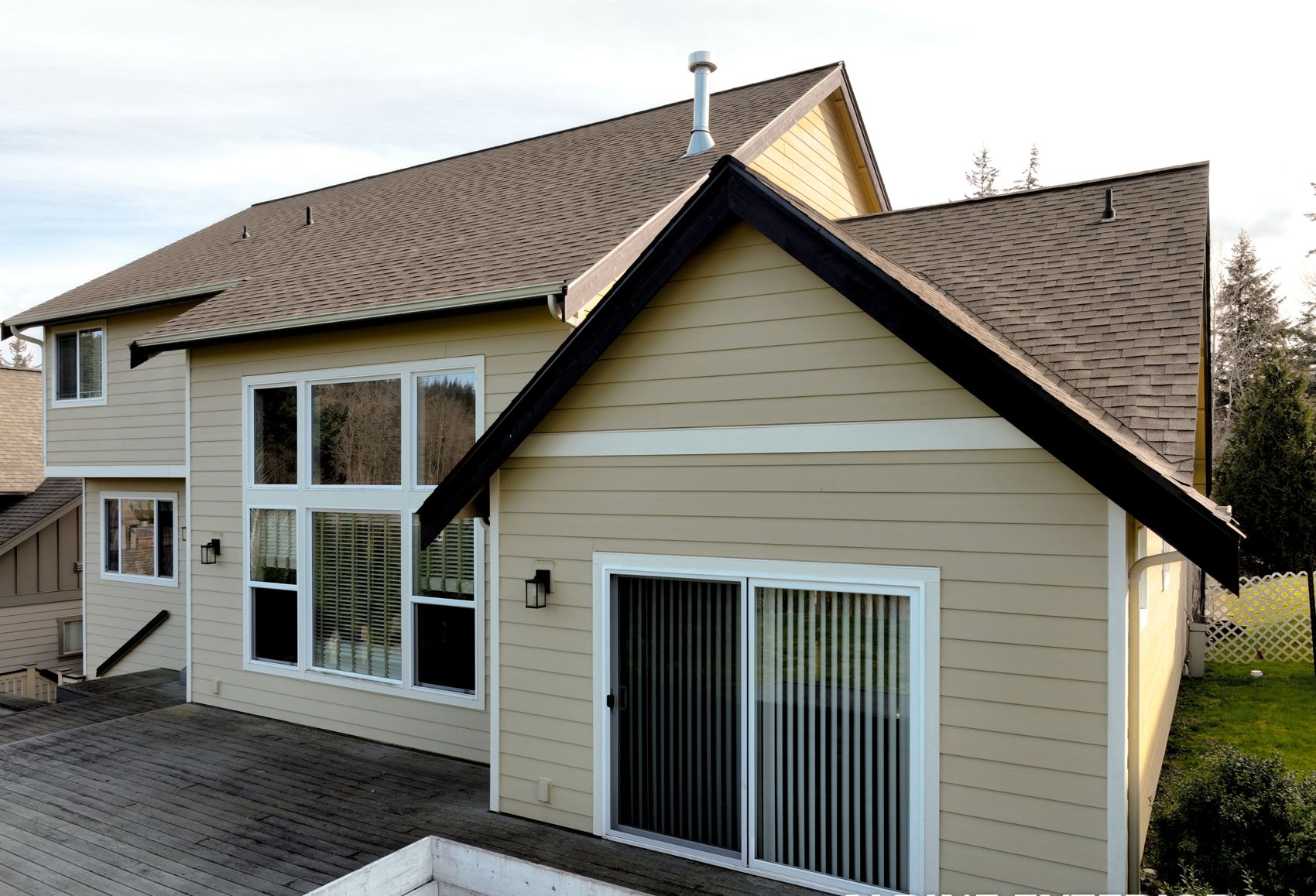
If you've noticed a soft spot in the trim below a window, a dark streak trailing down from a corner, or paint that's started to bubble near a sill, you may be looking at water that's already gotten behind the siding. In Whatcom County — from downtown Bellingham to Ferndale, Lynden, Blaine, Birch Bay, Sudden Valley, and out to the islands — this is one of the most common siding problems we get called about, and window corners are almost always where it shows up first. This page walks through what to look for, why it happens so often here, and what your realistic options are.
Water behind siding rarely announces itself right away. It tends to work quietly inside the wall for months or years before anything is visible from the outside, which is part of what makes window corners worth checking even when nothing looks obviously wrong. Signs worth taking seriously include:
Any one of these on its own isn't necessarily an emergency, but a combination — say, exterior staining plus an interior musty smell — usually means the water has been getting in for a while.
Window corners fail more than flat wall sections because they're where several materials and joints meet: siding, trim boards, flashing, and window flanges all butt together at that spot, and every seam is a potential path for water if it wasn't lapped or sealed correctly to begin with. A few things make this particularly common in our part of Washington:
It depends on what's happening behind the siding, which is exactly the hard part — you often can't tell from the outside how far it's gone. A few general guidelines:
If you're seeing surface staining or slightly failed caulk with no soft wood, no interior odor, and no interior staining, this is worth scheduling a repair but isn't an emergency. If you're seeing soft or spongy material, bulging siding, an interior musty smell, or any staining on interior drywall or trim, treat it as more urgent — that combination usually means moisture has reached the sheathing or framing, and wood-frame construction doesn't tolerate sustained wetness well. Left alone, rot spreads, and mold, given water and organic material to feed on, will keep growing as long as conditions stay damp — which, in our climate, is most of the year.
Timing also matters. If you find a problem in late summer, there's a real window to get it repaired before the wet season sets in around October. If you're finding it in the middle of a wet Whatcom County winter, at minimum get it temporarily weatherproofed so it doesn't get worse while you wait for a proper repair.
Once we open up a corner and see how far the damage extends, the repair-versus-replace decision usually comes down to a few factors: how much of the underlying sheathing and framing is affected, how old and how far degraded the existing siding is, and whether the damage is isolated to one corner or has spread along the wall.
| Situation | Typical approach |
|---|---|
| Isolated corner, sound siding elsewhere, minor sheathing damage | Cut out and replace the affected trim and siding section, repair flashing, re-seal — a targeted repair, often a few hundred to low thousands of dollars depending on access and extent |
| Rot has spread into wall studs or window framing | Structural repair of the framing before any new siding goes back on — cost climbs with the amount of framing involved |
| Siding is older (original builder-grade wood or early fiber cement) and showing wear across the whole wall, not just the corner | Often makes more sense to re-side the affected wall or elevation rather than patch a material that's near the end of its service life anyway |
| Whole-house siding is aging and multiple corners or areas show similar issues | Full re-side, which also lets us correct flashing details and moisture barrier gaps house-wide instead of one corner at a time |
Honestly, patch repairs on a wall that's otherwise failing don't always pencil out — you can spend real money fixing one corner and be back again in two years when the next spot fails. On the other hand, jumping straight to a full re-side when the rest of the wall is genuinely sound is overkill. We'll open up the area and give you a straight, honest answer rather than defaulting to the bigger job.
Most of the fixes that actually prevent this from recurring are done at the flashing and detailing level, not just at the surface:
Worth noting for anyone re-siding or replacing windows: the Washington State Energy Code's requirements for continuous air barriers and insulation mean that opening up a wall for repair also means restoring the water-resistive barrier and air barrier continuity at that spot, not just making it look right from the street. Doing this correctly the first time is a lot of what separates a repair that lasts from one that fails again in a couple of winters.
Start with a moisture meter if you have one, or look for the indirect signs: soft or spongy trim when you press on it, paint that's bubbling rather than just fading, staining that follows a corner or seam rather than being spread evenly, and any musty smell near the same spot on the interior. None of these prove exactly how bad it is, but a combination of two or three is a reliable sign it's time to open it up and look rather than guess.
In Whatcom County, west- and southwest-facing walls generally take the worst of it because that's the direction wind-driven rain comes from off the Bay and the Strait most often. North-facing walls fail for a different reason — less direct rain but more shade, which means more moss, more algae, and slower drying between storms. Either exposure can produce the same rot at a window corner; the mechanism is just different.
It depends on the cause and your specific policy. Sudden water damage from a covered event is often treated differently than gradual water intrusion from long-term flashing or sealant failure, and most policies exclude damage that's considered a maintenance issue rather than a sudden loss. We're happy to document what we find with photos for your claim, but you'll need to check with your insurer on how they classify it before assuming it's covered.
That depends on how far it's already progressed, which is the frustrating part — there's no fixed timeline that applies to every house. Surface staining with no soft wood can often wait for a scheduling window, ideally before the wet season starts. Once you're seeing soft wood, interior odor, or interior staining, waiting generally means more of the framing gets involved, and framing repairs cost more than trim and siding repairs alone. When in doubt, get it looked at rather than guessing.
Window corners are an easy place to overlook until the damage is already significant, and in a climate like ours — with the rain volume, the wind off the water, and the moss that comes with all the tree cover — they're one of the first spots we check on any inspection. Alpine Exteriors works on siding and window-corner repairs throughout Whatcom County, from Bellingham and Ferndale to Lynden, Blaine, Birch Bay, Sudden Valley, and the islands, and we're happy to take a look and lay out repair versus replace options honestly. Alpine Exteriors is licensed in Washington under contractor license ALPINI751OW — reach out and we'll get a look at it.