
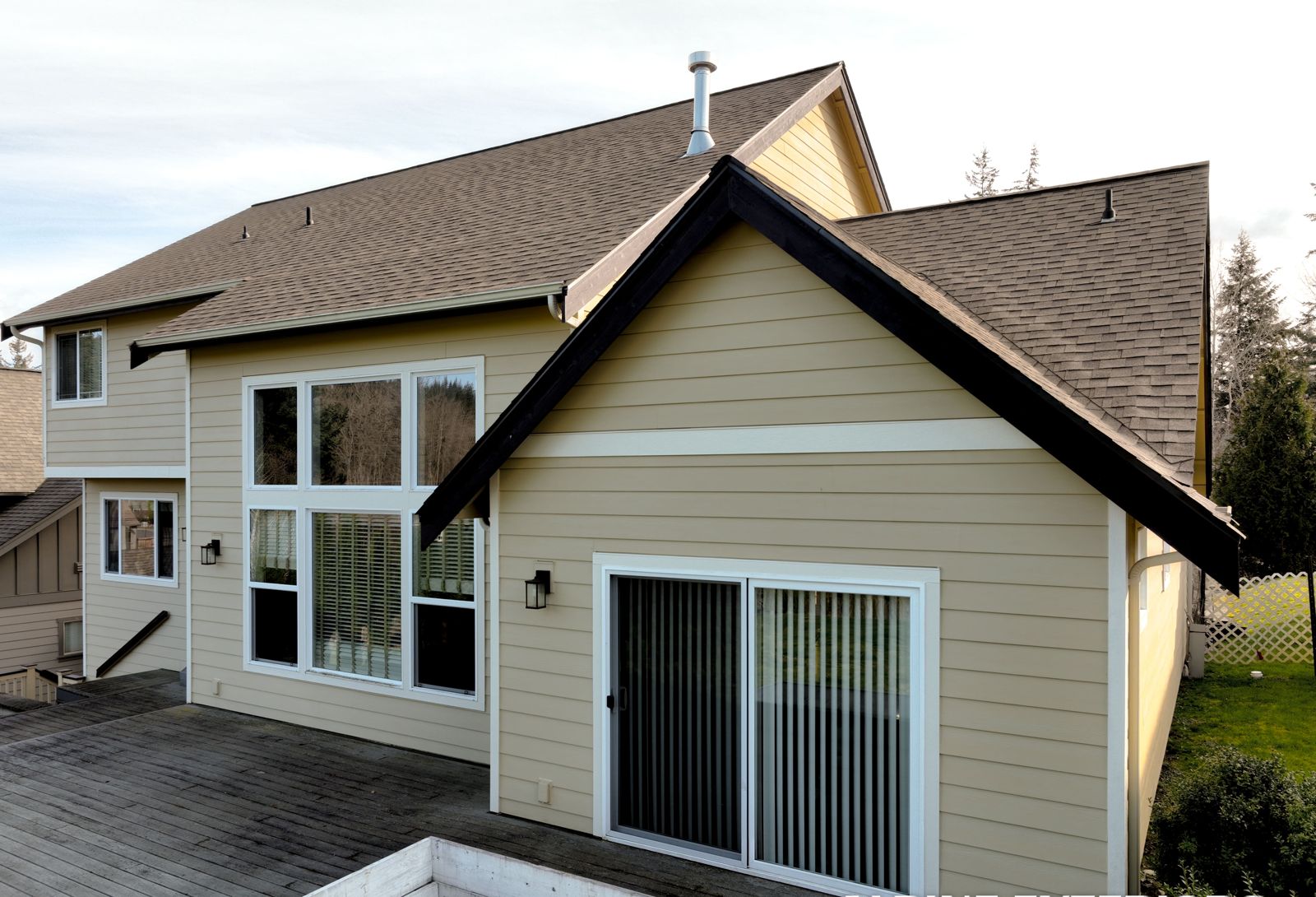
Geneva sits in the timbered foothills above Lake Whatcom, where tree cover, damp shade, and cool nights that dip below freezing in winter all work on a home's exterior at once. If your house backs up to trees, sits low on a lot where runoff collects, or has any history of soft trim or rot around windows, James Hardie fiber cement is usually the better long-term match — it shrugs off moisture and doesn't feed moss the way some vinyl profiles do in shaded spots. If you're siding a rental, an outbuilding, or a budget-driven remodel and the lot gets decent sun and airflow, quality vinyl siding is a reasonable, lower-cost option that will hold up fine with normal upkeep. Neither material is wrong for Whatcom County — the right pick depends on your specific lot, budget, and how long you plan to own the home.
James Hardie fiber cement is a blend of cement, sand, and cellulose fibers pressed into planks, panels, or shingle-style siding and then factory-finished. In a place like Geneva, where rain is more a fact of daily life than a seasonal event, the appeal of fiber cement is straightforward: it doesn't absorb water the way wood does, it won't warp or delaminate in a wet winter, and it's not a food source for the moss and algae that colonize shaded, tree-lined lots around Lake Whatcom. Hardie's ColorPlus factory finish also holds color well through the gray, low-light stretch of a Whatcom County winter, which matters when a home doesn't get direct sun for months at a time.
Fiber cement is heavier and more rigid than vinyl, so it resists denting from hail, wind-blown branches, and the occasional errant baseball in a way vinyl can't. It's also a Class A fire-rated material, which some homeowners on the wooded foothill lots around Geneva weigh alongside defensible-space landscaping. The tradeoffs are real: fiber cement costs more upfront, it's heavier to install (installers need to follow Hardie's fastening and clearance specifications, particularly ground clearance and flashing details, to keep it performing well in a wet climate), and while ColorPlus finishes are durable, standard primed fiber cement will eventually need repainting, and any field-cut edges should be sealed and painted at install to keep water out.
We follow James Hardie's published fastening, clearance, and flashing requirements rather than treating it as a generic lap product, because those details are what separate a fiber cement installation that performs for decades from one that traps moisture behind it. That includes maintaining proper clearance above grade, roof lines, and decks, and flashing every window, door, and horizontal transition so water is directed out and away from the wall rather than into it.
Vinyl siding is an extruded PVC panel, usually installed in horizontal lap courses over a water-resistive barrier. Its biggest draw is upfront cost — it's typically the least expensive siding option per square foot installed — and it never needs painting, since the color runs through the material. For a straightforward Geneva home on an open, well-drained lot with decent sun exposure, that low-maintenance profile is genuinely convenient.
Vinyl's weak points show up in exactly the conditions Geneva has plenty of. In shaded, damp spots under conifers, algae and moss can take hold on vinyl just as they can on other siding types, and vinyl's textured or wood-grain finishes give organic growth more surface to grip. Standard vinyl can also become brittle in a cold snap, and the foothills above Lake Whatcom see enough freeze-thaw cycling each winter that older or lower-grade vinyl can crack on impact when temperatures drop. Because vinyl panels aren't fully sealed at the seams and rely on overlap and proper installation to shed water, sloppy work — gaps at trim, insufficient overlap, panels hung too tight without room to expand and contract — can let wind-driven rain work its way behind the siding over time, which is a bigger risk during the sideways rain events that blow in off Bellingham Bay and the Strait than it would be in a drier climate.
Insulated vinyl, which bonds a foam backer to the panel, is worth a look if energy performance is a priority and budget still rules out fiber cement; it adds some rigidity and a modest R-value bump over hollow-back vinyl, though it costs more than standard vinyl and narrows the price gap with fiber cement somewhat. For a shop or accessory structure where appearance matters less, standard vinyl remains the most economical option, but for a primary residence we usually walk clients through insulated vinyl as the more sensible vinyl-tier choice in this climate.
| Factor | James Hardie Fiber Cement | Vinyl Siding |
|---|---|---|
| Installed cost | Higher upfront; typically a meaningful premium over vinyl per square foot due to material and labor | Lower upfront; generally the most budget-friendly common siding option |
| Lifespan | Long-lived when properly flashed and maintained; ColorPlus finishes are warrantied for decades | Long-lived under normal conditions, but standard-grade panels can become brittle and crack sooner in repeated freeze-thaw and impact |
| Maintenance | Low with ColorPlus finish; occasional washing to keep moss/algae from gaining a foothold in shaded areas; field cuts need sealing/painting | Very low routine maintenance; no painting, but cracked or faded panels usually need full replacement rather than spot repair |
| Appearance | Crisp, low-sheen factory finish; holds a more substantial, dimensional look that resembles painted wood lap or shingle siding | Wide color and profile range, but can look and sound thinner; color can fade unevenly over many years of UV and weather exposure |
Geneva's location matters more than a generic "Whatcom County" answer would suggest. Homes tucked into the tree line above Lake Whatcom deal with prolonged shade, needle and leaf litter that holds moisture against the wall, and the kind of persistent damp that gives moss a real head start compared to an open lot in Ferndale or Blaine. That combination is exactly where fiber cement earns its keep: it doesn't wick water into the substrate the way older wood siding did, and it's far less hospitable to sustained moss and algae growth than a textured vinyl panel sitting in the shade. For a home with any history of soft trim, rot at window sills, or siding that's stayed damp long after a storm has passed, we'd steer toward James Hardie almost every time.
That said, not every Geneva property fits that profile. A newer build on a cleared, sun-exposed lot, a detached shop, or a secondary structure where budget matters more than 30-year performance can do well with vinyl, provided it's installed correctly — proper overlap, correct nailing that allows for expansion, and careful flashing at windows, doors, and roof lines to keep wind-driven rain from finding a way behind the panels. Whatever material you choose, the Washington State Energy Code's continuous insulation and air-sealing requirements for the building envelope apply the same way regardless of cladding, so the house wrap, flashing, and insulation detailing behind the siding matter as much as the siding itself. Alpine Exteriors treats that assembly — not just the visible panel — as the actual weatherproofing system on every Geneva-area project.
Many of the older homes around Geneva and Sudden Valley were originally sided in cedar or hardboard decades ago, and by the time a homeowner calls about a full re-side, there's often already some hidden rot in the sheathing behind that original siding from years of trapped moisture. That's worth knowing before you pick a replacement material, because a tear-off is the point where a crew can actually inspect and repair the wall assembly rather than sealing a problem back up. Whichever siding you choose, we'd rather find and fix soft sheathing now than have it resurface in five years.
Cost is the other honest factor. If you're planning to stay in the home for decades, the higher installed cost of fiber cement is usually offset by fewer repaint cycles, less risk of moisture damage in a shaded, wet microclimate, and stronger resale appeal in a market where buyers increasingly ask about siding material. If you're renovating for near-term resale, doing a rental, or working with a tight budget, well-installed vinyl is a defensible choice that won't embarrass you, as long as expectations about lifespan and repair (versus spot patching) are set going in.
Fiber cement itself isn't organic, so it doesn't feed algae or moss the way older wood siding could, and its factory finish tends to shed grime more evenly than a textured vinyl profile. That said, no siding material is moss-proof in a shaded, damp spot near Lake Whatcom — both fiber cement and vinyl need occasional gentle washing in areas that stay wet under tree cover, and keeping branches trimmed back so the wall gets some airflow and light helps more than the siding choice alone.
It can, particularly older or lower-grade vinyl that's already lost some flexibility, or panels that took an impact from a fallen branch or a ladder. Higher-quality vinyl formulated for colder climates holds up better, but fiber cement's rigidity generally makes it more forgiving through repeated freeze-thaw cycling in the foothills above the lake.
Expect fiber cement to run meaningfully higher per square foot installed than vinyl once you account for material and the more labor-intensive installation process; exact numbers depend heavily on your home's size, trim detail, and how much of the existing siding and sheathing needs to come off. We'd rather walk your specific house and give you a real range than quote a number that doesn't reflect your project.
The Washington State Energy Code's requirements for continuous insulation and a properly sealed water-resistive barrier apply to the wall assembly behind the siding, not to the cladding material itself, so neither fiber cement nor vinyl is automatically "more compliant." What matters is that the house wrap, insulation, and flashing details are installed correctly under whichever siding you choose, which is why we treat that assembly as part of the job rather than an afterthought.
If you're weighing James Hardie fiber cement against vinyl for a home in Geneva, Sudden Valley, or anywhere else around Lake Whatcom and Bellingham, Alpine Exteriors can walk your property, look at how your lot handles shade and moisture, and give you an honest recommendation instead of a one-size-fits-all pitch. Alpine Exteriors is licensed in Washington under contractor license ALPINI751OW. Reach out to schedule a walk-through and get a written estimate for both siding options on your actual home.