
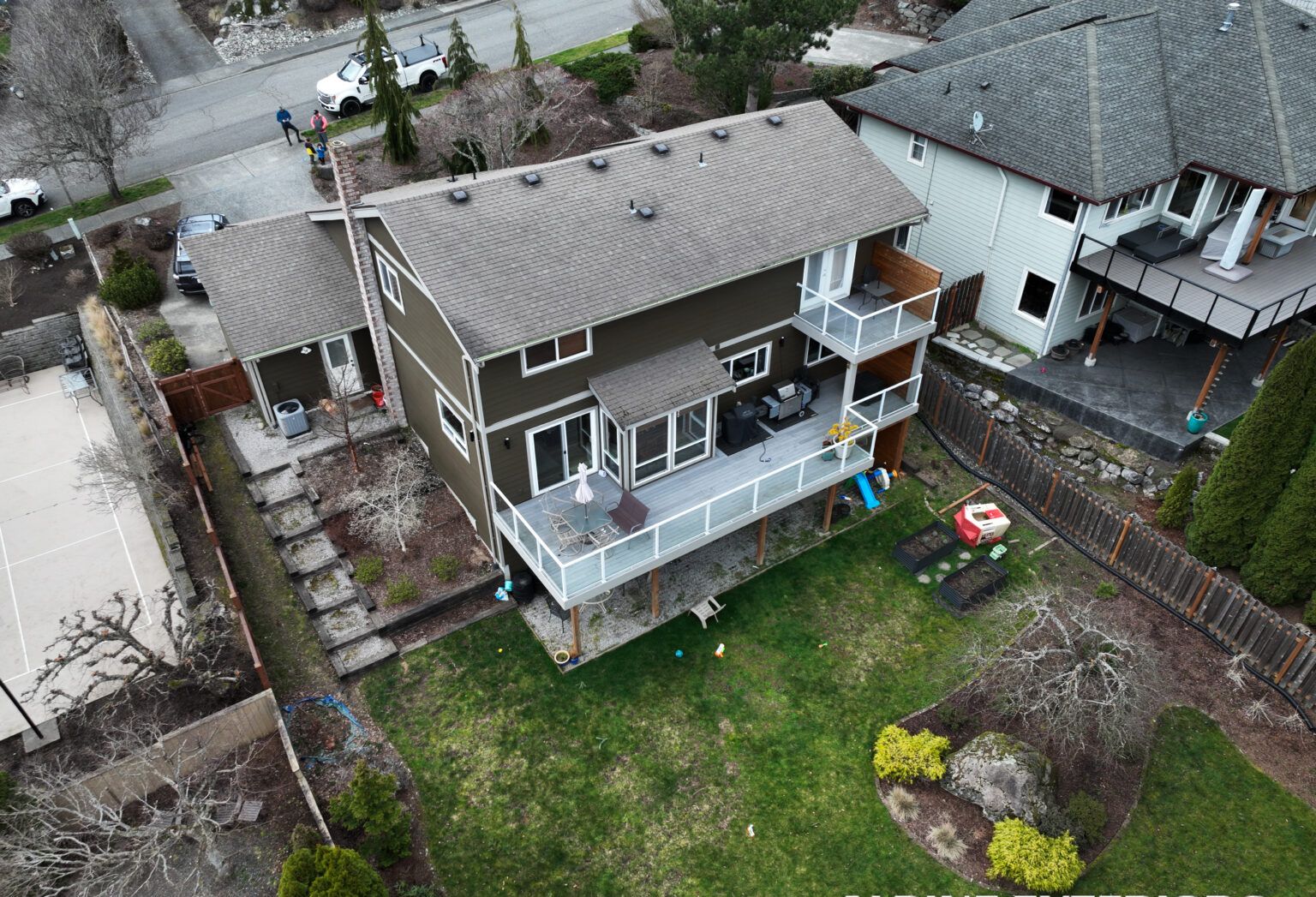
If you're re-siding a house in Lynden, you're choosing materials for a specific climate: wet winters, mossy shade under big evergreens, fog that settles into the Nooksack valley, and cold snaps that swing harder here than they do closer to the water in Bellingham. The two materials most homeowners in Whatcom County end up comparing are James Hardie fiber cement and vinyl siding. Both are legitimate choices. Neither is automatically "better" — the right pick depends on your budget, how long you plan to own the home, and how much upkeep you're willing to do. This page walks through both options honestly, compares them head-to-head, and tells you which one tends to make more sense for Lynden specifically.
If you're staying in the home long-term, want the closest thing to an "install it and mostly forget it" exterior, or your lot backs up to trees and holds shade and moisture the way a lot of Lynden and Sudden Valley properties do, James Hardie fiber cement is usually the stronger fit. It resists moisture-driven rot, holds paint far longer than wood, and stands up to the freeze-thaw swings that show up in the Nooksack valley and the foothills toward Mt. Baker better than most other claddings.
If you're working with a tighter renovation budget, siding a rental or investment property, or re-siding a home you plan to sell within the next several years, vinyl siding is a reasonable, lower-cost option — as long as it's installed correctly, with attention to the wind-driven rain this region gets off Bellingham Bay and the Strait of Georgia during winter storms. Vinyl isn't a bad material; it's a different trade-off, and it's worth understanding before you commit either way.
James Hardie fiber cement siding is made from cement, sand, and cellulose fibers, pressed and cured into planks, shingles, or panels. It's heavier and more rigid than vinyl, and it's engineered specifically to handle wet, temperate climates like ours. Whatcom County gets a lot of sustained rain rather than short heavy downpours, and homes near Birch Bay, Blaine, and the islands take direct wind-driven rain off the water. Fiber cement doesn't absorb moisture the way wood does, and it doesn't warp, cup, or delaminate the way lower-grade composite products can when they stay damp for weeks at a time.
The other advantage specific to this region is how fiber cement handles moss and algae. Shaded lots — the kind you see all over Sudden Valley, along the tree lines outside Lynden, and in the older neighborhoods of Bellingham — stay damp longer after a rain, and that dampness is what feeds moss and green algae staining on siding. Fiber cement's factory-applied finish (James Hardie's ColorPlus technology, where available) resists that staining better than raw wood and holds up to occasional gentle washing without the surface breaking down.
Fiber cement is also non-combustible, which some Whatcom County homeowners value even though wildfire risk here is lower than in Eastern Washington — it's simply a durable, stable material by nature. The real drawbacks are cost and installation. Fiber cement is heavier, requires specific fasteners and blade types, and needs a crew that's actually trained on it — cut it wrong, seal the butt joints wrong, or skip the rainscreen gap, and you lose a lot of the moisture performance you paid for. It also costs meaningfully more than vinyl, both in materials and labor, and while it holds paint for a long time, it does eventually need repainting — it is not a zero-maintenance product, just a low-maintenance one.
Vinyl siding is PVC-based, lightweight, comes pre-colored (no painting needed at install), and is widely available in a range of profiles and colors. Its biggest advantage is upfront cost — both material and labor tend to run noticeably lower than fiber cement, which matters if you're renovating on a budget or siding a property where you're not planning to recoup a premium finish in resale.
Vinyl performs fine in Whatcom County as long as it's installed with the right clearances and fastening technique. Because it expands and contracts with temperature more than fiber cement does, it needs to be hung correctly — nailed loosely enough to move, not "shrink-wrapped" tight — or it can buckle when temperatures swing. That matters more here than people expect: Lynden and the areas closer to the foothills see colder overnight lows and more freeze-thaw cycling in winter than Bellingham proper, which sits closer to the moderating influence of the bay. Cheap or improperly installed vinyl can become brittle and crack in a hard cold snap, particularly on the north or east-facing walls that don't get afternoon sun.
Vinyl also doesn't stand up as well to direct wind-driven rain as fiber cement does when the underlying water-resistive barrier and flashing details aren't done well — the panels themselves shed water fine, but vinyl relies more heavily on what's behind it, since seams and panel laps aren't fully sealed the way a properly caulked fiber cement joint is. On shaded, moss-prone lots, vinyl can also develop green algae staining, and while it can be power-washed, repeated aggressive washing over the years can dull the factory finish. It won't rot, which is a real advantage over wood, but it also doesn't offer the same rigidity or fire resistance as fiber cement, and lower grades of vinyl can look visibly "plastic" up close compared to fiber cement's wood-grain texture and crisper shadow lines.
| Factor | James Hardie Fiber Cement | Vinyl Siding |
|---|---|---|
| Installed cost | Roughly $9–$16 per square foot installed, depending on profile and trim detail | Roughly $4–$9 per square foot installed, depending on thickness and profile |
| Typical lifespan | 30–50 years with normal upkeep | 20–40 years, shorter if exposed to repeated freeze-thaw stress or poor installation |
| Maintenance | Occasional gentle washing; repainting every 10–15 years depending on exposure and finish | Occasional washing; no painting needed, but panels can fade or become brittle over time |
| Appearance | Crisper shadow lines, realistic wood-grain and lap textures, wide color range including factory-baked finishes | Wide color and profile selection, but lower grades can look flat or plastic up close |
| Moisture/rot resistance | Excellent — engineered for wet climates, does not rot | Good — won't rot, but performance depends heavily on correct installation and underlying flashing |
| Cold-weather performance | Stable across temperature swings, holds up well through freeze-thaw | Can become brittle and crack in hard cold snaps if not installed with proper expansion clearance |
Lynden sits further from the moderating water of Bellingham Bay than most of the rest of Whatcom County, which means it tends to run a few degrees colder on winter nights and sees more frost and freeze-thaw cycling, especially as you move toward the foothills near Mt. Baker. That cold-weather stability tips the scale toward James Hardie fiber cement for most Lynden homes, particularly ones with any east- or north-facing exposure that stays shaded and cold longer through the day. Fiber cement also plays well with the Washington State Energy Code's building envelope requirements — when installed with a rainscreen gap and continuous insulation behind it, it supports the kind of wall assembly performance the code is pushing homes toward, and it gives you a durable, long-lasting layer over that insulation rather than one that's more sensitive to temperature swings.
That said, fiber cement isn't automatically the right call for every situation in Lynden. If you're re-siding a rental property, a small outbuilding, or a home you're prepping for a quick resale rather than long-term ownership, vinyl siding — installed correctly, by a crew that understands the local wind-driven rain and cold-snap conditions — is a legitimate, lower-cost way to get a clean, weathertight exterior without overspending on a feature the next owner may not value the same way you do. The honest answer is that the "wrong" choice in either direction is usually a wrong installation, not a wrong material. A well-installed vinyl job will outperform a poorly installed fiber cement job, and vice versa.
Alpine Exteriors works on both types of siding projects across Whatcom County, from Bellingham and Ferndale out to Lynden, Blaine, Birch Bay, Sudden Valley, and the islands, and the conversation we have with most Lynden homeowners comes down to how long they're planning to stay in the house and how much of the upkeep they want to take on themselves. We'll walk your specific lot, exposure, and wall assembly with you before recommending one over the other — a heavily shaded, tree-lined property gets a different recommendation than an open lot with full sun exposure, even within the same neighborhood.
No. Wood siding in Whatcom County's wet climate often needs repainting every 3–7 years because the wood itself absorbs and releases moisture, which breaks down paint adhesion faster. James Hardie fiber cement, especially with a factory-applied ColorPlus finish, typically goes 10–15 years before it needs repainting, because the material itself isn't absorbing water the way raw wood does. It still needs painting eventually — it's not a never-paint product — but the interval is meaningfully longer.
Yes, though it's less common with quality vinyl installed correctly. Vinyl expands and contracts with temperature, and it needs to be fastened with room to move rather than nailed tight. In a hard cold snap — which Lynden and the foothill areas see more of than the immediate Bellingham waterfront — vinyl that was installed too tight or that's a thinner, lower grade product can become brittle and crack, especially on shaded, north-facing walls. Thicker vinyl profiles installed with proper clearance hold up much better through these swings.
Both can develop surface moss and green algae staining on shaded, damp walls, which is common on wooded lots around Sudden Valley and the tree-lined properties outside Lynden. Fiber cement's factory finish resists staining somewhat better and tolerates gentle washing over the years without the surface breaking down. Vinyl can also be washed clean, but repeated aggressive cleaning can dull its factory color over time. Trimming back overhanging branches and improving airflow around the walls helps with either material.
It depends on your time horizon. If you're planning to hold the property for decades or live in it long-term, fiber cement's longer lifespan and lower repainting frequency often make it the better value over time, even with the higher upfront cost. If you're siding a rental you might sell or refinance in the next several years, or a starter home where you're trying to keep renovation costs down, a correctly installed vinyl product is a reasonable, lower-cost choice that still holds up well in this climate.
Every lot in Whatcom County is a little different — sun exposure, tree cover, distance from the water, and which direction your walls face all change which siding makes more sense. Alpine Exteriors (WA contractor license ALPINI751OW) has looked at this trade-off on homes across Lynden, Ferndale, Blaine, Birch Bay, and Sudden Valley, and we're glad to walk your property with you, look at your current siding condition, and give you a straightforward recommendation — not a sales pitch for whichever material happens to have the best margin. Reach out to Alpine Exteriors to schedule a walkthrough and get a written estimate for both options before you decide.