
Point Roberts is a small peninsula cut off from the rest of Whatcom County by the Canadian border, with water on three sides - the Strait of Georgia to the west and north, Boundary Bay to the east. That layout exposes homes here to wind-driven rain from more directions than most of Whatcom County ever sees, plus salt-laden air and long stretches of damp weather that can keep siding wet for days at a stretch. In that setting, James Hardie fiber cement generally holds up better over the long haul, particularly on the west- and north-facing walls that catch the worst of the weather rolling in off the water. Vinyl siding still has an honest place in the conversation - it costs less to install and performs reasonably well on more sheltered elevations, additions, or outbuildings - but homeowners who want a single siding job to carry them through decades of Point Roberts weather usually land on fiber cement. Which one is right for a given house depends on budget, how exposed the specific walls are, and how long the current owner plans to stay.
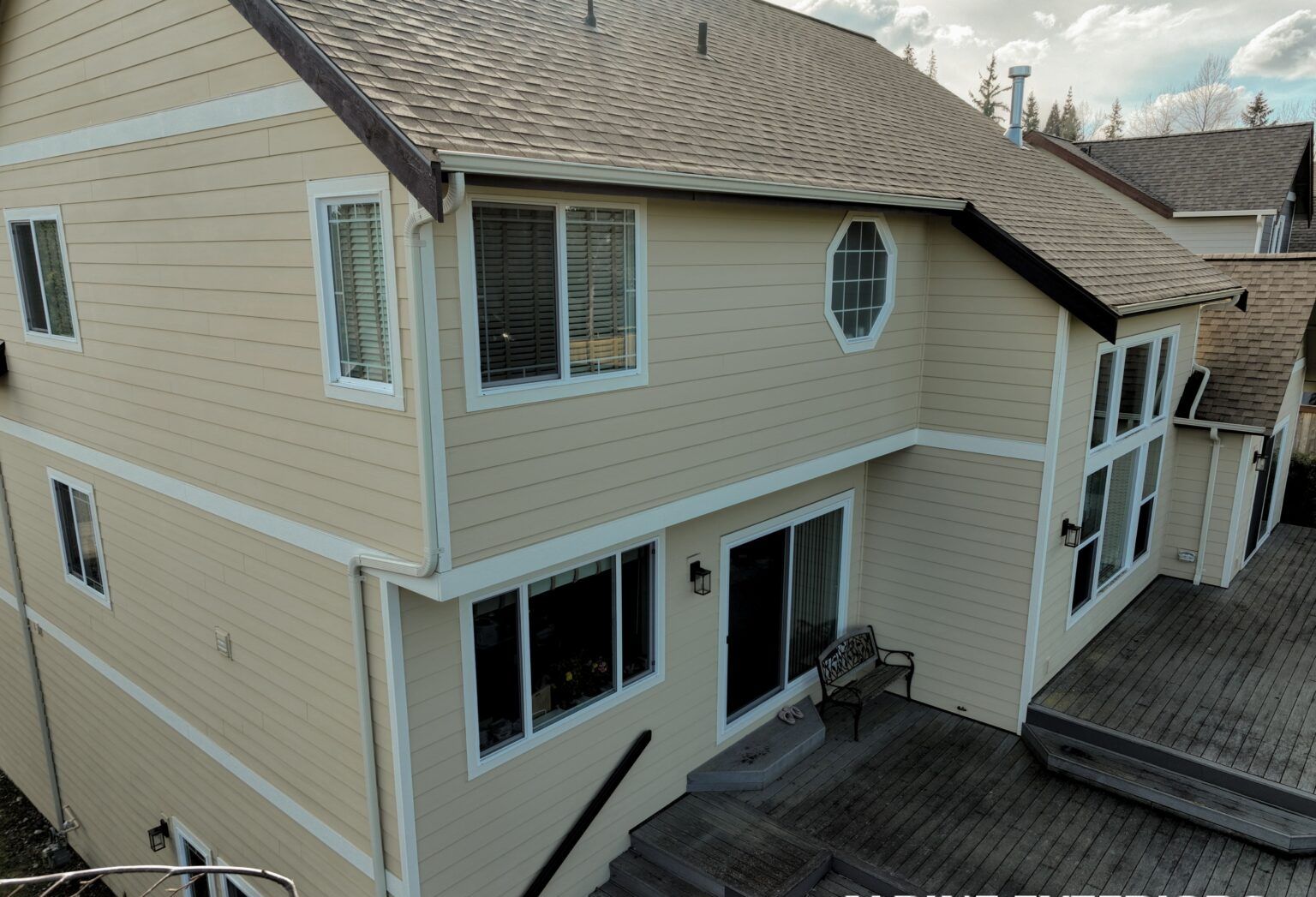
James Hardie siding is made from a blend of cement, sand, and cellulose fibers, formed into planks or panels and cured. It doesn't rot, it isn't a food source for carpenter ants or moisture-loving insects, and it holds paint far longer than wood because the board itself doesn't swell and shrink much with changes in moisture or temperature. For a place like Point Roberts, where salt air and near-constant dampness are part of daily life, that resistance to moisture intrusion is the main reason it gets specified so often.
Fiber cement is heavier and more rigid than vinyl, so it resists denting from wind-blown debris and stays flat against the wall rather than rippling in direct sun the way some vinyl can over time. It also carries a Class A fire rating, which isn't a major factor for this particular coastal microclimate but is still worth noting for insurance purposes.
The tradeoffs are real. Fiber cement costs more to install, both in materials and labor, because the boards are heavier, need to be cut with the right tools - a dust-controlled saw or shears rather than a standard circular saw - and have to be caulked and field-painted, or ordered pre-finished with Hardie's factory ColorPlus coating. It's also a job where crew experience matters more than with vinyl: improperly flashed fiber cement can still let water get behind the panels, and once that happens, the framing behind it faces the same rot risk as any other siding failure. The material itself is excellent; the installation is where quality varies most from one job to the next.
Vinyl siding is extruded PVC, typically installed as horizontal panels that interlock and hang on the wall rather than being fastened rigidly to it, which lets the panels expand and contract with temperature swings. It's lighter, faster to install, and costs meaningfully less than fiber cement in both materials and labor - which is a big part of why it remains one of the most common siding choices on new construction and re-sides across Whatcom County.
Modern vinyl, especially thicker-gauge or insulated vinyl, performs reasonably well against wind and rain when it's installed with the correct nailing pattern and expansion clearance, and it never needs painting since the color runs through the material rather than sitting on top of it. For homeowners on a tighter budget, or for outbuildings, rental units, and additions where long-term curb appeal is a lower priority than cost, vinyl is a fair, honest choice - not a corner-cut, just a different set of tradeoffs.
Where vinyl struggles in this specific location is the combination of sustained wind and cooler, damp conditions. Point Roberts catches wind off the Strait more consistently than more sheltered parts of Bellingham or Lynden, and vinyl panels that aren't hung with proper clearance can rattle, buckle, or in a hard gust, pull loose entirely - something local crews see here more often than farther inland. Vinyl also gets more brittle in cold weather, and while Whatcom County rarely sees extreme cold at sea level, the occasional freeze events that move through the foothills, plus the general damp chill near the water, can make older or thinner-gauge vinyl crack on impact from a dropped ladder, a wind-thrown branch, or even a stray baseball. It also tends to fade and chalk over the years, especially on south- and west-facing walls that get the most sun, and once it fades there's no repainting it back to match - the affected run typically has to be replaced.
| Factor | James Hardie Fiber Cement | Vinyl Siding |
|---|---|---|
| Upfront cost | Higher material and labor cost; specialized tools and more install time | Lower material and labor cost; faster install |
| Typical lifespan | Often several decades with proper installation and maintenance | Commonly two to four decades, shorter on exposed, wind-heavy elevations |
| Maintenance | Needs periodic repainting or recoating (longer intervals with factory ColorPlus finish) and occasional caulk checks | No painting needed, but panels can warp, crack, or blow loose and need spot repair or full-run replacement to match color |
| Moisture/rot resistance | Excellent - won't rot or feed insects; performance still depends on correct flashing and a drainage gap behind it | Won't rot itself, but traps moisture against sheathing if installed too tight or without a drainage plane |
| Wind performance | Rigid and heavy; resists flexing and denting in gusty conditions | Can rattle, oil-can, or detach in sustained wind if not installed with correct clearance and fastening |
| Appearance over time | Holds color and a flatter profile longer; repaintable if it does fade | Can fade, chalk, or ripple in strong sun; cannot be repainted to restore original color |
For a full house re-side on Point Roberts, especially anything within direct view of the water or on a lot without much windbreak, fiber cement is usually the more sensible long-term investment. The wind-driven rain coming off the Strait tends to hit siding at an angle rather than straight on, which pushes water into seams and laps that stay dry on more sheltered homes. Fiber cement's rigidity and factory-applied finish give it an edge in exactly that kind of exposure, and it holds up better against the salt air that settles on everything near the water.
Moss and algae growth is another factor worth planning around, particularly on north-facing walls or anywhere shaded by trees or a neighboring structure, which is common on the more wooded lots around Point Roberts. Both materials can grow moss in those spots, but a painted or factory-coated surface tends to shed a power wash more cleanly than vinyl's textured, grooved profile, which can trap organic growth in the laps over time.
Cost is the honest counterweight. If the budget doesn't stretch to fiber cement for the whole house, a reasonable middle path is to use it on the most exposed elevations - typically west and north - and vinyl on the more sheltered south and east walls or on a detached garage or shop building. That split isn't unusual, and it lets a homeowner put the stronger material where the weather actually hits hardest.
Any re-side that touches a meaningful percentage of the exterior wall area is also worth checking against the Washington State Energy Code, which can trigger requirements for continuous exterior insulation or an upgraded water-resistive barrier depending on the scope of the project. Fiber cement pairs well with rigid foam insulation and a rainscreen gap behind it, and getting that assembly right matters as much as the siding material itself - a good product installed without a proper drainage plane behind it will still trap moisture against the sheathing over a Point Roberts winter. Alpine Exteriors builds that drainage gap and flashing detail into every re-side we do here, whether the finish material ends up being fiber cement or vinyl, because the wall assembly behind the siding is what actually keeps water out, and we've applied it on homes from Bellingham and Ferndale out to Blaine, Birch Bay, and Point Roberts.
With correct installation - proper flashing, a drainage gap, and fasteners driven to spec - fiber cement siding commonly lasts several decades in this climate. The finish coat, whether field-painted or factory-applied, will need attention on a longer cycle than vinyl needs cleaning, but the board itself doesn't rot or degrade the way wood does under constant damp exposure.
Decent-quality vinyl installed with the correct nailing pattern and expansion clearance can handle typical Point Roberts wind, but it's less forgiving of installation shortcuts than fiber cement. On the most exposed lots - open to the water with no windbreak - we more often recommend fiber cement or at least a heavier-gauge insulated vinyl product, since standard vinyl on those walls is where we see the most callbacks for rattling or loosened panels.
It depends on the scope of the project. A re-side that involves removing siding down to the sheathing over a significant portion of the exterior can trigger energy code requirements around continuous insulation or the water-resistive barrier, while a smaller repair or partial re-side may not. It's worth having this checked against the current code before the project is bid, since it can change both the assembly detail and the cost.
Yes, and it's a reasonably common approach for stretching a budget - fiber cement on the walls that face the water or prevailing wind, vinyl on more sheltered elevations or secondary structures. The main thing to get right is the transition detail where the two materials meet, so water is still shed properly at that seam.
If you're weighing James Hardie against vinyl for a home in Point Roberts, Blaine, Birch Bay, or anywhere else in Whatcom County, Alpine Exteriors can walk the property, look at how each elevation is actually exposed to wind and rain, and lay out real cost and lifespan differences for your specific house rather than a generic recommendation. We hold Washington contractor license ALPINI751OW - reach out to schedule a walkthrough and get a straight answer on which siding makes sense for your home.