
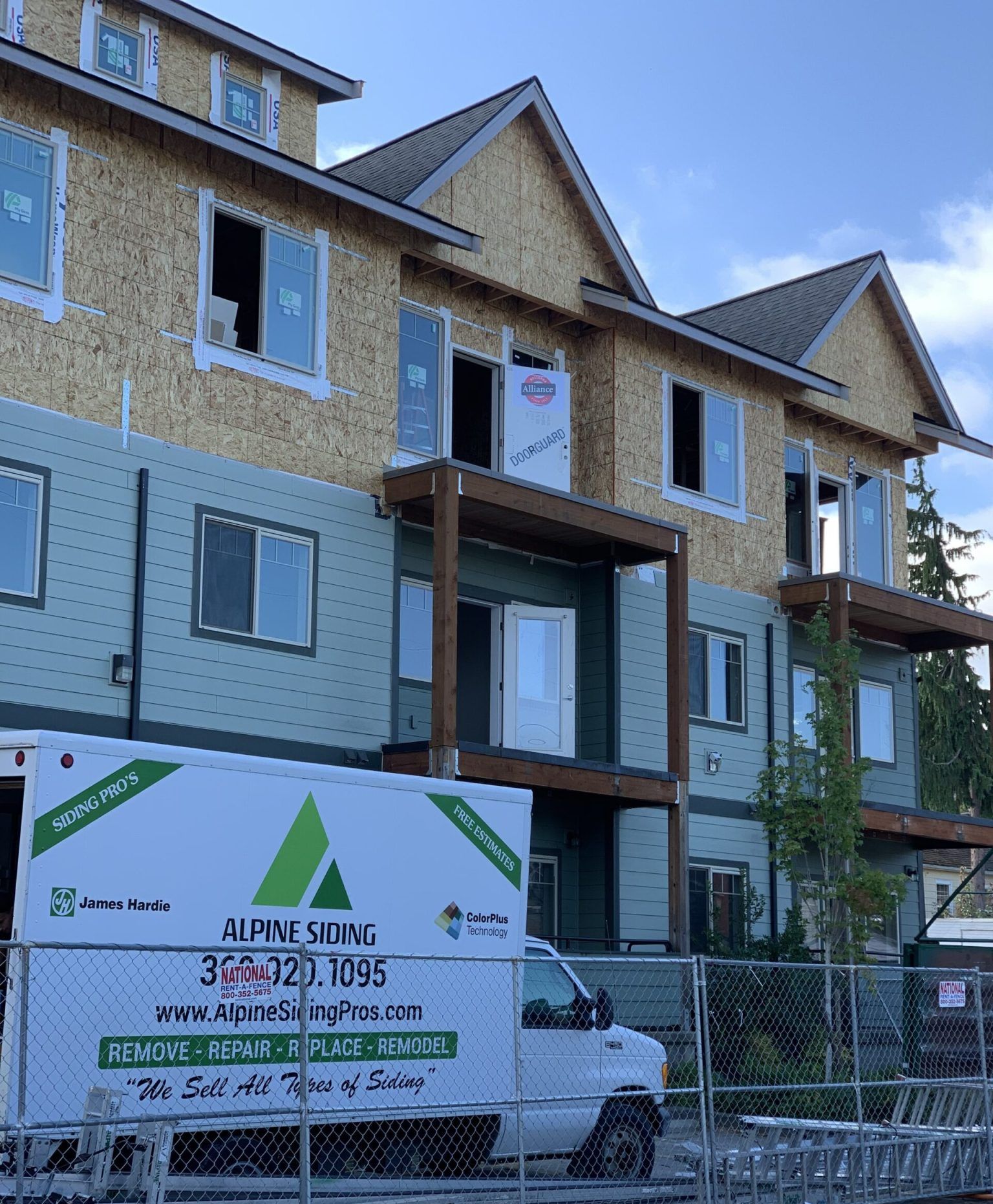
Semiahmoo sits on a narrow spit between Semiahmoo Bay and Drayton Harbor, a few minutes from the Peace Arch border crossing, and the siding on a home here does a different job than siding a few miles inland in Lynden or Sudden Valley. Wind off the Strait of Georgia drives rain sideways against west- and north-facing walls, salt-laden air works on fasteners and trim, and mature fir and cedar canopy along the bluffs keeps whole sides of some houses shaded and damp for weeks at a stretch. Choosing between James Hardie fiber cement and vinyl siding here is less about which product is "better" in the abstract and more about which one matches your exposure, your budget, and how long you plan to own the house. Alpine Exteriors has installed both across Whatcom County, and this page lays out the honest tradeoffs rather than pushing one product.
If your home sits close to the water, on a bluff with direct exposure to wind-driven rain, or under heavy tree shade where moisture lingers, James Hardie fiber cement is generally the more durable long-term choice — it doesn't rot, it holds up better against wind-blown debris, and it tolerates the freeze-thaw swings that come with occasional Fraser Valley outflow winds. If your home is more sheltered — inland, protected by other structures or a windbreak of trees, or you're working with a tighter renovation budget — vinyl siding can be a reasonable option, provided it's installed with proper clearances and a quality water-resistive barrier underneath. Neither choice is wrong; they just carry different maintenance obligations and different upfront costs, and your specific lot on the Semiahmoo peninsula matters more than any general rule.
James Hardie's fiber cement products — HardiePlank lap siding, HardieShingle for accent areas, and HardiePanel for modern vertical looks — are made from cement, sand, and cellulose fiber pressed into boards that are then cured. The material doesn't absorb water the way wood does, so it doesn't swell, rot, or feed fungal growth the way older cedar lap siding can once a butt joint fails and water gets behind it. For a Semiahmoo home taking direct wind-driven rain off the bay, that resistance to moisture intrusion at the board level is the main draw. It's also heavy and rigid, which means it holds up better against branches and debris carried by wind gusts than a lighter panel product does, and it doesn't dent or crack the way vinyl can when struck.
The tradeoffs are real. Fiber cement is significantly heavier than vinyl, so installation is more labor-intensive — it requires specific fastening schedules, fiber-cement-rated blades, and careful edge sealing, and a poor installation can undermine all of the material's durability advantages. Field-cut edges need to be primed before installation or they'll wick moisture. If you choose a factory-primed board rather than Hardie's ColorPlus prefinished option, you'll need to paint it, and on a house exposed to constant salt spray and rain, that paint job will need attention on a cycle similar to any other painted exterior — typically every ten to fifteen years depending on exposure and paint quality. Upfront material and labor costs run higher than vinyl. None of that makes it a bad choice for this area; it just means the durability comes with a real installation-quality dependency and a higher initial investment.
Vinyl siding is extruded PVC formed into panels — common profiles include double 4 or double 5 lap styles, Dutch lap for a shadow-line look, and insulated versions with a foam backing laminated to the panel. Its main advantages are cost and low maintenance: it doesn't need painting, ever, and a periodic rinse with a garden hose or soft wash handles most surface grime. It's lighter and faster to install than fiber cement, which keeps labor costs down, and modern vinyl formulations hold color reasonably well on north-facing walls that don't get intense sun exposure.
The drawbacks matter more in a place like Semiahmoo than they would somewhere calmer. Vinyl becomes more brittle in cold snaps, and while Whatcom County's coastal winters are mild most of the time, this area does get periodic Fraser Valley outflow events — cold, dry wind funneling down from British Columbia through the Fraser Valley gap — that can drop temperatures quickly and bring sustained wind. Vinyl that's already a decade or more old can crack under wind-driven impact from branches or debris during those events in a way fiber cement typically won't. Vinyl also needs to be installed with room to expand and contract with temperature swings; installers who nail it too tight for a tighter, more finished look can cause buckling later. In shaded, damp spots — common under Whatcom County's fir and cedar canopy — algae and moss can grow on vinyl's surface just as they can on any siding, though vinyl doesn't feed rot the way exposed wood trim can. Seams and overlaps are also more numerous than on fiber cement lap boards, so wind-driven rain intrusion is more dependent on correct installation technique, particularly around window and door flashing.
| Factor | James Hardie Fiber Cement | Vinyl Siding |
|---|---|---|
| Installed cost | Roughly $9–$14 per square foot installed, depending on profile and finish | Roughly $4–$9 per square foot installed, depending on panel thickness and insulation backing |
| Typical lifespan | 30–50+ years, especially with factory ColorPlus finish | 20–30 years, shorter on south- and west-facing walls with heavy UV exposure |
| Maintenance | Occasional washing; repainting every 10–15 years unless prefinished; caulk joints checked periodically | Occasional washing; no repainting; cracked or warped panels need individual replacement |
| Appearance | Deep wood-grain textures, holds bold and dark colors well, crisp shadow lines | Lighter wood-grain texture, wide color range but darker colors can absorb heat and warp, visible panel seams |
Semiahmoo's geography puts a lot of homes in genuinely tough exposure: waterfront and near-waterfront properties along the spit take direct wind off the Strait of Georgia and Semiahmoo Bay, with rain driven horizontally against walls during winter storms rather than falling straight down. That kind of wind-driven rain finds every weak seam, and it's exactly the scenario where fiber cement's rigidity and resistance to moisture absorption earns its higher price. Homes set back from the water under mature tree cover face a different problem — persistent shade keeps siding damp longer after every rain, which is ideal conditions for moss and algae. Fiber cement doesn't feed that growth the way old wood siding does, but it still needs an occasional wash; vinyl handles the washing part just as easily and is worth considering if that shaded wall isn't also taking direct wind exposure.
The occasional Fraser Valley outflow wind event is worth planning around specifically because Semiahmoo and the rest of northern Whatcom County are closer to the outflow gap than Bellingham or points south. These events bring a sharp temperature drop along with sustained wind, and that combination of cold plus wind-driven debris is where vinyl's brittleness becomes a real maintenance issue over a siding's lifetime, while fiber cement generally shrugs it off. That said, a well-sheltered home — protected by other structures, terrain, or a windbreak — doesn't face the same risk, and vinyl remains a perfectly serviceable, lower-cost option in those spots.
Whichever material you choose, the wall assembly behind it matters as much as the siding itself. The Washington State Energy Code sets minimum requirements for wall insulation and continuous air and water control layers, and both fiber cement and vinyl are installed over a code-required water-resistive barrier — the siding is the outer skin, not the only line of defense against moisture. Fiber cement pairs a little more naturally with continuous rigid insulation approaches some builders use to meet code, since it can be furred out cleanly, but vinyl can meet the same code requirements when the wall assembly behind it is built correctly. Alpine Exteriors builds the water-resistive barrier and flashing details to code regardless of which siding material a Semiahmoo homeowner chooses, because that underlying assembly is what actually keeps wind-driven rain out of the wall cavity.
It can, particularly on older panels or during a Fraser Valley outflow event that combines a fast temperature drop with sustained wind and blown debris. Vinyl becomes more brittle as it ages and as temperatures fall, so an impact that a newer panel would flex through can crack a panel that's ten or fifteen years old. This isn't a constant problem — Whatcom County's coastal winters are mild most of the time — but it's a real consideration for homes that see repeated outflow wind events over the years.
Fiber cement doesn't feed fungal or algae growth the way exposed wood does, but it isn't immune to surface growth in a shaded, damp spot — moss and algae can grow on the surface of any siding material if that wall stays wet for extended periods. The advantage of fiber cement is that even if growth appears, it's a cosmetic issue solved with a wash, not a sign that moisture is getting into the board and starting to break it down the way it would with untreated wood.
For homes with direct wind and rain exposure off the water, most owners find the added upfront cost justified by a longer service life and less vulnerability to wind-driven rain intrusion and impact damage. For a more sheltered lot, the calculation is closer, and a lower-cost vinyl installation with attentive flashing detail can perform well for two or three decades. It comes down to your specific exposure and how long you plan to stay in the home.
Yes, this is a common approach — some homeowners use fiber cement on the most exposed elevation (often the west or north wall facing the water) and vinyl on more sheltered sides to balance cost against durability where it matters most. It takes careful detailing where the two materials meet so water is directed out rather than trapped behind a transition, which is a detail worth discussing with whoever is doing the installation.
Every lot on the Semiahmoo peninsula faces a slightly different mix of wind, shade, and moisture exposure, and the right siding choice follows from that exposure rather than from a general preference. Alpine Exteriors, WA contractor license ALPINI751OW, can walk your specific property, point out where wind-driven rain and shade are likely to cause the most wear, and give you a straightforward comparison of fiber cement and vinyl costs for that house. Reach out to Alpine Exteriors for a walkthrough before you commit to a material — a short conversation about your home's exposure is worth more than any general recommendation.