
Glacier sits differently than the rest of our Whatcom County service area. It's a small mountain community strung along the Mount Baker Highway, tucked under a heavy canopy of Douglas fir, hemlock and cedar, with more elevation and a longer stretch of true winter than Bellingham, Ferndale or the coastal edges of Blaine and Birch Bay. That combination of shade, moisture and elevation changes which siding colors actually hold up here, not just which ones look good in a showroom sample. This guide walks through the colors we see perform well on Glacier homes, the ones that struggle, and why, based on what we watch happen to siding after a few Whatcom County winters.
For most homes in and around Glacier, mid-tone to dark, muted colors outperform bright or pale ones. Deep charcoal, forest and moss greens, warm greiges, and weathered wood tones tend to look intentional for years, while bright whites and pastel tones often look tired within a couple of seasons. The reason isn't fashion, it's physics: Glacier's tree cover keeps many walls in near-constant shade and dampness, which is exactly the environment where algae and moss take hold fastest. Darker, more saturated colors visually mask the gray-green streaking that develops on north- and east-facing walls long before a homeowner would notice it on a lighter finish. That doesn't mean light colors are off the table entirely, but they need a clearer case made for them, which we cover below.
We didn't rank these colors on trend appeal. The criteria below reflect what actually determines whether a color still looks good on a Glacier home five or ten years after installation.
Charcoal has become a common choice on newer builds and remodels throughout Whatcom County, and it earns that popularity in a forested setting like Glacier. Against a backdrop of dark evergreens and basalt-gray skies, charcoal reads as deliberate rather than harsh, and it does an excellent job of masking the gray-green streaking that develops on shaded walls. The tradeoff is heat and material behavior. On vinyl siding, very dark colors absorb more solar heat than lighter ones, and while our cloud cover limits how hot panels get compared to sunnier climates, a south- or west-facing wall that does get direct exposure can still see more expansion and contraction over the years than a lighter panel would. Fiber cement and engineered wood siding don't have that same warping risk, which is one reason we steer homeowners who want a true near-black toward those materials rather than vinyl.
A muted forest green is one of the more honest color choices for Glacier specifically, because it doesn't fight the setting, it matches it. Homes tucked into the tree line with this color on the siding tend to blend rather than stand out, which some owners want and others don't. Practically, mid-tone greens hide biofilm about as well as charcoal does, since the hue is already close to what algae growth looks like on a painted surface. The downside is that a poorly chosen green pigment can look flat or slightly artificial next to the real color of the surrounding cedar and fir, so we'd rather see a sample held up against the actual lot before committing, not just viewed on a screen or a small swatch.
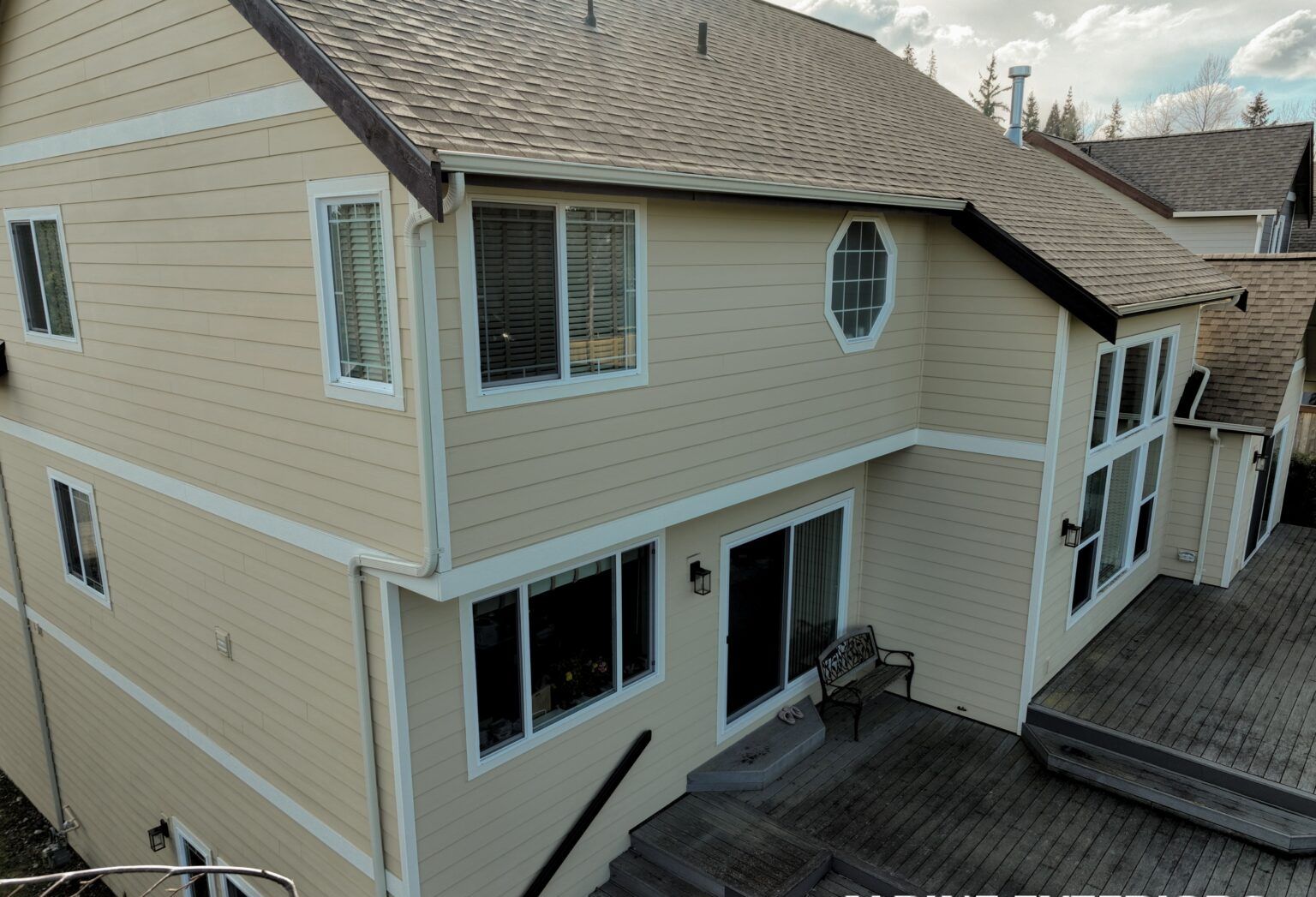
Greige, the blend of gray and beige, has stayed popular because it works with almost any trim and roof color, and it photographs well for resale listings. It performs reasonably in Glacier's conditions, hiding light dust and pollen streaking better than a pure white, though it shows algae staining more readily than charcoal or forest green because the base tone is lighter. It's a solid middle-ground pick for owners who want something neutral and broadly marketable rather than a color that leans hard into the mountain setting.
Wood-look fiber cement and engineered wood siding, finished in warm brown or weathered cedar tones, fit Glacier's setting naturally and are common on cabins and homes throughout the Mount Baker corridor. The honest drawback here is less about the color and more about what it's covering: true solid wood siding, regardless of finish color, is the material most exposed to rot risk in a shaded, damp environment like Glacier's, because it holds moisture longer than fiber cement or vinyl and gets less drying time between rain events under a tree canopy. If the wood-tone look matters to a homeowner, we typically recommend achieving it through a fiber cement or engineered wood product with a factory wood-grain finish rather than solid wood boards, so the aesthetic doesn't come with the maintenance burden.
A cooler, slightly blue-leaning gray works well on homes with stone or basalt accents, which show up often in this part of Whatcom County. It reads as calm and coordinated against overcast skies, and it hides moderate algae streaking reasonably well, though not quite as effectively as charcoal or forest green because the lighter value still contrasts with dark biofilm spots. Where it struggles is on homes without much other color variation; on a plain box-shaped structure it can look a little cold without warmer trim or a wood-tone door and accents to balance it.
Light colors aren't wrong for Glacier, but they demand more from the homeowner. A warm cream or off-white can look genuinely striking against dark trees, especially on homes with good sun exposure and less overhanging canopy. The honest tradeoff is maintenance frequency: on a shaded, north-facing wall, a light color will show the first traces of moss and algae staining well before a darker color would, sometimes within a single wet season. If a homeowner picks a light color for a heavily shaded lot, we tell them upfront to expect more frequent washing, and ideally a finish product with built-in mildew resistance, to keep it looking the way it did on installation day.
Traditional and less common on new builds, but it has a real place in a rural, forested community like Glacier where older farmhouses and outbuildings set a visual precedent. It hides dirt and moderate staining well, similar to charcoal, and tends to age gracefully rather than looking dated the way some trend colors do after a decade. It's a strong color, though, and not one every buyer wants to see at resale, so we mention that tradeoff plainly to owners who are choosing partly with future sale value in mind.
A few choices consistently cause regret on homes in Glacier's specific conditions, separate from the general color guidance above.
Not necessarily. Fading is driven more by UV exposure and pigment quality than by how dark a color starts out, and Glacier's tree canopy limits direct UV exposure on most walls compared to open, sun-exposed lots elsewhere in Whatcom County. What dark colors can show instead, on the small number of walls that do get real sun, is more heat-related expansion if the material is vinyl. Fiber cement and quality engineered wood siding hold color and shape more consistently across both shaded and sun-exposed walls than vinyl does in dark tones.
It depends on where the home sits. Glacier itself is largely unincorporated with fewer formal covenants than communities like Sudden Valley, which does have a design review process that can steer exterior color palettes. If a property is part of a homeowners association or a platted development with recorded covenants, it's worth checking those documents, or asking the HOA directly, before ordering material. Alpine Exteriors can help pull typical approved-color ranges from a covenant document if a homeowner isn't sure how to read it.
Fiber cement with a factory-applied, baked-on finish tends to hold color most consistently through Glacier's freeze-thaw cycles and damp shade, because the finish is cured and bonded before installation rather than relying on field-applied paint. Quality vinyl in mid-tone colors also performs well and needs the least maintenance, though very dark vinyl on a sun-exposed wall is the one combination we watch more closely for warping over time. Solid wood siding, whatever the finish color, carries the highest rot risk in this environment and needs the most upkeep regardless of hue.
No. The Washington State Energy Code governs the performance of the wall assembly, insulation levels, and air sealing, not the color or finish of the siding itself. Where it does matter is indirectly: meeting the code on some remodels requires adding continuous insulation under new siding, which changes trim depth and reveal lines. That's a detail to resolve with your contractor early, but it doesn't put any color off limits.
Photos and paint chips look different under Glacier's filtered, tree-shaded light than they do in a showroom or on a sunny lot down in Bellingham. Alpine Exteriors, WA contractor license ALPINI751OW, works throughout Whatcom County including Glacier, Bellingham, Ferndale, Lynden, Blaine, Birch Bay, Sudden Valley and the islands, and we're glad to bring large-format samples out to a specific property so a color decision gets made against the real siding, the real trees and the real light, not a screen. If you're planning a re-side and want an honest read on which colors and materials will actually hold up on your lot, reach out to Alpine Exteriors and we'll walk the property with you.