
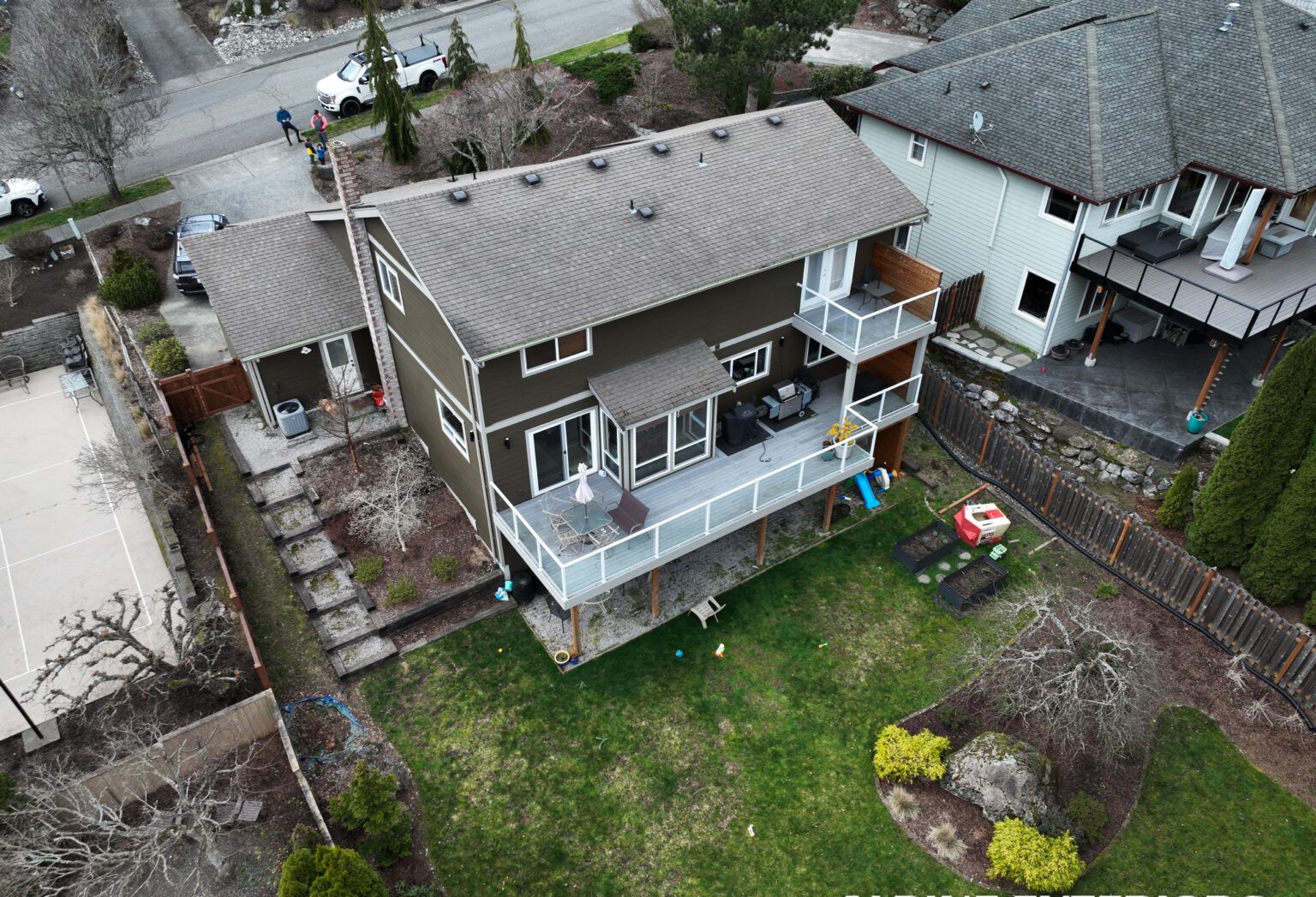
If you want a color that still looks good five and ten years from now on a home in Sumas or anywhere else in Whatcom County, the safest bets are cool-to-neutral grays, deep forest greens, and warm greiges or taupes. These three families do the best job of hiding the moss and algae streaking that shows up on north- and east-facing walls under our tree cover, they read as calm and settled against the evergreen backdrop and farmland fog that defines this part of the county, and they tend to clear local HOA and neighborhood color guidelines without a fight. Whites, blues, and near-black charcoals can all work too, and we cover the real tradeoffs of each below, but if you want one paragraph of guidance before you keep reading: gray, green, or greige, in a low-gloss finish, on a fiber cement or engineered wood product rated for the Pacific Northwest.
Color choice for siding in Sumas isn't the same exercise as it is in a dry, sunny climate. We weighed each option against conditions that are specific to Whatcom County and the far northwest corner of Washington, not generic curb-appeal advice.
Gray is the most common choice we install across Whatcom County, for good reason. Mid-tone grays with a slight blue or green undertone hide moss shadowing better than almost any other family, because the color itself sits close to what early-stage algae growth looks like against a damp wall, so streaking reads as texture rather than an obvious problem. Gray also pairs cleanly with the region's gravel, stone, and cedar accent trends, and it's the color family least likely to raise questions from an HOA design committee. The tradeoff: gray can look flat and cold under our long stretches of overcast sky if you go too light or too blue, so we usually steer clients toward a gray with some warmth in it, paired with a contrasting trim color so the house doesn't disappear into the fog.
A dark forest or hunter green sits naturally against the fir, cedar, and hemlock that back up to most Sumas and Lynden properties, and it does an excellent job masking moss and algae simply because the color families overlap. Deep green also tends to read as a traditional, settled choice that clears HOA review easily. The downside is that on a heavily shaded lot, a dark green home can look almost camouflaged and lose curb definition, especially under the low winter light we get from November through February; it works best with a lighter trim or accent color to keep the architecture visible from the street.
Very dark siding has become popular for a modern look, and against Whatcom County's green landscape it can look genuinely striking, especially on newer builds with clean trim lines. It's worth being honest about two real drawbacks, though. First, dark pigments fade and chalk faster than mid-tones over years of UV exposure, even in a cloudy climate, and that fade shows up as unevenness rather than an all-over lightening, which tends to look worse than a lighter color aging the same way. Second, several vinyl siding manufacturers restrict how dark a color they'll warranty, because dark panels absorb more heat and can warp on south- and west-facing walls — a rule that still applies here even though our summers are mild. If you want a near-black look, fiber cement with a factory-baked finish handles it far better than vinyl, and it's worth confirming warranty language on the specific color before you commit.
Crisp white or a soft cream is a classic look on the farmhouses and older homes scattered through Sumas, Lynden, and Ferndale, and it brightens a lot that sits under heavy tree cover. It's also the color that shows moss, algae, and general grime the fastest and most obviously of any option on this list, since every green streak or gray water stain stands out against a light background. Homeowners who choose white in this region should plan on more frequent soft-washing to keep it looking crisp, and it's worth asking about an algae-resistant additive in the finish, which several fiber cement lines offer, to buy some time between cleanings.
Slate or coastal blue nods nicely to the water, and it's a natural fit for Blaine, Birch Bay, and other spots close to the bay and the Strait. It hides moderate algae streaking reasonably well — better than white, though not as well as gray or green — and it tends to look fresh without feeling trendy. The main caution is picking the right saturation: a bright or highly saturated blue can look out of place against farmland and forest a few miles inland, while a muted, grayed-down blue blends in across most of the county, coastal or not.
Warm neutral tones that sit between gray and brown are one of the most versatile choices for this area. They blend with fog, with evergreen cover, and with the exposed cedar and stone accents common on remodels here, and they tend to age gracefully because fading happens evenly rather than in obvious patches. Earth tones also clear most HOA reviews without issue. The tradeoff is that a poorly chosen greige can drift pink or too beige depending on the light, so it's worth viewing a large sample outdoors under our actual overcast sky rather than trusting a small chip indoors or a photo on a screen.
A few choices consistently cause problems for homeowners in Sumas and the rest of Whatcom County, and it's worth naming them directly rather than leaving them out.
The rate of growth depends mostly on shade, moisture, and airflow around the wall, not color, but color determines how visible that growth is. Colors close to green or gray in tone camouflage early streaking, while white and very light colors make the same amount of growth much more obvious. A siding product with a factory algae-resistant additive helps regardless of color, and it's worth asking about on a shaded, north-facing elevation in particular.
Yes, to a degree. UV exposure adds up over years even under mostly overcast skies, and south- and west-facing walls still take the brunt of it. Darker, more saturated pigments show that cumulative fade as visible chalking and unevenness sooner than mid-tone neutrals, which is one reason we lean toward gray, green, or greige for long-term color stability rather than steering every client toward the darkest trending shade.
Several developments in the county, including Sudden Valley, maintain approved exterior color guidelines or require design review before exterior changes, and some newer subdivisions around Bellingham, Ferndale, and Lynden do the same. Requirements vary by community and can change, so the right step is checking your specific HOA's current covenants or architectural guidelines before ordering material, not assuming a color that worked for a neighbor will automatically be approved for you.
Re-siding a home in Washington can trigger Washington State Energy Code prescriptive requirements for wall insulation, and on many older homes that means adding continuous insulation under the new siding. That doesn't restrict which color you can choose, but it does change the furring depth and how deep the trim reveals sit around windows and corners, which affects how shadow lines read on the finished wall. It's a detail worth discussing with your contractor at the same time you're picking a color, since the two decisions get finalized together during the same project.
Picking a siding color that still looks right in ten years takes more than a sample chip held up against your porch railing — it takes seeing real material against your actual lot, your tree line, and your neighborhood's norms. Alpine Exteriors is a Washington-licensed siding contractor (license ALPINI751OW) serving Sumas and the rest of Whatcom County, including Bellingham, Ferndale, Lynden, Blaine, Birch Bay, Sudden Valley, and the islands. We can walk your property, bring large-format samples so you can see them in our actual daylight rather than under showroom lighting, and talk through which color family and finish will hold up best on your specific exposure. Reach out to Alpine Exteriors to schedule a siding color consultation and get a straight answer about what will actually work on your home.