
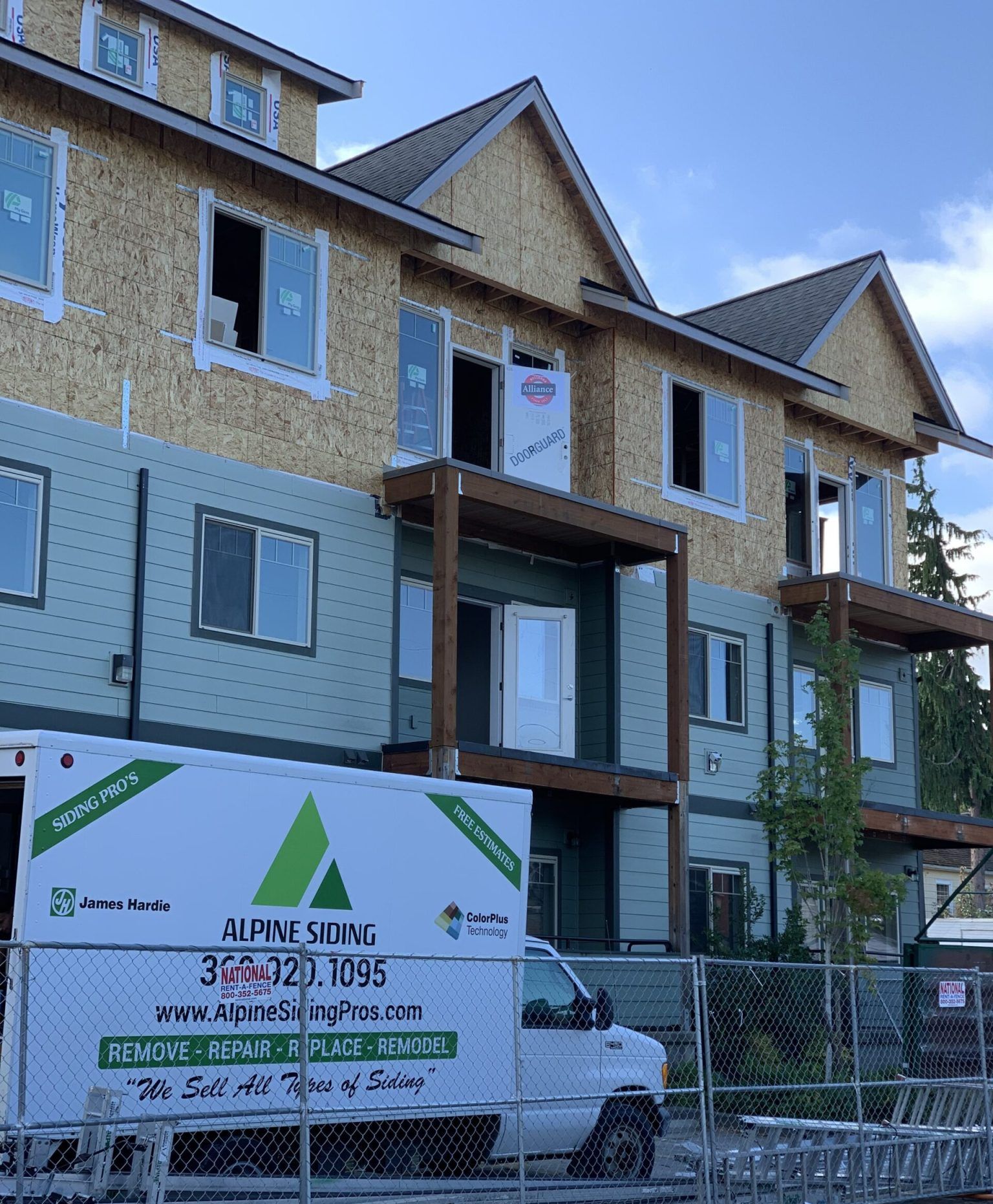
If you want a quick answer before the reasoning: for most homes in York, Bellingham, and the rest of Whatcom County — Ferndale, Lynden, Blaine, Birch Bay, Sudden Valley, and the islands — the safest, best-performing choices are warm and cool mid-tone neutrals (greiges, soft grays, warm taupes), muted blues and greens that echo the Salish Sea landscape, and classic warm whites rather than stark bright white. These hold their look longer under our gray-sky light, hide the inevitable moss and pollen film between cleanings, and read as timeless rather than trendy against the fir, cedar, and evergreen backdrop that surrounds most Whatcom County lots.
Deep charcoal, black-green, and near-black colors can look striking on the right home, but they carry real trade-offs in a marine climate that we'll walk through honestly below — this is a case where it's worth understanding the physics of dark siding before you commit. Bright white and very saturated, high-chroma colors (bold reds, oranges, saturated blues) tend to be the riskiest picks here, for reasons tied to both our light and our HOA norms.
Color choice bigger than a swatch decision — it interacts with your climate, your neighborhood covenants, your roofline, and how the paint or finish itself is manufactured. We weighed each color family against five criteria specific to Whatcom County:
We're not rating one manufacturer's palette in isolation. Fiber cement products like James Hardie's ColorPlus lineup dominate what we install, but the same climate logic applies to vinyl, engineered wood, and site-painted siding — the physics of sun, rain, and salt don't care which substrate is underneath.
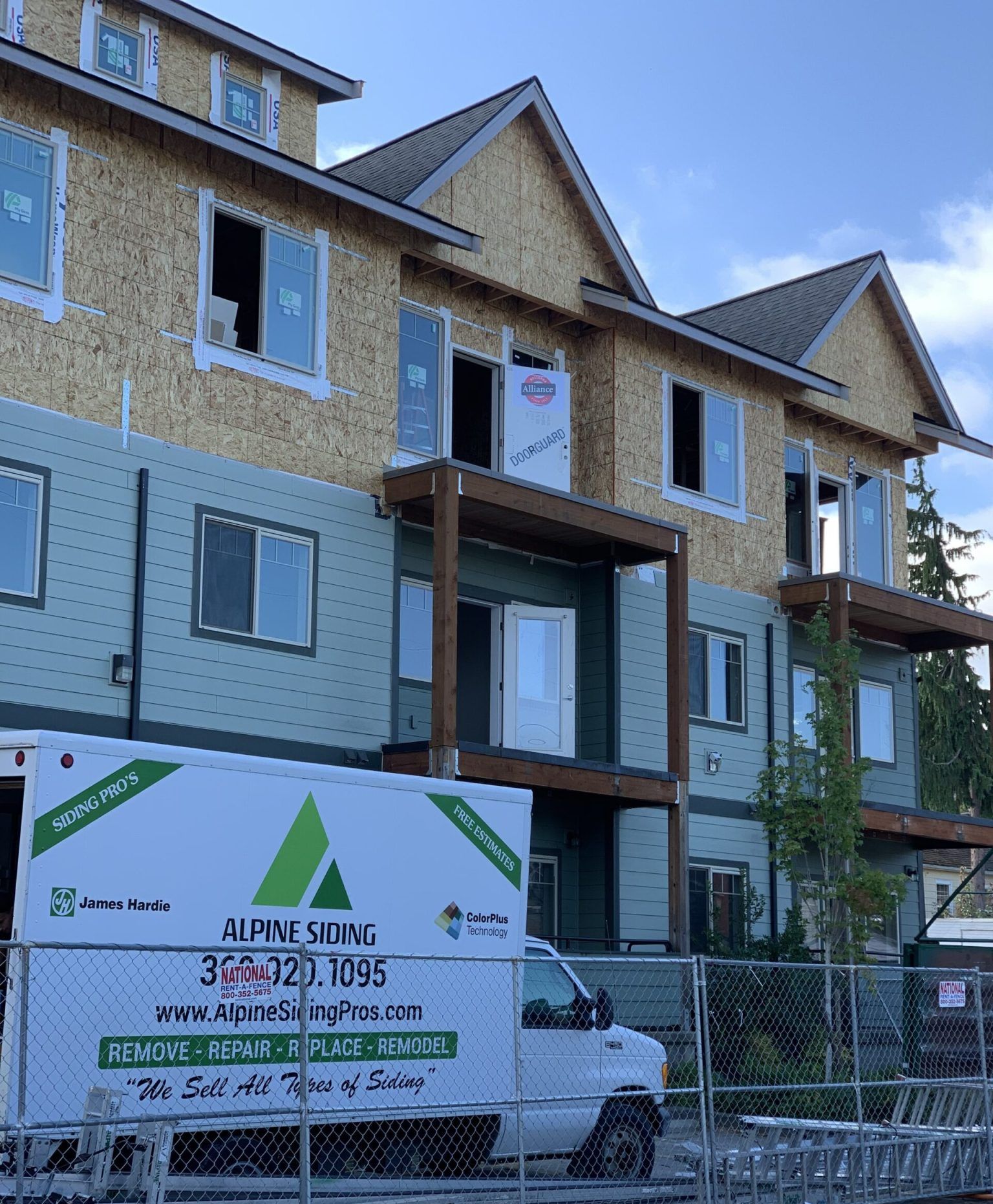
It's tempting to treat siding color the way you'd treat interior paint — pick what you like, repaint in a few years if you tire of it. Siding doesn't work that way. A full re-side or a full repaint of fiber cement or wood siding is a multi-thousand-dollar project, and in Whatcom County's wet climate, that project only gets scheduled every decade or two, not every few years. The color you choose has to survive roughly ten to fifteen years of low-angle Pacific Northwest light, driving rain off Bellingham Bay and the Strait, and the moss and algae growth that colonizes anything shaded and damp. That's why we tell clients the color choice is a bigger decision than most homeowners realize going in — get it right once, and you're not revisiting it every repaint cycle.
There's also a resale dimension. Homes in established Bellingham neighborhoods like York tend to sit under mature cedar and fir canopy, and colors that look sharp on a builder's rendering can look muddy or garish once the house is surrounded by actual Pacific Northwest greenery and gray light. Buyers notice a home that looks intentional versus one that looks like a color trend from a decade ago.
James Hardie's ColorPlus technology is a factory-applied color system, not a can of paint. Instead of shipping plain fiber cement boards to be primed and painted on-site — the traditional approach, still common with cedar and some engineered wood siding — ColorPlus panels are coated with multiple layers of finish inside a controlled factory environment, then cured before they ever reach the job site. That's what people mean when they call it "baked-on": the finish is cured under controlled heat and conditions that a paint crew standing on a ladder in Bellingham drizzle simply cannot replicate.
The practical difference between factory finish and field paint comes down to three things: uniformity (no lap marks, no thin spots, no color variance between boards from different cans), adhesion (the finish is bonded to the substrate before installation, not applied after the material has already been exposed to job-site humidity), and the separate finish warranty that typically comes with it. That last point matters — the ColorPlus finish warranty is a distinct, separate warranty from the base product's substrate warranty, and it specifically covers fading, chipping, cracking, and peeling of the color coat itself under normal conditions. Read the terms before assuming full coverage; warranties on any exterior finish have exclusions for damage from improper installation, physical impact, or unaddressed moisture intrusion.
Job-site painted siding isn't automatically bad — it gives you access to literally any color, including custom matches — but you're trusting weather conditions on install day, the prep quality of that specific crew, and a single-warranty structure that usually ties the paint job's performance to your painter's workmanship guarantee rather than a manufacturer's factory process.
Two climate factors do most of the work in determining how a siding color ages here, and neither is unique to any one neighborhood — they apply from York and downtown Bellingham out to Blaine and the islands.
Homes near Bellingham Bay, Birch Bay, Blaine, and the island communities sit close enough to salt water that airborne salt affects exterior materials, though this is a much gentler version of coastal exposure than you'd see on an open ocean coastline. Salt air accelerates the breakdown of lower-quality paint films and can leave a fine residue that dulls sheen over time, especially on darker colors where dulling is more visually obvious. Factory-cured finishes generally resist this better than field-applied paint because the cure process produces a denser, more chemically stable coating.
Whatcom County doesn't get the wind-driven deluges of a hurricane coast, but we do get sustained driving rain pushed inland off Bellingham Bay and the Strait of Georgia, especially during fall and winter storm systems. The bigger issue for siding color isn't the rain itself — it's the cycling. Siding here gets wet, then partially dries, sometimes several times a day for months on end. That constant moisture cycling is what feeds moss and algae growth on north- and west-facing walls, and it's also what causes fading, chipping, and eventual cracking on paint films that weren't formulated or applied for sustained damp exposure. Lighter, cooler colors tend to show algae streaking more visibly; darker colors hide organic growth better but show mineral staining and chalking more obviously once it happens.
Here's how the realistic color families perform, based on how they actually hold up on Whatcom County homes rather than how they look in a rendering.
This is the single most common mistake we see: choosing a color from a small chip held under indoor lighting, or worse, from a photo on a screen. Whatcom County's light is unusual even by Pacific Northwest standards — heavy cloud cover most of the year, filtered green light under tree canopy, and a narrow window of harsh, high-angle summer sun. A greige that looks neutral on a chip can pull noticeably green or purple once it's on a wall under our typical overcast, and a color that looks perfect on a sunny showroom day can look completely different by October.
Always view large sample boards — not paint chips — on the actual house, in the actual location, at different times of day, for at least a few days before committing. Hold the sample near your roof, your stonework, and any trim accent you're planning, since undertones react to their neighbors more than they do in isolation.
A single-color field with a contrasting trim and a distinct front-door or shutter accent is still the most common, and most resale-safe, approach in Whatcom County. It's simple to maintain, easy to touch up, and reads as clean rather than busy under our muted light.
Multi-color schemes — a different field color on gables versus the main wall plane, or mixed siding profiles like board-and-batten paired with lap siding in two tones — can look excellent on homes with real architectural variation, but they add complexity: more transition flashing detail, more edges where moisture can find a way in if the installation isn't precise, and more colors to keep matched if you ever need a repair years down the road. We generally recommend multi-color schemes only when the home's architecture genuinely calls for it, not as a way to make a plain box look more interesting.
Color choice affects cost in ways that aren't always obvious upfront. Factory-finished fiber cement in a standard palette color is typically the most cost-predictable option, since the finish is included in the material price and there's no separate paint labor line. Custom color matching, whether on fiber cement or wood siding, adds cost for special-order finishing or additional paint labor, and can extend lead times. Darker custom colors on fiber cement sometimes carry a modest upcharge from manufacturers due to the additional coating layers needed for UV stability.
| Approach | Typical Cost Position | Long-Term Consideration |
|---|---|---|
| Standard ColorPlus factory finish | Baseline — included in material cost | Separate finish warranty; best fade/chip resistance; touch-up paint available by color code |
| Custom/premium ColorPlus color | Modest upcharge over standard palette | Same factory-cure durability; slightly longer order lead time |
| Field-painted fiber cement or wood | Added painting labor on top of material and installation | Repaint cycle likely sooner; warranty tied to painter's workmanship, not a factory process |
| Multi-color / multi-accent scheme | Added trim, flashing, and transition detail labor | More edges to maintain and match if a future repair is needed |
None of these numbers are fixed — get a written estimate for your specific home, lot, and color plan rather than assuming a national average applies to a Whatcom County job.
Even the best factory-cured finish will underperform if the installation behind it is wrong. Correct installation means proper flashing detail at every window, door, and roofline transition so water is directed away from the wall assembly rather than trapped behind the siding; correct fastener placement and nailing patterns so panels aren't stressed or cracked at the fastener line; and proper clearance from grade, decks, and roof lines so splash-back and standing moisture don't sit against the bottom courses. In Whatcom County, correct installation also has to account for the Washington State Energy Code's requirements around the wall assembly — house wrap, air sealing, and in some assemblies a rainscreen gap — since a code-compliant wall assembly is also what keeps moisture from cycling behind the siding and attacking the finish or the substrate from the back side, where no amount of good color or finish quality can protect it.
In the foothill areas around Sudden Valley and higher-elevation lots, freeze-thaw cycling adds another reason correct installation matters: trapped moisture that freezes and expands behind poorly flashed siding can crack both wood and fiber cement regardless of the finish on the surface. This is one area where hiring a licensed, experienced crew — Alpine Exteriors is a WA-licensed contractor (license ALPINI751OW) serving Whatcom County — matters as much as the color decision itself, because a beautiful color on a poorly installed wall will fail from behind before the finish itself ever fades.
No color is maintenance-free in this climate, but a few habits keep any color looking its best through Whatcom County's long moss season, which generally runs from fall through spring wherever shade and moisture combine:
The right color for a shaded York lot under mature fir canopy is rarely the right color for an open, water-view lot in Birch Bay or Blaine — the light, the landscape, and even the salt exposure are different enough that a one-size-fits-all recommendation does homeowners a disservice. The best approach is always the same, though: understand how the finish is made, understand how Whatcom County's rain and light will treat it over a decade, sample it honestly on your own house, and choose for how you want the home to look in year twelve, not just in the listing photos.
For most homes, yes, mainly because of consistency and cure quality. A factory finish like ColorPlus technology is cured under controlled conditions before the siding ever reaches your property, which produces a more uniform, better-bonded coat than paint applied on a ladder in variable Bellingham weather. Field paint isn't inherently bad and remains the only route to a fully custom color, but it depends heavily on job-site conditions and the applying crew's prep work, and it typically carries a workmanship warranty rather than a manufacturer's separate finish warranty.
Dark colors don't necessarily fade faster in percentage terms, but any fading, chalking, or mineral staining is far more visually obvious on a dark surface than on a light or mid-tone one, so the perception of aging is stronger. Dark colors also show algae and moss growth differently than light colors — often less visible at first, then a more noticeable contrast once organic growth or mineral bloom sets in. It's a real trade-off worth weighing, not a myth to dismiss and not a dealbreaker either.
Possibly. Many developments around York, Sudden Valley, and newer subdivisions in Ferndale and Lynden have architectural review committees that approve exterior colors before work begins, and some limit saturation or require colors from an approved regional palette. Always check your covenants and, where relevant, City of Bellingham or county design guidelines before finalizing a color, since repainting after installation to satisfy an HOA is an avoidable expense.
Plan on at least an annual rinse of the shadiest, dampest walls — typically north- and west-facing exposures — to slow moss and algae growth before it takes hold, plus keeping gutters clear and vegetation trimmed back so water and shade don't linger against the siding. Homes near salt water benefit from an occasional extra rinse to clear residue. This maintenance matters regardless of good finish quality, since even the best factory-cured color still sits in a genuinely wet, mossy climate.
Choosing a siding color that will still look right in Whatcom County's light ten years from now takes more than a paint chip and a guess. Alpine Exteriors works with homeowners across York, Bellingham, Ferndale, Lynden, Blaine, Birch Bay, Sudden Valley, and the islands to sample real boards on real homes, explain the honest trade-offs of each color and finish option, and install it correctly so the finish performs the way it's meant to. Contact Alpine Exteriors (WA contractor license ALPINI751OW) to schedule an on-site color consultation for your home.