
Chuckanut sits in one of the more demanding micro-climates in Whatcom County. The homes here are tucked under second-growth fir and maple on steep, forested lots above Chuckanut Bay and the Interurban corridor, which means less direct sun on the walls, more standing moisture in the shade, and a longer window every year for moss and algae to take hold. Add the wind-driven rain that comes off Bellingham Bay and the Strait of Georgia during a southwesterly blow, plus the mild but real freeze-thaw swings that show up at the higher elevations toward Chuckanut Mountain and Blanchard, and you have a climate that is genuinely tougher on exterior materials than the flatter parts of Bellingham or Ferndale. We wrote this guide the way we'd explain it to a neighbor: honestly, with the trade-offs left in.
For most Chuckanut homes, factory-finished fiber cement siding and pre-finished steel siding are the two materials that hold up best over a full ownership cycle. Both resist rot outright, both shrug off moss and algae far better than bare wood, and both tolerate the freeze-thaw cycling this area sees without cracking the way some rigid materials can. Engineered wood siding is a reasonable middle ground when budget is tight and the home's site has decent overhangs and airflow, though it depends more heavily on flawless installation and upkeep to avoid moisture problems. Cedar remains the material a lot of Chuckanut homeowners want for the look, and it can absolutely work here, but only with a maintenance commitment that not every household actually keeps up over the years. Vinyl is the least expensive option and is used successfully on plenty of homes in the flatter parts of Whatcom County, but on a shaded, wind-exposed Chuckanut lot it's usually not our first recommendation unless the budget genuinely requires it.
There isn't a single "correct" siding for every house in Chuckanut. A sun-exposed lot near the water with good roof overhangs has different needs than a heavily wooded lot set back from the road with almost no direct light on the north wall. The right call depends on your specific site, your home's existing wall assembly, and how much maintenance you actually want to do. That said, the material comparisons below reflect what we consistently see hold up, and what we see fail early, on homes throughout this part of the county.
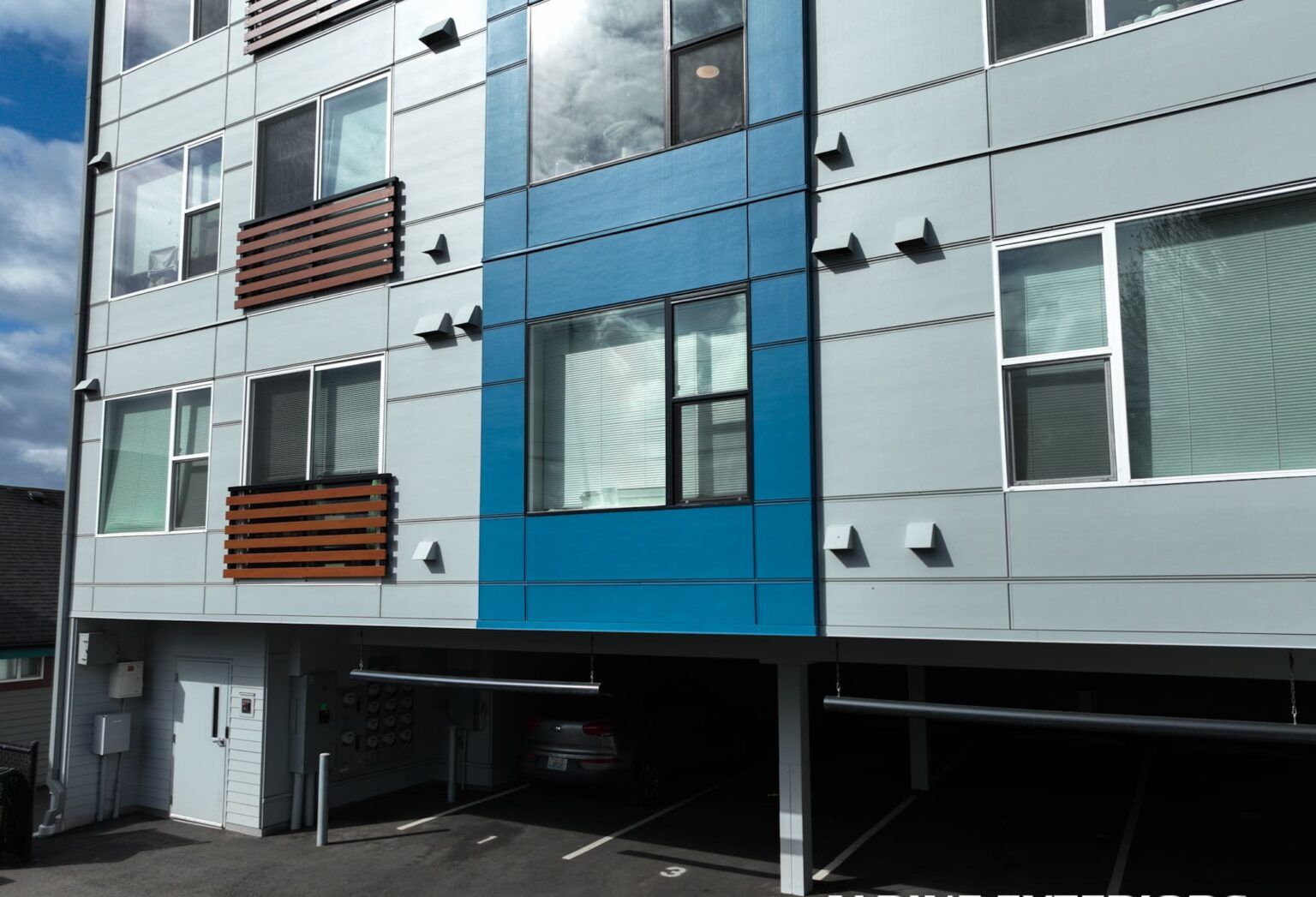
Fiber cement (cement, sand, and cellulose fiber pressed into planks or panels) is the material we spec most often on Chuckanut homes, and it's usually one of our top two recommendations. It doesn't rot, it doesn't feed moss and algae growth the way wood does, and factory-applied finishes hold color far longer than field-applied paint on wood siding. It's also heavy and rigid enough to resist the kind of wind-driven rain that pushes into south and west walls during a fall storm, provided the laps and caulked joints are detailed correctly.
The honest downsides: it's heavier and more labor-intensive to install than vinyl or engineered wood, which shows up in the price. It has to be field-cut with proper dust control, and any cut edges need to be sealed or they can wick moisture. It's also not indestructible — a hard enough impact can chip the factory finish, and any unsealed cut edge left exposed to Chuckanut's rain over a season or two will eventually take on moisture. None of that is a reason to avoid it; it's just what a crew needs to get right on install day.
Engineered wood siding (wood strands or fiber bonded with resin, treated for moisture and finished at the factory) gives you closer to the look and workability of real wood at a lower material cost than fiber cement. It installs faster, cuts more easily, and holds paint well. For a Chuckanut lot with decent roof overhangs and reasonable airflow around the walls, it's a legitimate middle option.
Where it struggles is in exactly the conditions Chuckanut has in abundance: prolonged shade and near-constant moisture. Engineered wood depends on its factory sealant staying intact at every cut, fastener, and joint. If that seal is compromised — a poorly caulked butt joint, a fastener driven at the wrong angle, a cut edge left unsealed — the exposed wood fiber can swell and eventually delaminate faster than solid wood would in the same spot. On a shaded, wind-exposed wall it needs a genuinely careful installer and periodic re-caulking to hold up over the long run. We use it, but we're selective about where on a house it goes.
A lot of homeowners want cedar in Chuckanut because it's the traditional look for this part of the Pacific Northwest, and western red cedar does have natural oils that resist decay better than most other softwoods. Done well — back-primed, installed with a rainscreen gap, and refinished on a real schedule — it can look excellent for decades.
The catch is maintenance, and it's a real one here. Cedar left in deep shade on a Chuckanut lot stays damp longer than cedar on an open, sunny wall, which accelerates both moss growth and eventual rot at end grain, fastener heads, and butt joints. It needs refinishing on a real cycle — not "whenever we get to it" — and any board that starts to check or cup needs to be addressed before it lets water behind the cladding. We install cedar when a homeowner wants that look and is genuinely committed to the upkeep. We're candid when we don't think that's the case, because a neglected cedar wall on a shaded Chuckanut lot rots faster than most people expect.
Vinyl is the least expensive option per square foot and it does have real advantages: it never rots, it doesn't need painting, and modern profiles have improved a lot over older generations. On a sunnier, more open Whatcom County lot with decent overhangs, vinyl performs fine for a long service life.
On a Chuckanut lot facing wind-driven rain, though, we're more cautious about it. Vinyl siding is installed with expansion gaps at every fastener and joint, and those gaps, along with the panel-to-panel laps, are exactly where sideways-driven rain can find a path behind the cladding if the underlying weather-resistive barrier and flashing aren't detailed with real care. It also tends to trap moisture behind it rather than let a wall dry actively, which matters more in a climate this consistently damp than in a drier one. Cheaper vinyl can also become brittle over time, and a hard impact on a cold day — not uncommon during the county's occasional freeze events — can crack a panel. We'll install vinyl when a homeowner wants the lower upfront cost and understands the trade-offs; we don't push it as the best long-term fit for a shaded, wind-exposed Chuckanut wall.
Factory-finished steel siding is the other material we consistently recommend alongside fiber cement, and on more exposed or waterfront-adjacent Chuckanut lots it's often our top pick. It's dimensionally stable across temperature swings, doesn't feed moss or algae the way porous materials can, and stands up well to wind-driven rain because the panel seams are engineered specifically to shed water rather than rely on caulk alone.
It's a more industrial or modern look, which isn't the aesthetic every Chuckanut homeowner wants on a traditional home. It can also dent from a hard enough impact — a fallen branch is a real consideration under Chuckanut's tree canopy — and while a ding in steel siding is usually cosmetic rather than a performance problem, it's more visible than a similar mark on a textured material. Cost also runs comparable to or above fiber cement depending on the panel system and finish selected. For homeowners open to the look, though, it's one of the lowest-maintenance, best-performing choices for this specific climate.
A few choices come up regularly in this area that we steer homeowners away from, or at least flag clearly before they commit.
Alpine Exteriors has worked on enough homes in this specific pocket of Whatcom County to know which of these problems show up as a leak in year three versus a leak in year fifteen — and it's almost always tied to one of the shortcuts above, not the base material itself.
It affects the wall assembly more than it restricts the cladding material itself. Current Washington State Energy Code prescriptive paths generally call for continuous exterior insulation or an equivalent performance path, along with a properly installed weather-resistive barrier, and many assemblies now expect a ventilated rainscreen gap behind the siding. That means the bigger compliance questions come up in how the wall is built behind whichever siding you choose — vinyl, fiber cement, wood, or steel can all be installed to meet code when the assembly is detailed correctly.
Costs vary a lot based on the home's size, existing wall condition, and how much of the substrate needs repair before new siding goes on, so we don't quote firm numbers without seeing the house. As a general range, vinyl tends to sit at the lower end per square foot, engineered wood in the middle, and fiber cement or steel toward the higher end given their material and labor costs. A site visit is the only way to get a number that actually reflects your home.
It depends heavily on how shaded the specific wall is and which material is on it. A north-facing wall buried under fir canopy will need attention more often than a south-facing wall in a clearing. On resistant materials like fiber cement or steel, an annual soft wash is usually enough to keep growth from establishing. On wood, it needs to be part of a broader maintenance routine that also includes checking the finish and caulking, not just cleaning the surface.
Yes — this comes up often, since a lot of Chuckanut homes have a distinct wood-sided, cabin-in-the-trees look that owners want to keep even when they're moving off of real wood. Fiber cement and engineered wood both come in lap and shingle-style profiles that read very close to traditional cedar siding from the street, and we can walk you through samples against your existing trim and roofline before you commit to anything.
Every Chuckanut lot is a little different — how much sun it gets, how exposed it is to wind off the water, how the existing wall is holding up underneath the current siding. Alpine Exteriors is a licensed Washington contractor (license ALPINI751OW) serving Bellingham, Ferndale, Lynden, Blaine, Birch Bay, Sudden Valley, the islands, and Chuckanut, and we'd rather walk your specific house with you than sell you on a single material before we've seen it. If you're weighing your options, reach out to Alpine Exteriors for an on-site assessment and a straightforward rundown of what we'd actually recommend for your home.