
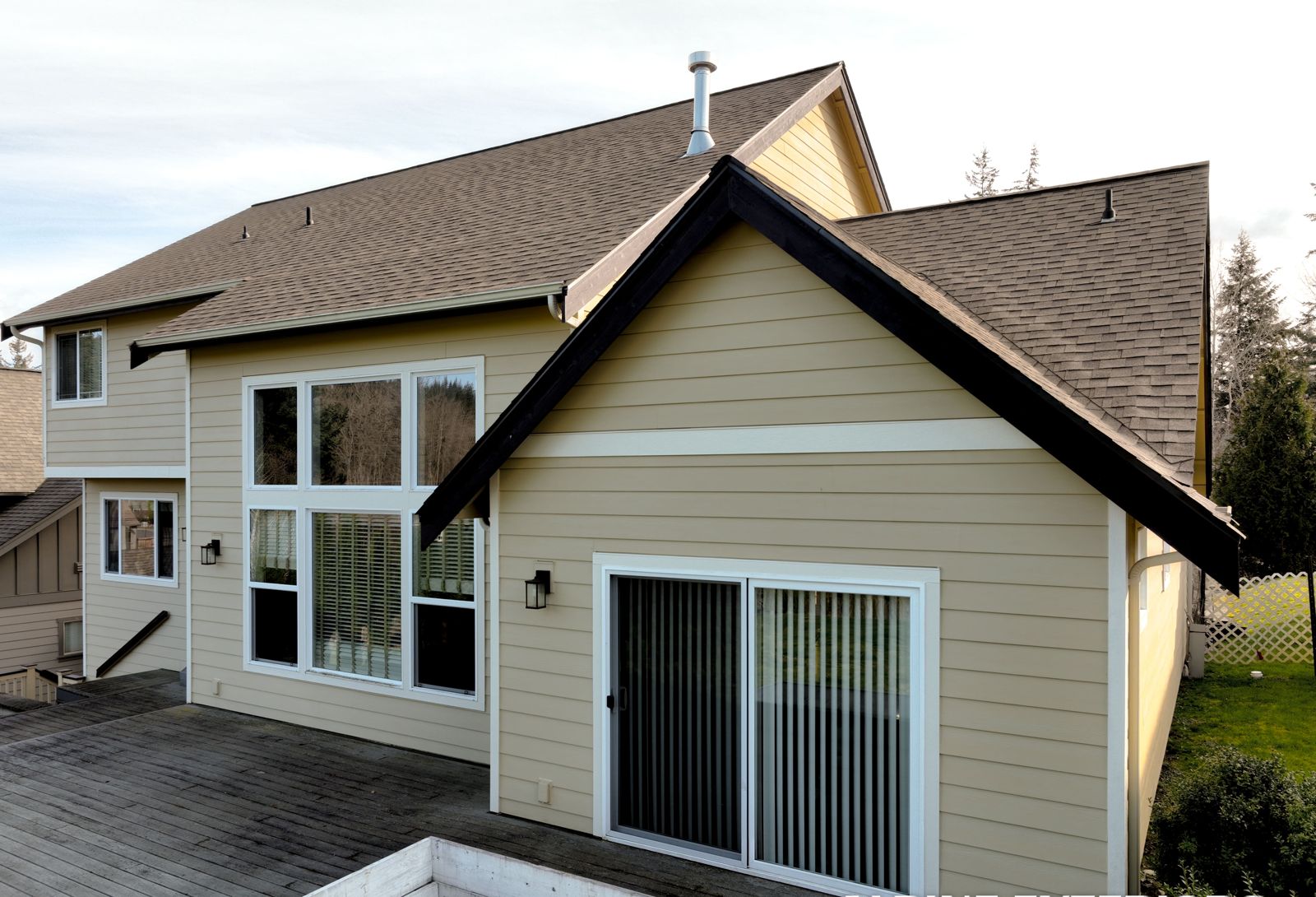
Deming sits back from the water, tucked into the Nooksack River valley on the way up toward Mount Baker, and that changes the siding conversation compared to a home closer to Bellingham Bay. You still get Whatcom County's long, wet fall-through-spring stretch and the moss and algae that comes with it, but Deming also runs cooler overnight, sees more frost and freeze-thaw cycling in the shoulder seasons because of its elevation and distance from the moderating effect of the Salish Sea, and has a lot more tree cover shading roofs and walls for most of the day. The housing stock out here skews toward older farmhouses, log and board-and-batten cabins, single-wide and double-wide manufactured homes, and newer builds on acreage, rather than the tighter subdivisions closer to town. All of that matters when picking a siding material, because the failure modes in Deming are less about coastal wind-driven rain and more about standing moisture, shade-driven moss growth, and repeated freeze-thaw stress on anything that holds water.
Alpine Exteriors is a Washington-licensed contractor (license ALPINI751OW) working Bellingham, Ferndale, Lynden, Blaine, Birch Bay, Sudden Valley, and the county's rural interior including Deming, so this is a local read based on what we actually see failing and holding up on walls out here over a decade or two, not a generic national take.
For most Deming properties, the short answer is fiber cement siding for the primary structure, with engineered wood or cedar reserved for accent areas where you want a particular look without fully committing to its upkeep. Vinyl is a reasonable budget option in some cases, but it has real drawbacks here worth knowing up front. Metal panel siding is worth a look on outbuildings, shops, and some newer builds, less so on older farmhouse-style homes. None of these is a universal answer, and the right pick depends heavily on how much shade and moisture your specific lot deals with.
We weigh four things against each other, roughly in this order. First, moisture management: how well the material and the installation detail shed water and let the wall dry out between the rains that define this region, and how it performs if a house wrap or flashing detail isn't perfect. Second, moss and algae resistance: given the shade from conifers and the humidity that lingers in this valley longer than it does near open water, how much does the surface encourage biological growth, and how hard is it to clean without damaging the material. Third, freeze-thaw tolerance: Deming's temperature swings are more pronounced than Bellingham's, so any material that absorbs water and then sees a hard freeze needs real scrutiny. Fourth, fit with the housing stock and the Washington State Energy Code, since a lot of Deming homes are older and getting re-sided as part of a broader insulation and air-sealing upgrade, not a standalone cosmetic job.
Fiber cement, the category that includes products like James Hardie's lap and panel lines, tends to be our default recommendation for full re-sides in Deming. It doesn't rot, it holds paint well for a long stretch, and it doesn't feed mold and algae the way wood does. It tolerates freeze-thaw cycling without the material itself degrading, since it isn't absorbing water into a cellular wood structure the way cedar can.
Engineered wood siding, the LP SmartSide-style products, is a middle-ground option a fair number of Deming homeowners like for the look and the price. It's more affordable than fiber cement, faster to install, and comes primed, which shortens the finishing step. The concern is moisture at cut edges and seams; if the factory-sealed edges get compromised during installation or joint caulking isn't maintained, it can swell and delaminate, and that failure shows up faster in a shaded, damp valley than it would somewhere drier.
Cedar and other traditional wood siding has real appeal in Deming, especially for cabin-style and log-adjacent homes where the look is part of the point. Western red cedar is regionally appropriate and can look excellent for years with proper finishing. The honest drawback is maintenance: wood siding under heavy tree cover in a valley that doesn't get much direct sun or wind to dry it out is exactly the scenario that produces wood rot and persistent moss growth, and we see this constantly on older Deming properties with mature Douglas fir standing close to the house.
Vinyl siding remains the lowest-cost option and has genuinely improved over the last couple of product generations, particularly in impact resistance and colorfastness. It doesn't rot and it's low-maintenance in the sense that you're not painting it. Where it struggles in Deming is twofold: vinyl expands and contracts more than fiber cement with temperature swings, and Deming's freeze-thaw cycling is more pronounced than the coastal parts of the county, so panels installed too tight can buckle or warp over a few winters. It also tends to trap moisture and grow moss in its overlapping channels in shaded, damp conditions, and because it's thinner, cleaning it aggressively enough to remove that growth can crack or gouge it.
Metal siding, typically steel or aluminum panel systems, shows up more on shops, barns, and some newer contemporary builds around Deming than on traditional homes, but it handles this climate well in the right application. It doesn't rot, doesn't feed algae the way wood does, and shrugs off freeze-thaw cycling without concern. The tradeoffs are aesthetic fit for a farmhouse or cabin-style home, noise under heavy rain if it isn't backed properly, and the potential for dents from fallen branches, a real consideration under Deming's tree cover.
Skip any manufactured lap siding that isn't rated for real moisture exposure; Whatcom County's rural interior sees more standing humidity under tree cover than manufacturers testing in drier climates account for. Avoid installing wood or engineered wood siding tight against grade or against dense landscaping, since that traps moisture right where freeze-thaw does the most damage to a wall assembly. Be wary of any contractor who wants to install new siding over the old without checking what's underneath, because on a lot of Deming's older homes that's exactly where hidden wood rot has been quietly developing behind aging cladding for years. And don't assume any siding material is a substitute for proper roof overhangs, gutters, and grading; on a shaded, damp lot, the water management around the siding matters as much as the siding itself.
Moss and algae growth is more than cosmetic once it's established for a season or two. It holds moisture directly against the siding surface, which slows drying time after every rain and, on wood or engineered wood products, creates the conditions for rot underneath the growth even before it's visible from the ground. On fiber cement and metal it's mostly a cosmetic and cleaning issue, but on wood-based siding in a shaded Deming lot, established moss is a signal that the wall assembly underneath deserves a closer look, not just a pressure wash.
Not to the same degree. Deming sits inland in the Nooksack valley, well back from the open water and the Strait, so the sideways, wind-driven rain that hits exposed walls near the bay is much less of a factor here. The bigger moisture concern in Deming is standing humidity and slow-drying shade from tree cover, a different problem that calls for siding chosen more for breathability and moss resistance than for wind exposure.
Depending on the scope of the project, re-siding can trigger energy code requirements around continuous insulation and air sealing at the wall assembly, especially if the siding is coming off down to the sheathing anyway. For a lot of Deming's older farmhouses, that makes a re-side a good opportunity to add rigid insulation or upgrade the water-resistive barrier as part of the same job, since the wall is already open. Your contractor should walk you through what the current code requires for your specific scope before work starts.
For most of the older, shaded properties we see in Deming, yes, and the reasoning comes down to the specific combination of shade, humidity, and freeze-thaw cycling this valley sees. Vinyl can still be a sound choice on a sunnier lot or a budget-driven project, but on a shaded property with mature trees close to the house, fiber cement's resistance to moss, rot, and freeze-thaw stress tends to pay for itself over the life of the siding rather than needing earlier repair or replacement.
Ready to talk through siding options for your Deming property? Alpine Exteriors serves Deming and the rest of Whatcom County's rural interior alongside Bellingham, Ferndale, Lynden, Blaine, Birch Bay, and Sudden Valley, and we're happy to walk your specific lot, its shade, its sun exposure, and its age of construction before recommending a material. We're a licensed Washington contractor, license ALPINI751OW, and we'll give you a straight answer even if that answer is that your current siding has more life left in it than you think. Reach out for an on-site look and a written estimate with real material options laid out side by side.