
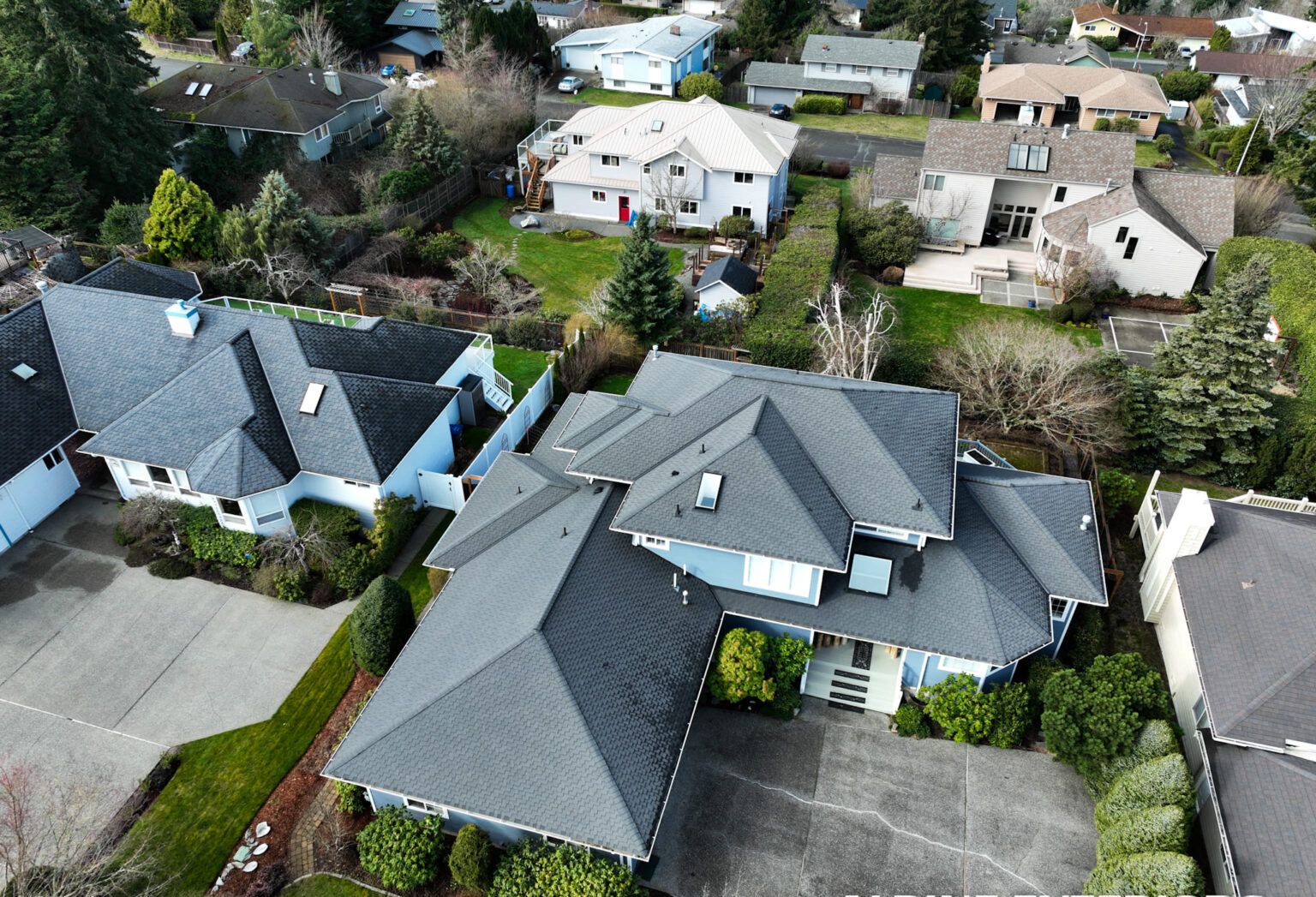
Point Roberts sits on its own peninsula, bordered by water on three sides and reachable only by crossing through Canada or by boat. That geography shapes everything about how siding performs there. Homes get near-constant damp air off Boundary Bay and the Strait of Georgia, wind-driven rain that finds every unsealed seam, and enough shade from fir and cedar cover to keep north walls perpetually green with moss and algae. Add a housing stock that ranges from 1960s and '70s beach cabins to larger newer builds, and you get a wide spread of siding conditions in a very small town. This guide walks through what actually holds up here, what doesn't, and why — based on what we see on siding tear-offs and re-sides across Whatcom County, including regular work in Point Roberts itself.
For most Point Roberts homes, fiber cement siding is the strongest all-around choice, with engineered wood siding a reasonable second option for homeowners who want a similar look at a lower installed cost. Both resist the two things that damage siding fastest here — sustained moisture and wind-driven rain — far better than the materials commonly found on the older beach cottages in town. Vinyl remains a legitimate budget option if it's installed correctly for the wind exposure, and cedar can still be the right call on a home where the owner wants a natural wood look and is committed to keeping up with maintenance. There isn't one universal answer; the right pick depends on the home's exposure to wind and shade, the owner's appetite for upkeep, and budget. Alpine Exteriors walks Point Roberts homeowners through that trade-off on-site rather than defaulting to one product for every house.
Point Roberts isn't a hurricane zone and it doesn't see the freeze-thaw cycling that shows up more in the Whatcom foothills around Sudden Valley. The pressures on siding here are different, and that's what we weighed each material against:
Fiber cement, most commonly sold under the James Hardie brand in this region, is a blend of cement, sand, and cellulose fiber pressed into planks or panels. It doesn't absorb water the way wood-based products do, it holds paint far longer than wood, and it doesn't feed moss and algae the way some textured products do, though algae can still grow on the surface film if a wall never gets sun and airflow. In our experience it's the most consistent performer against wind-driven rain when it's installed with the correct clearances and a rain-screen gap per code, because the water that does get behind a lap has somewhere to drain and dry rather than sitting against the substrate. The tradeoffs are real: it's heavier and more labor-intensive to install than vinyl or engineered wood, it needs to be field-cut and painted or factory-primed correctly to avoid raw edges absorbing moisture, and the material itself costs more upfront. It's also not something a homeowner installs themselves without experience — a poorly fastened or poorly flashed fiber cement job will fail just like any other material installed wrong. For a full-time Point Roberts residence, or a second home the owner doesn't want to think about for a decade or more, it's the material we recommend most often.
Engineered wood siding, such as LP SmartSide, is wood strand material bonded with resin and treated with a zinc borate additive for moisture and insect resistance, then coated with a factory finish. It installs faster than fiber cement, costs somewhat less, and gives a similar plank or panel look. It performs reasonably well against Point Roberts's rain and wind exposure as long as every cut edge is sealed and caulked at installation and the factory finish is kept intact — any breach in that coating is where moisture gets a foothold, since the core is still wood fiber. On shaded, moss-prone walls it needs the same attention to keeping gutters and vegetation clear that any wood-based product does. Homeowners sometimes remember older wood composite sidings from decades ago that had well-documented rot problems in wet climates; today's engineered wood products use different resins and treatments and are a genuinely different product, but that history is part of why some longtime Whatcom County residents are skeptical of the category, and it's a fair question to ask a contractor about before choosing it.
Vinyl is the lowest-cost option and the fastest to install, and modern vinyl doesn't rot, doesn't need painting, and sheds ordinary rain without issue. The problem in a place like Point Roberts is wind. Vinyl panels are designed to hang loosely on their nailing hem so they can expand and contract with temperature, which is fine in a sheltered yard but becomes a liability on an exposed bluff lot where sustained gusts off the water can rattle, lift, or in worse cases pop panels off their locks. That's addressable — there are wind-rated vinyl products and installation techniques (tighter nailing patterns, starter strips rated for higher wind loads) that hold up much better on exposed sites — but standard-grade vinyl installed with standard techniques is a real risk on Point Roberts's more open lots. Vinyl also telegraphs every irregularity in the wall behind it and doesn't hide underlying rot the way a heavier material might, which can actually work in an owner's favor by forcing problems to surface. For a sheltered lot with mature tree cover breaking the wind, vinyl remains a fair, honest budget choice.
A lot of the older housing stock in Point Roberts is original cedar shingle or channel siding, and there's a real argument for keeping that look on a home where it fits the character of the neighborhood. Western red cedar is naturally rot-resistant compared to other woods and looks the part on a Pacific Northwest coastal cottage. But it is still wood, and in a climate with this much sustained dampness, cedar needs a back-ventilated rain-screen installation, periodic refinishing or staining, and prompt repair of any failed caulk or flashing to hold up long-term. On shaded walls, moss and algae growth on cedar is close to constant without regular cleaning. We still install and repair cedar siding for owners who want it, but we tell every one of them upfront that it's the highest-maintenance option on this list, and it's a poor fit for a seasonal home that sits unattended for months at a time.
Steel or aluminum panel siding shows up occasionally on newer or more modern-styled Point Roberts homes. It doesn't rot, doesn't feed moss, and handles wind loads well when installed correctly, which makes it a genuinely strong performer against this location's weather. The drawbacks are cost, a more limited range of traditional lap-siding looks, and the fact that steel can dent and both steel and aluminum will show scratches through the finish over time, which matters more on a home near mature trees dropping branches than on an open lot. It's a good option for the right style of home and the right budget, but it's a smaller share of what we install because it doesn't suit every architectural style in the neighborhood.
A few choices we'd steer most Point Roberts homeowners away from. Older hardboard or particleboard-based siding products, if they're still on a home, are past due for replacement — that generation of product has a well-known history of swelling and rotting at joints in wet climates, and Point Roberts's conditions are about as hard on that material as it gets. Stucco or EIFS systems without a properly detailed drainage plane are a poor match for this much sustained rain; without that drainage layer, any water that gets behind the surface has nowhere to go. T1-11 plywood panel siding, still common on older outbuildings and some house additions in town, is prone to rot at the butt joints and bottom edge unless it's kept painted and flashed meticulously, and it's rarely worth re-doing over a better long-term material. And regardless of material, any siding installed flush against the wall without a rain-screen gap is working against, not with, the drainage assumptions built into current Washington State Energy Code wall assemblies — that gap is what lets incidental moisture dry out instead of sitting against the sheathing.
Not a different category of material, but different attention to installation. Point Roberts's open exposure to wind off Boundary Bay and the Strait of Georgia, plus its shaded, moss-prone lots, mean the same siding material needs tighter fastening, better flashing at wind-exposed corners, and more attention to drainage than a comparable install in a more sheltered part of the county like Lynden or inland Bellingham.
It varies widely with home size, the material chosen, and how much of the underlying sheathing or framing needs repair once old siding comes off — which is common on older beach cottages with a history of moisture intrusion. Vinyl re-sides tend to run toward the lower end of the range for exterior remodeling projects, fiber cement toward the middle to upper end, and any job that uncovers rot will add to the number. We give homeowners a firm number after an on-site look, not a phone estimate.
Sometimes, but we're cautious about it in Point Roberts specifically. Covering over siding without inspecting the sheathing underneath risks trapping existing moisture damage, and given how much of the older housing stock here has some history of wood rot, we usually recommend at least opening up a section to check the substrate before covering it over, even if that adds a step to the project.
Keep gutters and downspouts clear so water isn't sheeting down the wall, trim back vegetation that's shading the siding and keeping it damp, and have algae and moss washed off with a low-pressure, siding-appropriate cleaning rather than a pressure washer, which can force water behind laps and joints and cause more harm than the moss itself.
If you're weighing a re-side or repair on a Point Roberts home, Alpine Exteriors can walk the property with you, point out exactly where wind and moisture have already done damage, and lay out material options with honest pros and cons for your specific lot and budget — not a one-size answer. Alpine Exteriors is a licensed Washington contractor (ALPINI751OW) serving Point Roberts alongside the rest of Whatcom County, including Bellingham, Ferndale, Lynden, Blaine, Birch Bay, and Sudden Valley. Reach out for an on-site assessment before your next re-side or repair decision.