
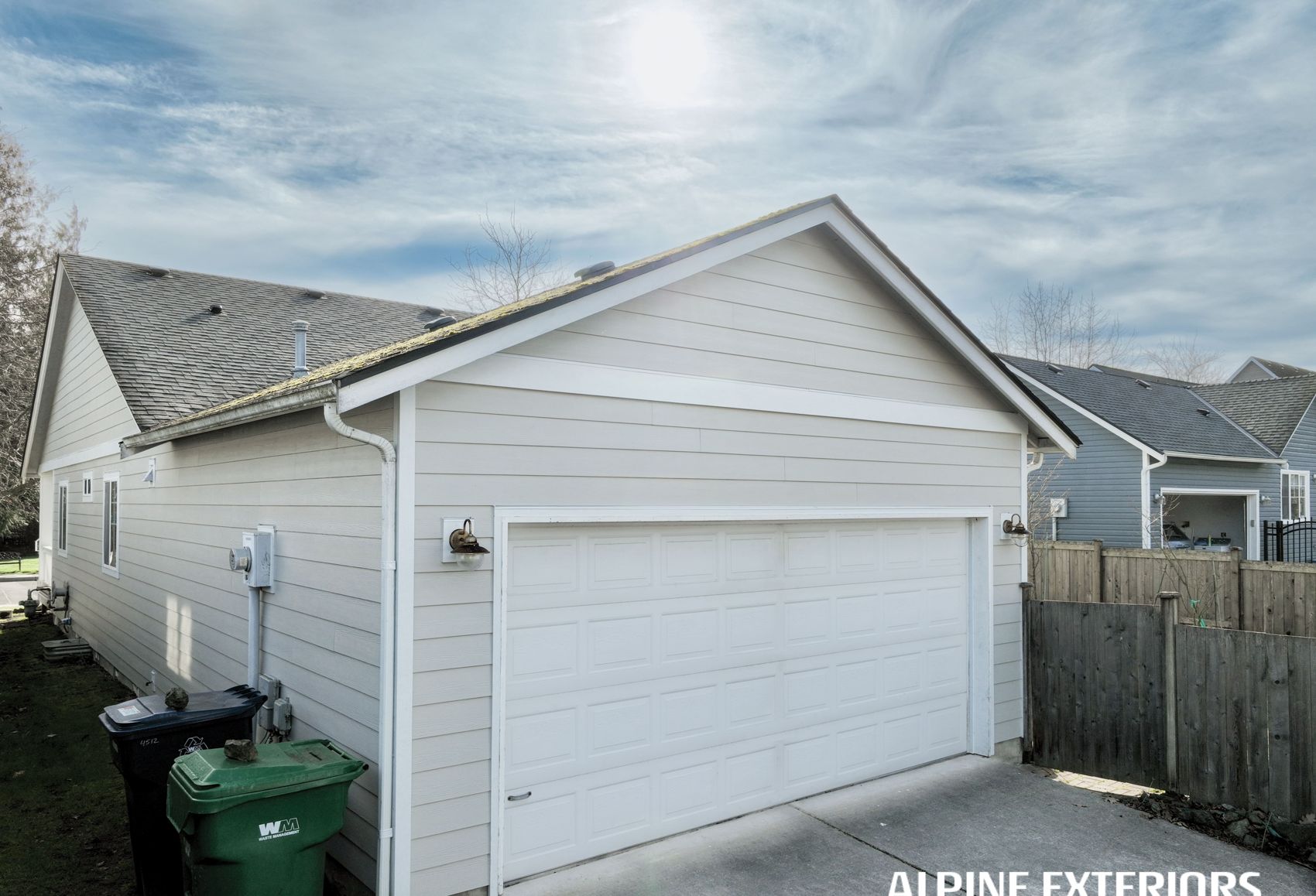
Whatcom County sits where the Salish Sea marine climate meets the foothills of Mount Baker, and that combination is hard on exterior siding in ways that don't show up in drier parts of the state. Homes in Bellingham, Ferndale, Lynden, Blaine, Birch Bay, Sudden Valley, the Columbia Valley area, and the islands see long stretches of low-intensity, persistent rain rather than short heavy storms. That kind of rain finds its way into small gaps that a homeowner in a drier climate might never think twice about. Over months and years, water that gets behind siding rather than shedding off of it is what causes rot, not any single storm event.
Wind direction matters here too. Properties facing Bellingham Bay, Semiahmoo Bay, or the open water toward the Strait of Georgia take wind-driven rain almost horizontally during winter systems, which pushes moisture into laps, seams, and trim joints that would stay dry on a calm day. Meanwhile, homes further inland and up in elevation — around Columbia Valley, Deming, Acme, and the foothill fringes of Whatcom County — deal with a different problem: freeze-thaw cycling. Water that soaks into a hairline crack in caulking or trim can freeze overnight in the colder foothill microclimate, expand, and widen that crack by spring. Repeat that enough winters in a row and small gaps become real entry points.
Shade, tree cover, and constant dampness across the county also make moss and algae a near-universal issue on north-facing walls and anything close to overhanging trees or dense landscaping. None of this is hurricane-force weather — Whatcom County doesn't deal with that — but sustained moisture exposure is arguably a slower, more persistent threat to siding, because it's easy to miss until it's already caused damage underneath the surface. The Washington State Energy Code also plays a role beyond just heating bills: it sets requirements for continuous insulation and the water-resistive barrier behind siding on many renovation and re-side projects, which means a proper inspection sometimes reveals code-related gaps as well as weather damage. This checklist is built around what actually goes wrong on homes in this specific region, not generic siding advice written for a different climate.
Panels and field surfaces
Trim, corners, and flashing
Caulking, joints, and penetrations
Moss, algae, and organic growth
Moisture and rot indicators
Foundation, grade, and lower wall areas
Attic and interior signs

Not every failed item on this list means a full re-side. A lot of what shows up during a homeowner walk-around is manageable if it's caught early. Cracked or shrunken caulk, for example, can often be cut out and replaced in an afternoon — it's inexpensive, and doing it before the next wet season starts is far cheaper than dealing with rot later. Moss and algae growth can usually be treated with a gentle wash and, where practical, some trimming back of overhanging vegetation to let the wall dry between rains; pressure washing siding aggressively can do more harm than good, so a soft-wash approach is generally safer for both the finish and any caulked joints.
Items that point to actual moisture intrusion — soft spots, visible rot, staining that keeps reappearing, or a musty smell near a wall — deserve a closer look before anyone patches over them. Covering up a soft or discolored area with new caulk or paint without finding out what's happening underneath just hides the problem for a season or two while it keeps getting worse. If a panel is soft, it's worth finding out how far the damage extends before deciding whether a spot repair, a partial re-side of that wall, or something larger is the right call. In many cases the visible damage is smaller than what's happening behind it, and in some cases it's the opposite — a small stain on the surface with much less structural concern than it first appears. Either way, that's information worth having before spending money on a fix.
Flashing and trim issues generally need proper reinstallation rather than a caulk-and-patch approach, since caulk isn't a substitute for flashing that directs water where it needs to go. If gutters or grading are contributing to the problem — water dumping against a wall or pooling at the foundation — those issues should be addressed alongside any siding repair, because fixing the siding without fixing the water source just means dealing with the same failure again in a year or two.
A homeowner can reasonably handle the visual walk-around described above, along with basic maintenance like re-caulking accessible joints, clearing debris from behind downspouts, or trimming vegetation away from the wall. Beyond that, a few situations are worth bringing in a professional rather than guessing:
Alpine Exteriors, licensed in Washington under ALPINI751OW, works on homes throughout Whatcom County — from Bellingham and Ferndale out to Lynden, Blaine, Birch Bay, Sudden Valley, Columbia Valley, and the islands — and can walk through a suspect area with you to figure out whether it's a minor repair or something that needs a broader fix. There's no shame in a repair turning out to be smaller than expected; it's far better to find that out than to assume the worst and pay for more work than the house actually needs, or the reverse.
A walk-around twice a year is a reasonable baseline for most homes here — once in late fall before the heavy rain season sets in, and again in spring to catch anything that developed over the winter. Homes with heavy shade, dense landscaping, or a north-facing wall exposed to persistent dampness may benefit from an extra check mid-winter, since moss and algae growth can accelerate quickly during the wettest stretch of the year.
It's not purely cosmetic. Moss holds moisture against the siding surface far longer than the wall would otherwise stay wet, and if it establishes in a seam, lap, or behind trim, it can keep that spot damp almost continuously. Over time that sustained dampness is what allows rot to start, particularly on wood-based siding or trim. Removing moss and keeping vegetation trimmed back so the wall can dry out between rains is a legitimate part of siding maintenance in this climate, not just an appearance issue.
The mechanisms differ somewhat. Homes closer to Bellingham Bay, Semiahmoo Bay, or the open water toward the Strait of Georgia deal more with wind-driven rain being pushed into seams and joints, since that exposure is more direct and more forceful. Homes further inland and up in elevation, such as around Columbia Valley, see more freeze-thaw cycling — water that gets into a small crack can freeze overnight and gradually widen that crack over successive winters. Both processes lead to similar end results, water intrusion and eventual rot, but the inspection priorities shift slightly depending on where a home sits.
For a small repair or spot patch, code compliance usually isn't the main concern — the priority is stopping water intrusion and matching the existing material reasonably well. Where the Washington State Energy Code becomes relevant is on larger projects, such as re-siding a full wall or the whole house, where current requirements for continuous insulation and the water-resistive barrier apply to the new work. If a repair is small and isolated, a licensed contractor can usually tell you quickly whether code triggers apply or not.
A homeowner walk-around like this one catches a lot, but some of the most damaging issues — moisture already trapped behind a wall, a flashing sequence installed incorrectly years ago, or a wall assembly that no longer meets current energy code — aren't always visible from the outside. Alpine Exteriors serves homeowners across Whatcom County, including Bellingham, Ferndale, Lynden, Blaine, Birch Bay, Sudden Valley, Columbia Valley, and the islands, and can take a closer look at anything on this checklist that raised a question. Reach out to schedule an inspection before the next wet season puts more pressure on any gaps this checklist helped you find.