

For most homes in Bellingham, Ferndale, Lynden, Blaine, Birch Bay and the islands, fiber cement trim (the kind most homeowners mean when they say "Hardie trim") earns its extra cost over the life of the siding job. It resists the rot, swelling and moss staining that our wet climate causes to wood trim, and it holds paint for far longer stretches between repaints. That said, it isn't automatically the right call for every house — a few situations genuinely favor wood, vinyl, or a mixed approach, and an honest contractor should tell you which one you're in before you sign anything.
Trim boards do a different job than field siding. They sit at corners, window returns, band boards, fascia edges and rake edges — exactly the places where water collects, wind drives rain sideways, and end grain gets exposed. On a typical Whatcom County house, wood trim fails first at these joints: a mitered corner opens up a hairline gap, water wicks into the end grain, and within a few wet seasons you've got soft, punky wood under the paint film long before the rest of the house shows its age. Fiber cement trim doesn't have that failure mode in the same way. It's a cementitious product reinforced with cellulose fibers, so it doesn't have grain to wick water along, it doesn't swell and shrink the way dimensional lumber does with humidity swings, and it isn't a food source for the fungi that cause rot. That's the core of the value proposition: less callback work at the vulnerable spots on the house.
The tradeoffs are real, though, and we'd rather list them than gloss over them. Fiber cement trim is heavier and more brittle than wood — it has to be scored and snapped or cut with a saw fitted for the dust, and factory-primed edges need to be sealed and painted on site or they'll wick moisture at the cut. It costs more upfront than finger-jointed wood trim and noticeably more than vinyl or cellular PVC trim in most cases, though the gap narrows once you count repaint cycles over a 15- to 20-year window. It also doesn't route or carve the way solid wood does, so if a home has genuinely ornate corbels, curved trim, or custom millwork profiles, wood (or PVC in some cases) may still be the better material for those specific elements even on a house where the field trim is fiber cement.
One more honest point: fiber cement trim is only as good as its installation and paint maintenance. Cut edges that aren't primed and sealed, nail heads that aren't set and caulked, and butt joints that rely on caulk alone instead of proper flashing will all eventually let water in, and once water gets behind fiber cement trim it can still cause problems at the sheathing and framing behind it — the trim itself just won't rot the way wood would. That's a detail a lot of trim quotes skip past, and it's one we walk homeowners through before we ever price a job.
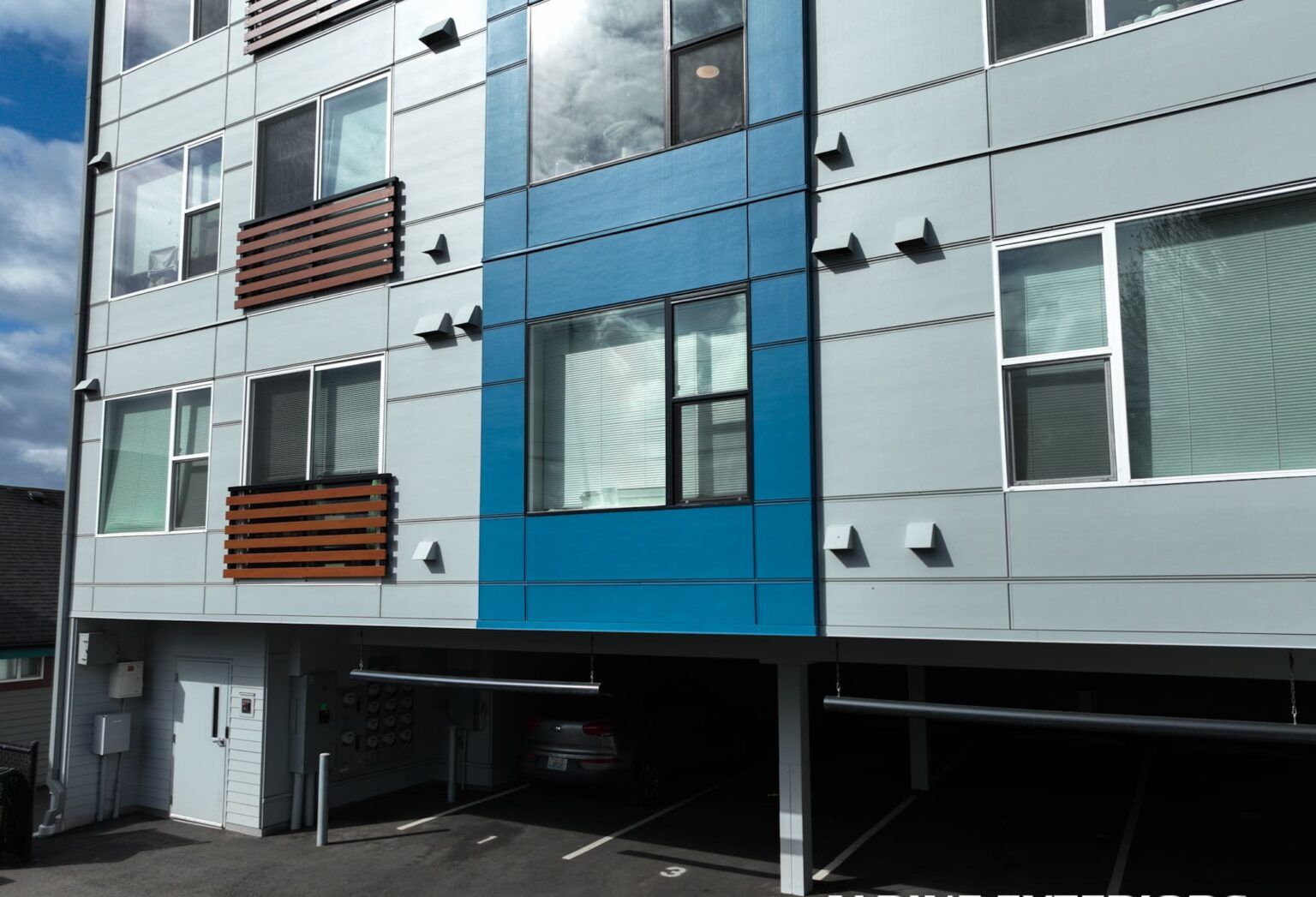
Whatcom County's climate isn't uniform, and that matters for a trim decision more than people expect. Bellingham, Birch Bay and Blaine sit exposed to wind-driven rain coming off Bellingham Bay and the Strait of Georgia — storms here don't just fall straight down, they drive horizontally into west- and northwest-facing walls, which is exactly the orientation where trim joints take the most punishment. Lynden and Ferndale, further inland, get somewhat less of that direct wind-driven exposure but still sit under the same marine-layer drizzle pattern for much of the year, where trim stays damp for days at a stretch rather than getting a quick soak-and-dry cycle. Up toward Sudden Valley and the foothills, the additional factor is freeze-thaw cycling in the colder months — moisture that gets into a joint or a checked piece of wood trim can freeze, expand, and widen the crack, accelerating failure in a way that doesn't happen as much closer to the water.
Add to that the near-constant presence of moss and algae on north-facing and shaded trim throughout the county — anywhere under fir or cedar canopy, or on the shadowed side of a house, green and black staining shows up faster than most homeowners expect, and it shows up faster and darker on porous, painted wood than on fiber cement. None of this is a hurricane-zone problem; nobody here is choosing trim for wind uplift or storm debris. It's a slower, wetter, mossier kind of wear, and it plays out over years of gray, drizzly weather rather than a single event.
The Washington State Energy Code is the other regional factor, though it touches trim only indirectly. The energy code governs the wall assembly — continuous insulation, air sealing, and vapor control at the sheathing — and a trim replacement or full re-side is often the moment a contractor is already opening up those details anyway. When we're already pulling old trim and re-flashing window openings to meet current energy code requirements, it costs relatively little extra to spec fiber cement trim at the same time, since the labor of doing the flashing and integration correctly is the same regardless of trim material.
Don't treat this as an all-or-nothing decision. In our experience walking Whatcom County homes, the right call usually comes down to a short list of questions:
We'd also point out that cost ranges vary a lot by house size, trim linear footage, and how much of the existing substrate needs repair before new trim goes on — a small window-trim refresh is a very different project from re-trimming a two-story home's fascia, corners and band boards. Get a walkthrough and a written scope before comparing bids, since "trim replacement" can mean very different amounts of actual work from one quote to the next.
Yes — factory-primed fiber cement trim still needs a field-applied topcoat, and cut edges need to be primed and sealed at install. Once painted with a quality exterior product, most homeowners in this climate can expect a longer stretch between repaints than they got with wood trim, though moss-prone, shaded north walls will still need cleaning and occasional touch-up sooner than sun-exposed walls.
It's generally installed after the old trim is removed, not layered over it, because the goal is to inspect and repair the sheathing and flashing underneath — if the old wood trim has been rotting for years, there's a good chance the substrate behind it needs attention too, and covering that up defeats the purpose of upgrading the trim in the first place.
It can be, especially at corners, window returns and band boards where wood trim tends to fail first in our climate — but it's worth pricing against a quality wood or PVC option for that specific scope, since the economics of a trim-only job are different from a full re-side where the flashing work is already happening.
It resists the growth somewhat better than bare or poorly sealed wood because it's less porous and doesn't hold moisture in its surface the way wood grain does, but it isn't moss-proof — any trim in a shaded, damp spot in Whatcom County will still need periodic cleaning regardless of material.
Trim decisions are easier to get right with eyes on the actual house — the exposure, the current condition, and which details are decorative versus structural. Alpine Exteriors is a licensed Washington contractor (license ALPINI751OW) serving Bellingham, Ferndale, Lynden, Blaine, Birch Bay, Sudden Valley and the islands, and we're happy to walk a property, point out where trim is actually failing versus just aging, and put together a scope that matches the budget and the house rather than a one-size-fits-all recommendation. Reach out to Alpine Exteriors for a straightforward, no-pressure assessment of what your trim actually needs.