
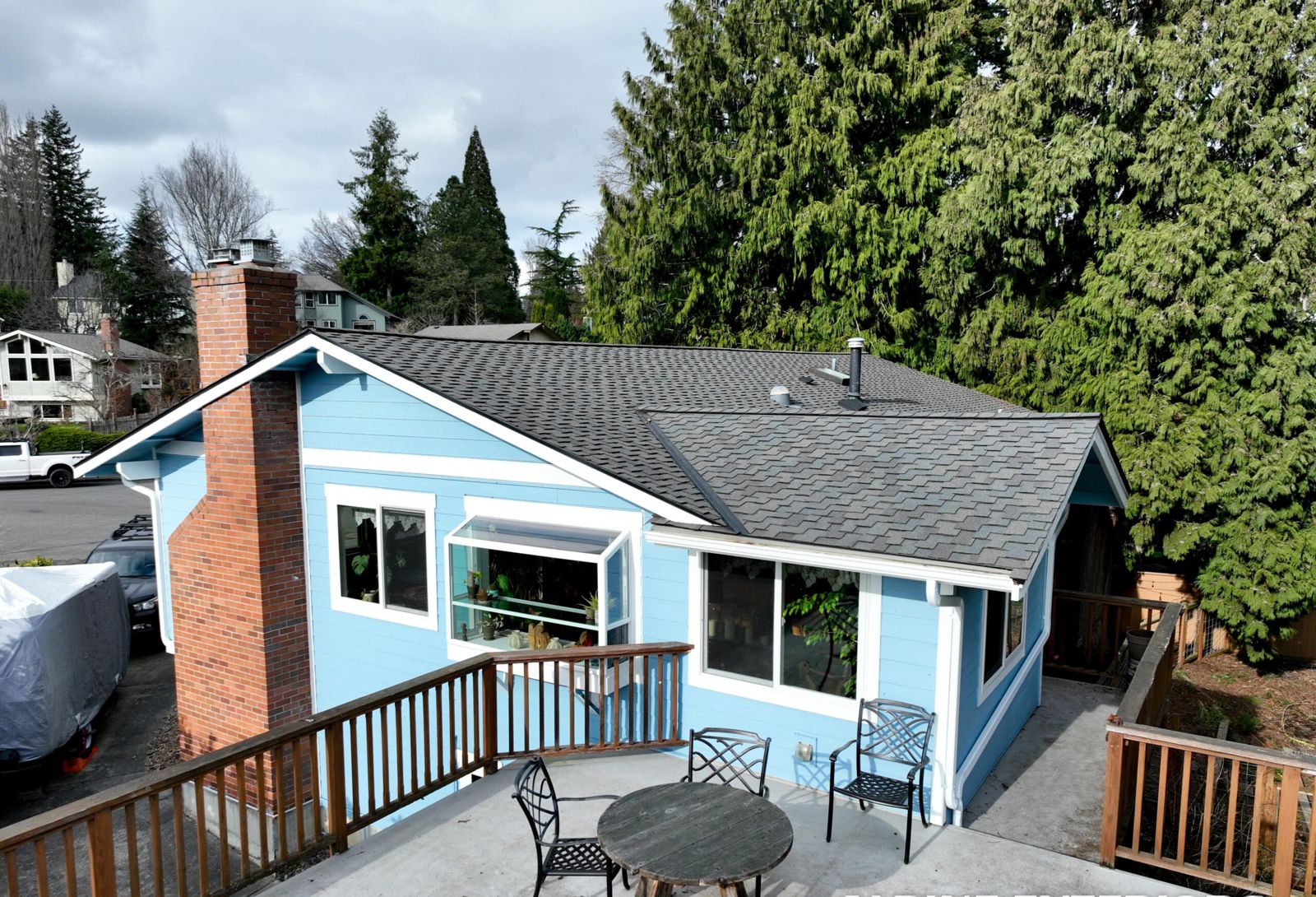
For most homes in Bellingham, Ferndale, Blaine, and the rest of Whatcom County, a rainscreen assembly is worth the added cost — but it is not automatically necessary on every wall of every house. It earns its keep fastest on west- and southwest-facing walls exposed to weather off Bellingham Bay and the Strait, on homes with a history of moisture problems, and on any wall getting re-sided down to the sheathing anyway.
Where it matters less is on short, sheltered, or heavily-overhung walls that already stay dry, where the marginal benefit is real but smaller and the payback period longer. The honest version of this answer is "it depends on the wall," not a blanket yes or no, and a contractor who tells you every square foot of your house needs it regardless of orientation is selling you a package, not solving your specific problem.
A rainscreen assembly is a small but consequential change to how siding is installed. Instead of fastening siding directly against the water-resistive barrier (WRB) and sheathing, installers add a drainage gap — usually created with vertical furring strips, a rigid plastic or vinyl matrix, or a purpose-built drainage mat — between the WRB and the back of the siding. That gap typically runs from about 3/8 inch up to a full inch, depending on the product and the assembly design.
That gap does three things a face-sealed, direct-applied installation cannot. First, it gives any water that gets past the siding — and on a house exposed to wind-driven rain, some always does — a path to drain straight down and out through weep openings at the bottom, rather than sitting against the sheathing. Second, it creates a capillary break, so moisture cannot wick from wet siding straight into the WRB and framing through surface contact. Third, it allows air to move behind the siding, which speeds drying after a storm and helps the back side of the siding itself dry out, not just the wall behind it.
The tradeoffs are real and worth stating plainly. A rainscreen adds labor and material cost, adds roughly the thickness of the gap to how far the siding projects (which affects trim details around windows, doors, and corners), and requires more careful detailing at penetrations, transitions, and the base of the wall — a poorly detailed rainscreen with no bug screen or bottom flashing can trap debris or invite pests instead of solving the drainage problem it was meant to fix. It is a system that rewards correct installation and punishes shortcuts, which is exactly why the installer matters as much as the product choice.
Whatcom County's coastal marine climate is the reason this question comes up here more than it does in drier parts of the state. Bellingham and the surrounding lowlands see a long, wet fall-through-spring season, and homes near open water — along Bellingham Bay, out toward Blaine and Birch Bay, and on the islands — take direct wind-driven rain off the Strait of Georgia and the Strait of Juan de Fuca. On exposed west and southwest walls, that rain doesn't just fall, it gets pushed sideways against the siding under wind pressure, which is precisely the condition a rainscreen's drainage gap and capillary break are designed to handle.
Persistent damp conditions also drive two other issues that show up constantly on siding inspections in this area: moss and algae growth on north-facing and shaded walls, and wood rot at the base of walls, under trim, and around poorly flashed windows on older homes. Rot in this region is rarely a single dramatic leak — it's usually the slow result of moisture that got behind the siding years ago and never had a way to dry out. A ventilated rainscreen gap directly addresses that failure mode by giving trapped moisture an exit.
Move up in elevation toward the foothills — around Sudden Valley, Lake Whatcom's east side, and the areas closer to the Mount Baker foothills — and freeze-thaw cycling becomes a factor the coastal lowlands don't deal with as much. Water that's trapped against sheathing and then freezes can expand cracks in caulking and finishes, accelerating the same rot process. A drained and ventilated wall assembly is more forgiving through repeated freeze-thaw cycles because there's simply less standing moisture in the wall to freeze in the first place.
Finally, the Washington State Energy Code matters here in a way it wouldn't in a drier climate zone. Whatcom County falls under Climate Zone 5, and the code's continuous insulation and air-barrier requirements often mean sheathing is wrapped with continuous exterior insulation or a rigid WRB system before siding goes on. Once you're already building up the wall assembly to meet code, adding a drainage gap on top of that insulation layer is a comparatively small incremental step — and in some assemblies, the furring strips used to create the rainscreen gap are the same strips used to fasten through continuous insulation, so the two requirements can be solved with one detail rather than two separate ones.
Start with the wall, not the whole house. Walk the exterior and note which elevations take direct weather — generally west and southwest faces, anything facing open water or a long unobstructed lawn, and any wall that's stayed damp or shown moss, staining, or soft trim in the past. Those are the walls where a rainscreen assembly pays for itself fastest. Sheltered walls under deep eaves, tucked behind a garage, or facing away from prevailing weather are lower priority.
Match the assembly to the siding material. Fiber cement — the most common siding material on newer Whatcom County homes — benefits from a rainscreen mainly through faster drying and reduced risk of moisture-driven paint failure at the joints, but it's a relatively rot-resistant material to begin with. Wood and engineered wood siding, including LP SmartSide-type products, benefit more directly, since those materials are more vulnerable to the kind of trapped moisture a rainscreen is built to eliminate. If you're deciding where to spend a limited budget, engineered wood and wood-clad walls on exposed elevations are where a rainscreen does the most real work.
Alpine Exteriors walks Whatcom County homes wall by wall for exactly this reason — a rainscreen recommendation should follow from what's actually happening on your siding and sheathing, not from a standard package applied to every job. On a re-siding project where the sheathing is already exposed, we'll tell you plainly whether a given wall is worth the upgrade or whether your money is better spent elsewhere on the same project.
No system stops moisture problems completely, and anyone who claims otherwise is overselling it. A rainscreen significantly reduces the risk of trapped moisture behind siding by giving water a drainage path and a way to dry out, which lowers the odds of the slow, hidden rot that's common in this climate — but flashing errors, failed caulking, or a damaged WRB can still let water in behind even a well-built rainscreen. It's a meaningful risk reduction, not a guarantee.
The Washington State Energy Code doesn't mandate a rainscreen gap by name for most single-family construction, though its continuous insulation and air-barrier requirements often result in a wall assembly that functions similarly, and some jurisdictions or specific products call for it as part of a manufacturer's warranty terms. Check with your local building department and the siding manufacturer's installation instructions before assuming either way — requirements can vary by product and by how the rest of the wall assembly is built.
It works with fiber cement, engineered wood, and most lap and panel siding types — the drainage gap is a wall-assembly detail, not a siding-material restriction. Fiber cement gets a smaller relative benefit since it's already fairly rot-resistant, while wood and engineered wood products see more direct protection, but both can be installed over a rainscreen gap successfully.
It adds a modest premium over direct-applied siding, driven mainly by the furring strips or drainage mat product, extra labor for detailing weeps and flashing at the new depth, and sometimes trim extensions around windows and doors. The exact difference depends heavily on your siding material, wall complexity, and whether the project is new siding on exposed sheathing versus a standalone retrofit — get a written bid comparing both approaches for your specific house rather than relying on a general rule of thumb.
If you're weighing a rainscreen assembly for a re-siding project in Bellingham, Ferndale, Lynden, Blaine, Birch Bay, Sudden Valley, or the islands, Alpine Exteriors can walk your specific walls, tell you where the upgrade genuinely pays off, and where it doesn't — no standard package, just an honest read on your siding and sheathing. Alpine Exteriors is licensed in Washington under ALPINI751OW; reach out to schedule an on-site assessment before your next siding project.