
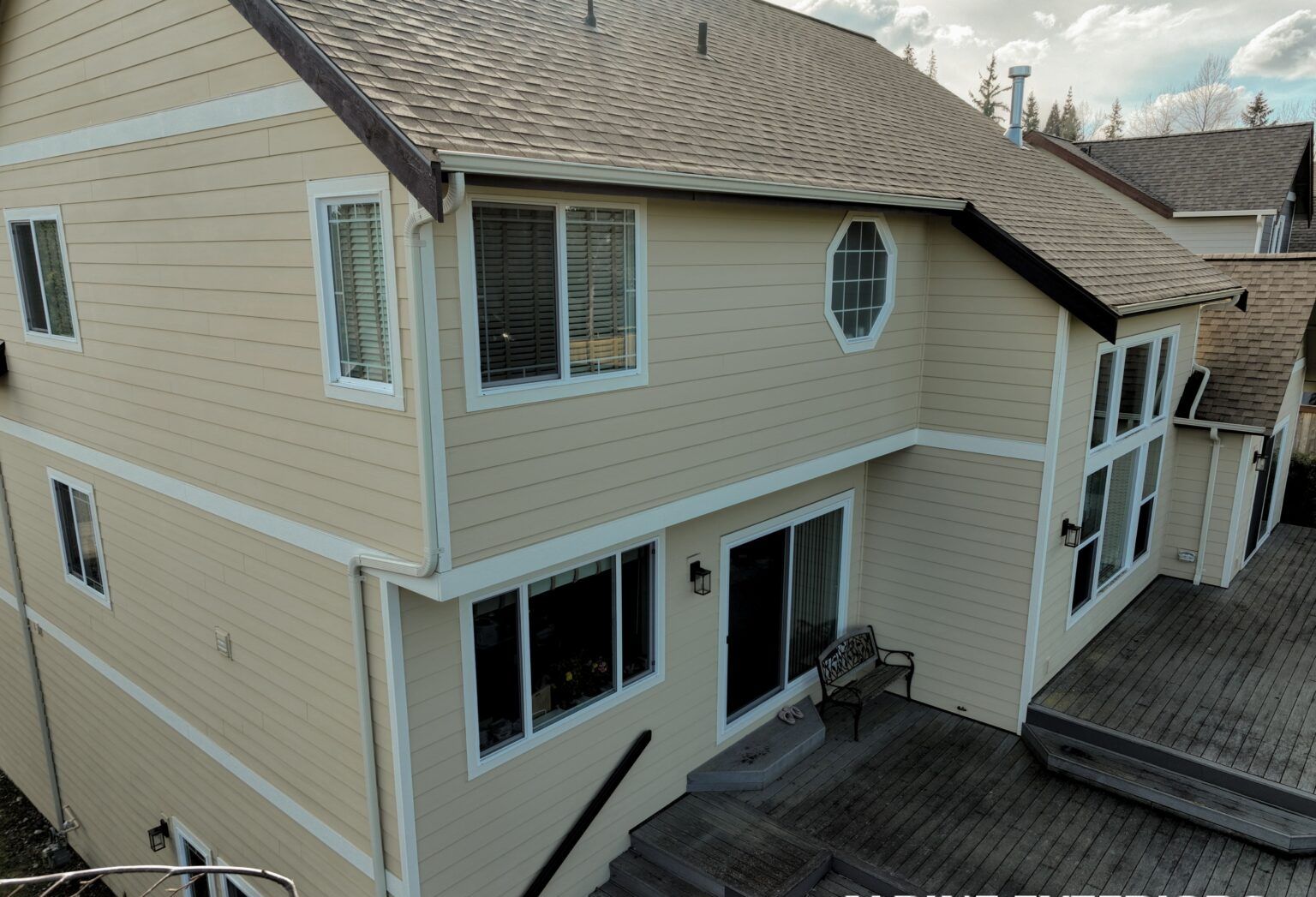
Nooksack sits in the shadow of the Cascade foothills, hugging the river of the same name, which means homes here take on a mix of conditions that few siding products are built to shrug off forever: long stretches of steady autumn and winter rain, heavy morning fog off the river bottom, shaded lots under fir and cedar canopy that never fully dry out, and cold snaps that swing into freeze-thaw cycles as cold air drains down from Mount Baker. Add wind-driven rain that pushes in off Bellingham Bay and the Strait of Georgia during winter storms, and it is easy to see why siding on a Nooksack house can fail years before the same product would in a drier part of the state.
Most homeowners do not notice siding failure until it is well underway, because the early stages hide in plain sight. A little discoloration gets written off as dirt. A soft spot gets blamed on an old paint job. By the time the damage is obvious from the street, there is often wood rot or moisture intrusion behind the siding that has been building for a season or more. This page walks through the warning signs specific to this part of Whatcom County, what is actually happening behind the surface, and how to tell the difference between a cosmetic issue and one that needs attention now.
Before getting into detail, here is the short list. If you recognize two or more of these on your own siding, it is worth a closer look, and if you see three or more, it is worth a professional inspection sooner rather than later.
When siding bubbles or blisters, moisture has gotten in behind the surface and has nowhere to go. On fiber cement and engineered wood products, this often shows up as a slight waviness you can see when the light hits the wall at a low angle in late afternoon. On vinyl, it can look like the panel has pulled slightly away from the wall or developed a rippled texture.
In Nooksack, this is usually tied to how much moisture the siding is exposed to and how slowly it dries. A shaded, north-facing wall under tree cover holds dampness for days after a storm, especially through the wetter months from October through April. If the original installation skipped a proper weather-resistive barrier or the flashing details around windows were cut short, water works its way behind the panel and stays there, since evaporation is slow in a shaded, humid microclimate like a river-valley lot.
This is the sign that worries us most, because it usually means the damage has already reached the wood sheathing or framing underneath the siding, not just the siding itself. Press a finger or a flat screwdriver handle, not the point, against a suspect area near the bottom of a wall, around a window sill, or below a deck ledger board. If it gives more than it should, or the surface feels chalky and crumbly rather than solid, there is a good chance rot has set in.
Wood rot needs sustained moisture and moderate temperatures to take hold, and Whatcom County's long wet season combined with mild winters is close to ideal for it. Homes near the Nooksack River floodplain or on lots with poor grading and slow drainage see this more often, because splash-back and standing water at the base of a wall keep the lowest courses of siding wet far longer than the rest of the house. Once rot starts, it does not stop on its own, and painting over it only hides the problem while it continues to spread.
Some moss and algae growth is close to unavoidable on shaded siding anywhere in Whatcom County, and a light green tinge that washes off is mostly cosmetic. The concern is growth that comes back heavy within a month or two of cleaning, or streaking that turns black rather than green. That pattern suggests the siding surface is staying wet longer than it should, which points to a drainage or ventilation issue rather than just normal biological growth.
Nooksack's tree canopy and river fog are the main drivers here. Lots that back up to timber or sit low near the river get less direct sun and more standing humidity than open lots closer to Lynden or Ferndale. Gutters that dump water directly onto siding, downspouts that discharge too close to the foundation, and shrubs planted tight against the house all make this worse by keeping the lowest few feet of wall damp between storms.
Look closely at the horizontal seams where siding courses overlap, and at the vertical joints where panels meet. Small hairline cracks in caulk are normal wear and tear. What is not normal is a seam that has actually opened up, a panel that has visibly warped or cupped away from the wall, or a joint where you can see the underlying house wrap or sheathing through the gap.
Freeze-thaw cycling plays a role here more than people expect for a maritime climate. Cold air draining down from the Mount Baker foothills can push overnight lows below freezing several times a winter even when Bellingham stays a few degrees warmer, and any moisture trapped in a seam expands as it freezes, working the joint looser each cycle. Over several winters, that repeated stress is enough to crack caulk, split trim, and pop fasteners that were driven correctly at installation.
If a wall needs repainting every three or four years instead of the seven to ten you would expect from a quality exterior coating, the siding underneath is telling you something. Paint failing quickly, especially in the form of peeling, alligatoring, or chalking that rubs off on your hand, usually means moisture is moving through the siding from behind. Paint is not designed to hold back that kind of pressure, so no amount of surface prep fixes a wall that is wet on the inside.
This shows up often on older wood and hardboard siding around Nooksack and Sudden Valley homes that were built or re-sided before better weather-resistive barriers were standard practice. It can also happen on newer fiber cement if the factory-primed cut edges were not field-sealed during installation, letting water wick in from every cut end and seam.
Walk the perimeter of the house and look at where siding meets trim, corner boards, and window or door casings. Gaps here are common failure points because they rely on flashing and sealant details that are easy to shortcut during installation and easy to miss during a quick visual inspection later. Wind-driven rain off Bellingham Bay and the Strait during winter storms will find any gap like this and push water behind the wall, even on a wall that otherwise looks fine.
Pay particular attention to window head flashing, the strip that directs water away from the top of a window, and to any spot where a deck, porch roof, or chimney penetrates the siding. These transition points fail more often than flat wall sections because they involve more materials meeting at more angles.
Siding failure is not only a cosmetic or structural issue. Gaps, rot, and compressed or waterlogged insulation behind failing siding reduce the wall's ability to hold heat, and Whatcom County's energy code standards assume a continuous, intact building envelope to hit their performance targets. If you notice a specific exterior wall that always feels cooler than the rest of the house, or a heating bill that has crept up without a clear reason, it is worth checking whether the siding on that wall shows any of the signs above. Under the Washington State Energy Code, new construction and many remodels are required to meet defined insulation and air-sealing performance for the wall assembly, and siding that has failed and let water into the wall cavity works directly against that.
Not every sign here means drop everything and call a contractor today. Some issues are worth monitoring through a season; others should not wait.
Urgent, address within days to a couple of weeks:
Can be monitored and scheduled for the next dry stretch:
The general rule is that anything involving softness, smell, or a visible gap into the wall assembly should move up the list, because those point to active moisture intrusion rather than surface wear.
If you have found one or more of these signs, the next step is a hands-on inspection rather than guesswork from the ground. A thorough look should include probing suspect areas rather than just visual inspection, checking behind trim at a few representative spots, and reviewing gutter and grading conditions around the foundation, since drainage is so often part of the root cause in this climate. Photographing problem areas as you find them, with a coin or tape measure in frame for scale, is useful both for your own records and for getting an accurate assessment or repair quote.
Alpine Exteriors inspects siding on homes throughout Whatcom County, including Nooksack, Lynden, Ferndale, Blaine, Birch Bay, Bellingham, Sudden Valley, and the islands, and can tell you honestly whether a wall needs spot repair, a full re-side, or nothing more than a cleaning and some fresh caulk. Not every failing sign means the whole house needs new siding. Sometimes a single wall with chronic exposure is the actual problem, and the rest of the siding has years of service life left. A repair-first approach costs less up front, but it is worth asking directly whether a patch will hold given what caused the failure in the first place, since re-covering rot without fixing the moisture source just delays the same problem.
Repair costs depend heavily on how much of the wall is affected and whether the sheathing underneath needs replacing along with the siding. A small spot repair on one section of wall is generally a modest cost, while a full re-side of a house is a much larger project, often running into the low-to-mid five figures depending on size, material choice, and how much trim and flashing work is involved. Alpine Exteriors provides a written estimate after an in-person inspection rather than a phone-quoted price, since the condition of the sheathing underneath is often the biggest cost factor and cannot be judged accurately from photos alone.
It depends entirely on what is causing the appearance problem. If the siding is structurally sound and the issue is surface moss, algae, or aging paint, a cleaning and repaint can add several more years of service life at a fraction of replacement cost. If the underlying cause is trapped moisture or early rot, cleaning and repainting will look good briefly and then fail again quickly, because the root problem was never addressed. A quick probe test in a few spots before committing to a repaint is the cheapest way to find out which situation you are in.
The combination of factors is fairly specific to this part of Whatcom County: long wet seasons, river-bottom fog and humidity, heavy tree canopy on many lots that slows drying, and cold air draining down from the Mount Baker foothills that produces more freeze-thaw cycling than nearby coastal areas see. None of these individually is unusual for the Pacific Northwest, but together they put more sustained moisture stress on exterior walls than a similar house would face in a sunnier, more open, or more sheltered location.
Coverage varies by policy and by the cause of the damage, and this is a question to bring directly to your insurance provider rather than rely on a general answer, since gradual wear and long-term moisture intrusion are often excluded even when a policy covers sudden water damage. Alpine Exteriors can document the condition of the siding and provide photos and a written assessment that you can submit to your insurer as part of a claim, but we do not make coverage determinations ourselves.
If your Nooksack home is showing any of the signs above, it is worth getting a professional opinion before the next wet season adds another layer of damage. Alpine Exteriors is a licensed Washington contractor, license ALPINI751OW, serving Whatcom County, including Nooksack, Lynden, Ferndale, Blaine, Birch Bay, Bellingham, Sudden Valley, and the islands. Reach out to schedule an inspection, and we will give you a straightforward read on what is happening behind your siding and what it will actually take to fix it.