
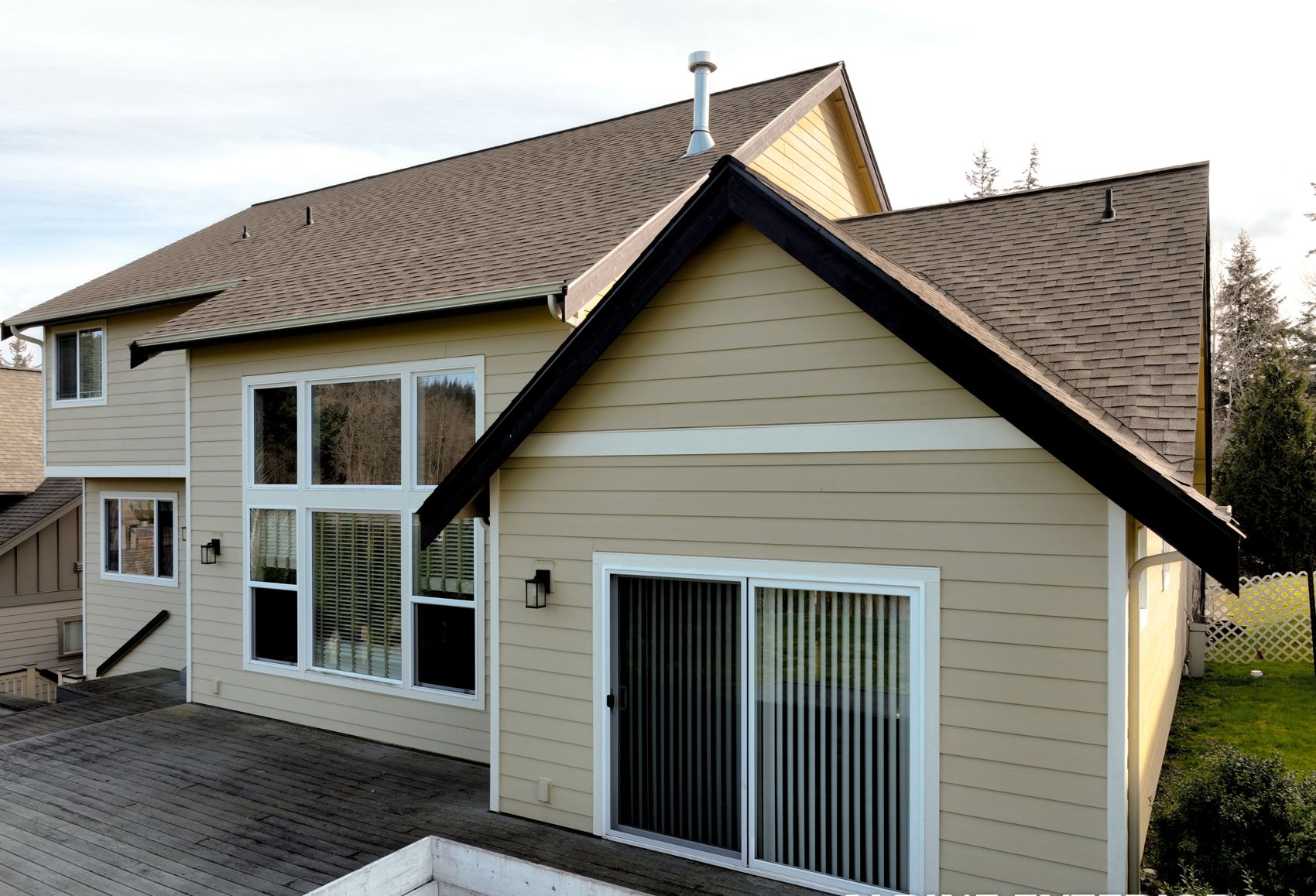
A butt joint is simply where two pieces of horizontal lap siding meet end-to-end along a wall, rather than at an outside or inside corner. On paper it's a small detail. In practice, it's one of the most common places we find active rot when we're up on a ladder in Bellingham, Ferndale, Lynden, Blaine, Birch Bay, Sudden Valley, or out on the islands. Water finds the seam, the seam holds water longer than the flat field of the siding, and wood-based products start to break down from the inside before anything looks wrong from the driveway.
Butt-joint rot is sneaky because the surface paint or coating often stays intact right up until the substrate underneath has already gone soft. Here's what we look for, and what you can check yourself with a flashlight and a flathead screwdriver:
Butt joints on the north and west-facing walls of a house, and anywhere under a roofline with a short or missing overhang, tend to show these signs first. If your home has cedar lap siding, older LP-style engineered wood siding, or fiber cement installed without back-priming at the cut ends, check those joints specifically — cut ends that weren't sealed at install are far more vulnerable than the factory edges.
Whatcom County's climate is genuinely tough on siding seams, and it's worth understanding why this specific detail fails so often in this region rather than treating it as a generic siding problem.
First, we get rain often, but not usually hard — long stretches of drizzle and low-intensity rain that sit against a wall for hours or days rather than a quick downpour that runs off. Butt joints rely on caulk and, ideally, a small gap or flashing behind the seam to shed that water. When caulk ages and shrinks (most exterior sealants start losing flexibility well before the 10-year mark, sooner with south and west sun exposure), that seam becomes a wick instead of a barrier. Slow, persistent moisture is worse for a joint like this than a single heavy storm.
Second, wind-driven rain off Bellingham Bay and the Strait of Georgia pushes moisture sideways into walls that face the water, rather than letting it simply run down the surface. Homes in Blaine, Birch Bay, and the waterfront areas around Bellingham take this at a different angle and frequency than homes tucked into Lynden or the valley, and we see butt-joint failures cluster on the exposed, water-facing elevations first.
Third, moss and algae are part of the picture, not just cosmetic. A joint that stays damp because of a caulk failure grows moss faster, and moss holds even more moisture against the wood, accelerating the cycle. It's a feedback loop we see constantly on shaded, north-facing walls in Sudden Valley and similar tree-covered lots.
Fourth, out toward the foothills — areas seeing more freeze-thaw cycling in winter than the immediate coastline — water that's already gotten behind a joint can freeze, expand, and physically pry the seam open further, which lets in more water on the next thaw. It's a slower mechanism than the coastal wind-driven rain problem, but it compounds the same underlying issue: a joint that wasn't sealed well enough to begin with.
Finally, plenty of the rot we find traces back to installation, not weather alone. Butt joints installed tight with no drainage gap, caulked instead of flashed, or using cut ends that were never back-primed, are set up to fail years before the rest of the siding shows any wear. The Washington State Energy Code has tightened requirements around wall assemblies and moisture management over the past several code cycles, and older installs — even ones that were code-compliant when built — sometimes predate those improvements.
It depends on how far along it is, and that's worth being honest about rather than telling every homeowner it's an emergency.
Surface staining with no soft wood underneath is a maintenance item — worth scheduling, not worth panicking over. A soft spot that's still small and localized to the joint itself is a repair you should get on the calendar within a season, particularly before the wet months set in, but it's not something that requires an emergency call. Where it becomes genuinely urgent is when the rot has traveled past the siding into the water-resistive barrier, the sheathing, or framing — you'll usually see this as spongy drywall or trim on the interior, a soft spot that extends well beyond the joint itself, or rot that's spread to adjacent boards. At that point, delaying lets the damage spread laterally and vertically, and what would have been a siding repair turns into a sheathing and possibly structural repair.
Our honest recommendation: don't ignore it, but don't assume every stained joint means the wall is failing. A quick inspection tells you which category you're in.
This is where we try to give homeowners a straight answer instead of defaulting to full replacement, because it isn't always warranted.
| Situation | Likely approach | Rough cost range |
|---|---|---|
| Isolated soft spot at one or two joints, sheathing dry | Cut out and replace the affected boards, re-flash and re-caulk properly | Several hundred dollars per joint area |
| Rot at multiple joints across one elevation, sheathing intact | Section replacement of that wall face | Low to mid thousands depending on wall size |
| Rot has reached sheathing or framing in multiple spots | Sheathing repair plus siding replacement, sometimes whole-house | Highly variable — needs an on-site assessment |
| Siding material is at end of life (worn caulk everywhere, chalking, multiple failure points) | Full re-side, addressing joint detailing correctly this time | Full siding replacement pricing, varies by size and material |
A few honest caveats: spot repairs can leave a visible color or texture difference if the original siding has faded, especially with cedar or older fiber cement. Matching an exact discontinued profile isn't always possible. And if a home has widespread joint failures, patching each one individually as it fails can end up costing more over several years than addressing the whole elevation at once — that's a judgment call based on how many problem areas we actually find, not a reason to upsell a full re-side when a repair will genuinely hold.
Cosmetic staining sits on the surface and the wood underneath stays firm when you press on it. Actual rot gives noticeably under light pressure from a screwdriver handle, and it's often accompanied by a slightly different texture — spongy or crumbly rather than solid. When in doubt, a quick in-person check settles it faster than guessing from a photo.
Rot from ongoing weather exposure and deferred maintenance is typically excluded, since most policies treat gradual moisture intrusion as a maintenance issue rather than a sudden covered event. There are occasional exceptions tied to a specific storm event, but we'd recommend treating this as an out-of-pocket repair to plan for rather than counting on a claim.
If the wood underneath is still sound, cleaning the joint and re-caulking with a quality exterior sealant is a legitimate short-term fix. If there's already soft wood behind the stain, caulking over it traps moisture in and lets the rot continue out of sight, so it's worth confirming the wood is solid first.
It can, depending on what you switch to and how the joints are detailed. Fiber cement and properly primed, flashed installations tend to hold up better against this region's persistent rain than untreated wood, but the joint detailing matters as much as the material — a poorly flashed joint on any material will eventually fail again.
If you're seeing staining, soft spots, or open seams at your siding's butt joints anywhere from Bellingham to Blaine, Lynden to the islands, it's worth having someone look before the next wet season sets in. Alpine Exteriors inspects the joint, checks how far the moisture has traveled, and gives you a clear repair-versus-replace recommendation — no upsell to a full re-side unless that's genuinely what the wall needs. Alpine Exteriors is a licensed Washington contractor (ALPINI751OW) working throughout Whatcom County; reach out to get an honest assessment of what's happening at your siding seams.