
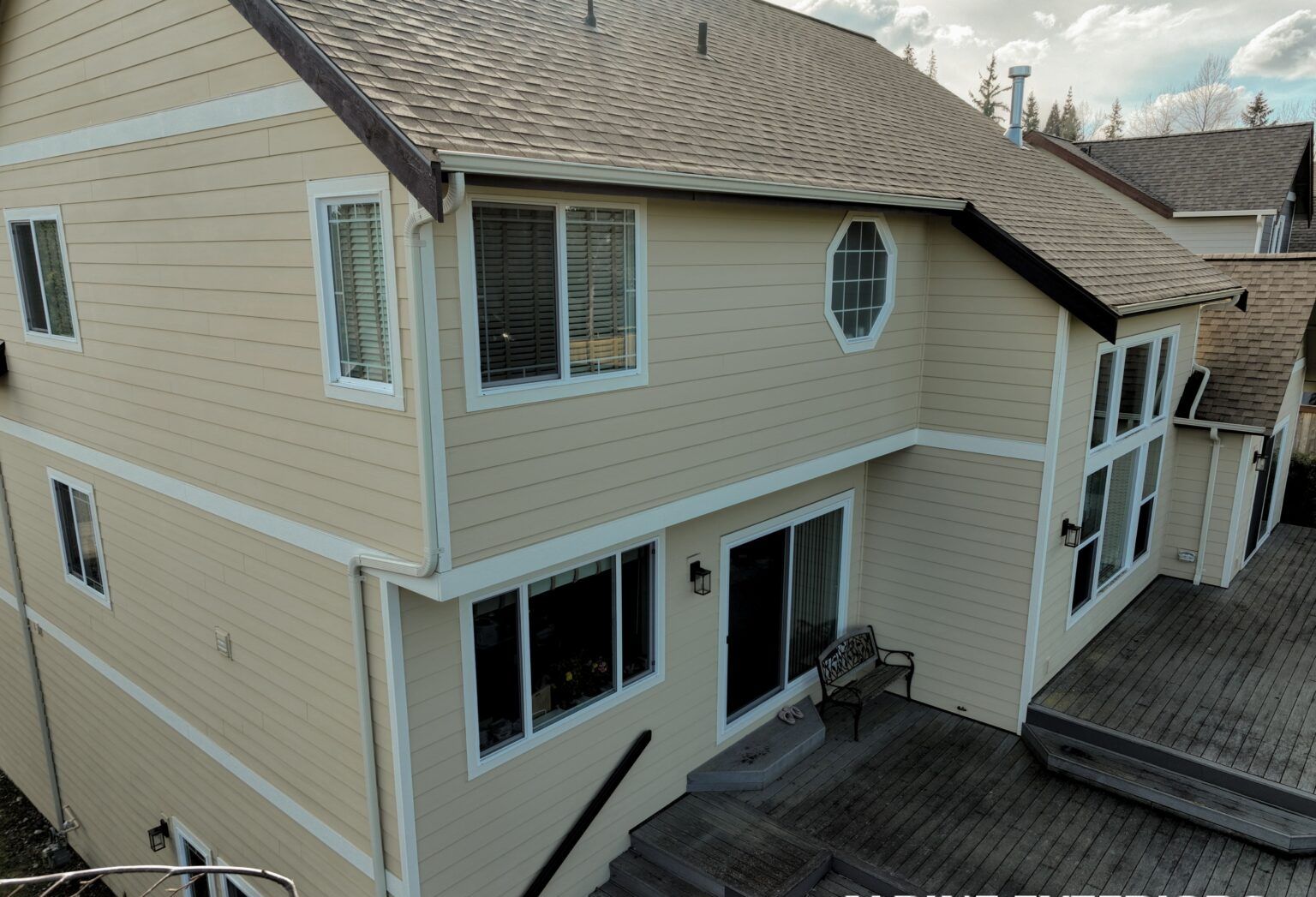
Picking a siding color in North Bellingham is a different exercise than picking one from a glossy brochure shot in California sun. Whatcom County's light is soft and diffuse for most of the year, moisture sits on north-facing walls longer than anywhere else in the state, and moss and algae will find any color that gives them a foothold. This guide is written specifically for homeowners in Bellingham, Ferndale, Lynden, Blaine, Birch Bay, Sudden Valley, and the surrounding islands, and it covers what actually holds up here versus what looks good for one dry August and then fights you every winter after.
For most homes in this region, the safest long-term performers are mid-tone warm grays, deep charcoal, and muted greens that already echo the surrounding fir and cedar cover. These colors share three traits that matter here: they hide the gray-green streaking that moss and airborne algae leave on north- and west-facing walls, they don't show chalking and UV fade as obviously as saturated reds or yellows, and they read as neutral enough to clear most neighborhood design committees without a fight. Deep charcoal has become a common choice in newer Bellingham-area subdivisions because it looks sharp against evergreen backdrops and against the gray sky that dominates roughly eight months of the year, though it comes with real maintenance trade-offs we cover below. If you want a lower-maintenance, lower-drama option that still looks intentional, a warm greige or driftwood gray is the closest thing to a safe default in this climate.
Color choice for siding isn't just an aesthetic decision in Whatcom County — it's a maintenance decision. We weighed each option against the conditions that actually show up on a jobsite here, not generic advice written for a different climate.
Mid-tone warm grays — sometimes marketed as 'driftwood,' 'pewter,' or 'stone' — are probably the single most practical choice for this region. They sit close enough to the natural tone of weathered cedar and overcast sky that they don't clash with the landscape, and their mid-value tone does a good job of camouflaging both dust streaking and the early stages of algae growth. The main drawback is that warm grays can look flat or slightly muddy under Bellingham's frequent gray-sky conditions if the undertone leans too cool; testing a sample board on the actual house, in actual weather, matters more with gray than with almost any other color family.
Charcoal has become popular on newer builds around Bellingham and Ferndale because it photographs well and contrasts nicely with cedar accents and black-framed windows. It also does a genuinely good job of hiding moss shadowing on north walls, since the color itself is already dark. The honest downside is heat and fading: charcoal absorbs more solar heat on the sun-exposed elevations, which can accelerate expansion-and-contraction stress on some vinyl products and, over many years, lead to visible sheen differences between sun-exposed and shaded walls. It also shows dust, pollen, and hard-water spotting more than people expect, particularly near roof valleys and gutter overflow points that see a lot of wind-driven rain in winter storms.
A muted, gray-leaning green can look genuinely at home in a county this heavily forested, and it has a practical advantage other colors don't: it's the one family where a little bit of natural moss growth doesn't read as a problem, because it blends into the color rather than standing out against it. The catch is that this same forgiving quality makes it harder to tell when the siding actually needs washing, so homes in sage or forest tones can end up with more biological buildup than owners realize before it starts affecting the paint or coating underneath. Bright or yellow-leaning greens fade unevenly and are best avoided here.
A well-chosen slate or muted navy blue reads coastal without looking out of place next to the evergreens, and it's a strong option for waterfront and near-waterfront properties around Birch Bay, Blaine, and the islands. Slate blue in particular hides water streaking reasonably well. Navy, like charcoal, runs into heat and fade issues on south-facing walls, and overly saturated or bright blues can look artificial against this region's muted natural palette and may draw pushback from design-conscious HOAs.
White and cream sidings can look sharp and traditional, and they reflect heat rather than absorbing it, which is a genuine durability advantage. The trade-off in this climate is significant, though: white shows algae and moss streaking faster and more starkly than any other color family, especially on north-facing walls under tree cover, which describes a large share of lots in Whatcom County. Homeowners who choose white or off-white here should go in expecting more frequent washing, not less, and should budget for exterior cleaning as a recurring line item rather than an occasional chore.
Warm brown and bronze tones pair naturally with cedar trim and stone accents and tend to hide dirt and pollen well. They can, however, start to look dated or heavy on smaller lots, and lower-quality brown pigments are prone to a chalky, faded look after several years of the freeze-thaw cycling that shows up in the foothill areas east of Bellingham and toward Lynden, where winter temperature swings are a bit wider than right on the water.
A few choices come up often enough in conversations with homeowners that they're worth calling out directly. Bright, highly saturated colors — reds, yellows, and true blacks in particular — tend to fade unevenly under this region's mix of low-angle winter sun and long summer daylight, and the fading is more noticeable because it happens unevenly between sun-exposed and shaded elevations rather than uniformly. True black siding, beyond the heat and fade concerns already noted for charcoal, also tends to show every water spot and pollen streak, which is a losing combination with wind-driven rain off the bay. Low-grade vinyl in any dark color is a particular risk here: cheaper vinyl formulations aren't engineered to handle the heat absorption of dark pigments and can warp or bow over time, which is a wall-assembly problem as much as a color problem. Finally, if your property is inside a covenant community like Sudden Valley or a planned development near Birch Bay or Blaine, skip the guesswork and get the palette confirmed with the architectural committee before ordering material — recoating or replacing siding because a color got flagged after installation is an expensive way to learn the rules.
Not directly. The Washington State Energy Code governs the insulation values, air sealing, and continuous insulation requirements of the wall assembly behind the siding, not the color of the cladding itself. Color affects how much heat the surface absorbs, which can matter for the long-term durability of the siding material, but it isn't a code compliance factor on its own — the assembly underneath has to meet WSEC requirements regardless of what color you choose on top.
It depends heavily on tree cover, sun exposure, and color, but most homes in shaded or north-facing locations around Bellingham, Ferndale, and Sudden Valley benefit from a wash at least once a year, and sometimes twice on heavily shaded walls. Lighter colors show the buildup sooner and often get washed more often as a result, while mid-tone grays and greens can hide moderate buildup for longer, which cuts both ways since it's easier to let maintenance slide without noticing.
Possibly. Planned communities such as Sudden Valley and several developments near Birch Bay and Blaine have architectural review processes or written covenants that limit exterior color palettes, and some require formal approval before installation. Even outside a formal HOA, it's worth checking with your neighborhood association or reviewing your plat's covenants, since enforcement varies a lot across unincorporated Whatcom County.
Dark siding isn't a bad idea because of rain specifically — wind-driven rain off Bellingham Bay and the Strait affects every color roughly the same way in terms of water intrusion, assuming the underlying rainscreen and flashing details are done correctly. The real trade-offs with dark siding are heat absorption, which can stress lower-quality vinyl over time, and the fact that water spots and pollen show up more visibly against a dark background than a mid-tone one.
Choosing a siding color that still looks good five winters from now takes more than a swatch under fluorescent showroom light. Alpine Exteriors works throughout Whatcom County — Bellingham, Ferndale, Lynden, Blaine, Birch Bay, Sudden Valley, and the islands — and can bring physical samples out to your property so you can see how a color actually reads against your roofline, your trees, and your neighbors' homes in real Pacific Northwest light. As a licensed Washington contractor (license ALPINI751OW), Alpine Exteriors can also walk you through how a given siding product and color perform together in this climate, and confirm the wall assembly underneath meets current Washington State Energy Code requirements before installation begins. If you're weighing colors for an upcoming siding project, reach out to Alpine Exteriors for a site visit and a straightforward rundown of what will hold up on your specific lot.