
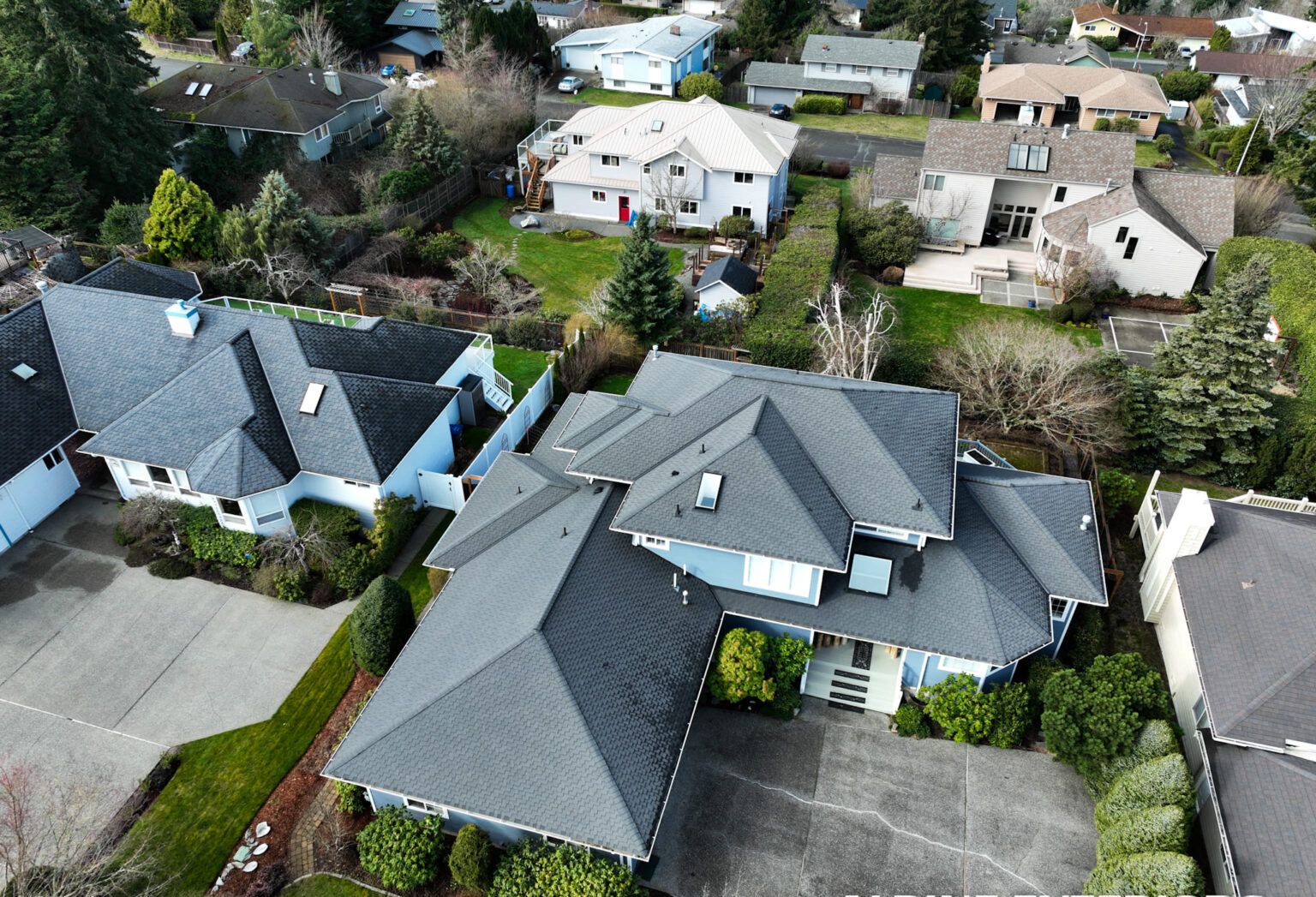
Most siding damage we see in Blaine can be repaired if it's caught before rot has spread past the boards you can see. The exceptions are wide-area moisture damage, siding that's already been patched more than once, or products old enough that a close color and profile match is no longer possible — in those cases, replacing the whole wall or elevation is usually the more honest recommendation than another patch.
Siding damage on a Whatcom County home rarely shows up as one clean problem. What homeowners usually call us about is a combination: a soft or spongy spot near a window sill, a lap board that's cupped or pulled away from the wall, dark streaking on a north-facing elevation, or caulk that's cracked and pulling away from trim. Each of those points to a different cause, and the cause matters more than the visible damage when deciding what to do about it.
The most common issues we find on repair calls in Blaine and the surrounding area include:
The repair-versus-replace decision comes down to how far the damage has actually traveled, not how bad it looks from the driveway. A single rotted board around a leaking window can often be cut out and replaced cleanly. Rot that's tracked along the wall inside multiple bays, or shows up in more than one unrelated spot on the same elevation, usually means the underlying moisture barrier has failed broadly enough that patching individual boards just delays the same repair a year or two down the road.
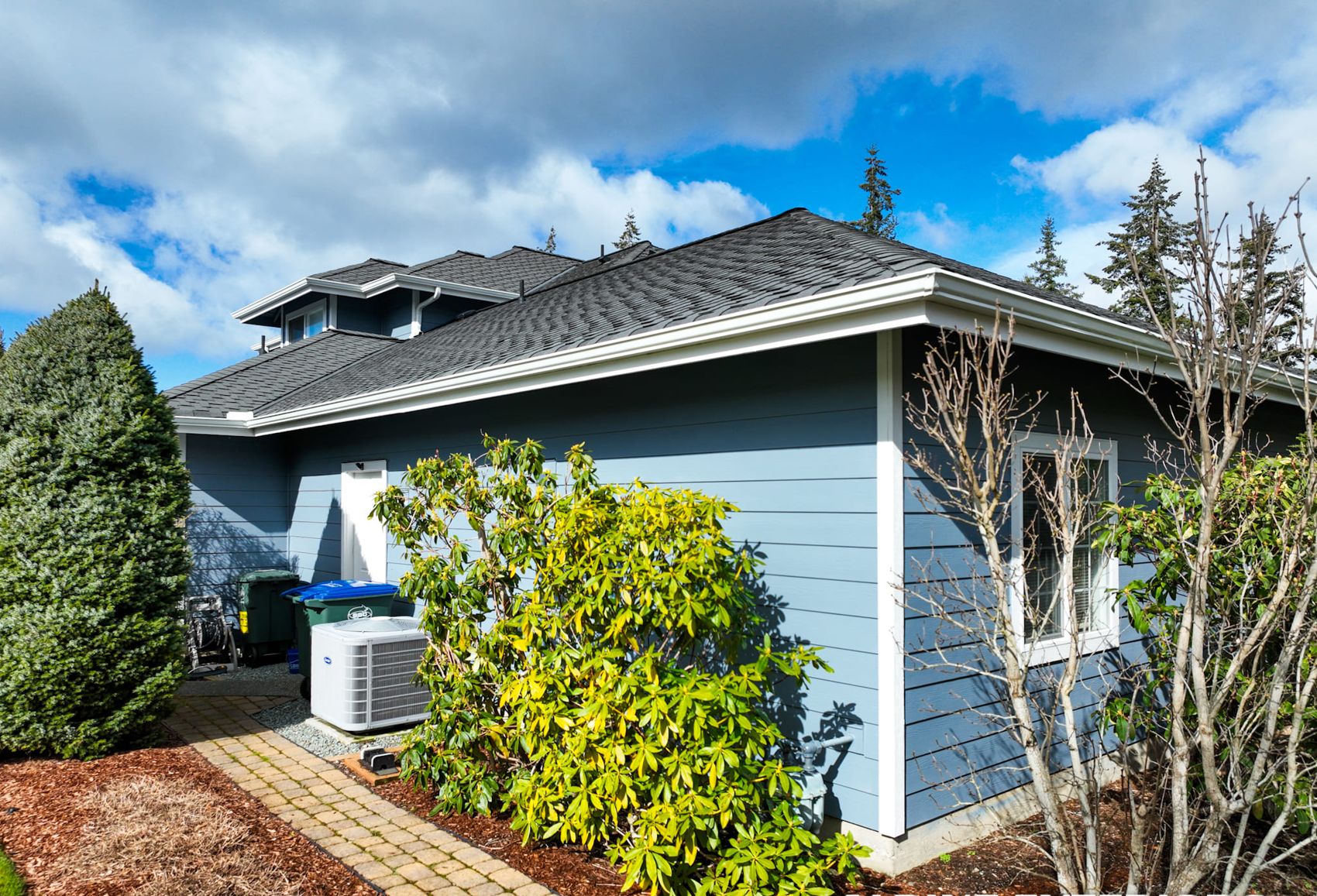
Blaine sits right on Semiahmoo Bay and Drayton Harbor, with a lot of exposed wall area facing straight into weather coming off the Strait of Georgia. That matters for siding in a specific way: wind-driven rain doesn't just fall on a wall, it gets pushed sideways and upward into laps, seams, and trim joints that were designed to shed water falling straight down. Homes on or near the waterfront, and anywhere with a clear fetch across the water, take more of this than a similar house a few miles inland in Bellingham or Ferndale.
On top of that, Whatcom County's rain pattern is less about intensity and more about duration. Long stretches of steady fall and winter rain, paired with short daylight hours and slower drying, mean any point where water gets behind the siding stays wet for longer before it has a chance to dry out. That's the main reason moss and algae are such a consistent issue here — it's less about the amount of rain and more about how rarely surfaces get a real chance to dry between storms.
Inland and up toward the foothills — Sudden Valley and the areas closer to Mt. Baker's lower elevations — freeze-thaw cycling becomes more of a factor than it is right in Blaine itself. Water that's already worked its way into a crack in siding, trim, or old caulk can freeze, expand, and widen that crack, which turns a small cosmetic issue into an entry point for water the next time it thaws. Blaine's coastal location moderates temperatures somewhat compared to those inland pockets, but the same principle applies any time overnight lows dip below freezing after a wet stretch.
One more regional factor that's easy to overlook: any siding replacement of meaningful scope in Washington has to account for the Washington State Energy Code. Depending on how much wall area is being opened up, code can require continuous insulation or specific vapor-permeable weather-resistive barrier details that weren't part of the original construction, especially on homes built before the more recent code cycles. That's not something to guess at — it's worth having whoever pulls the permit confirm what applies to the specific scope of work before materials are ordered.
Start with a walk around the house after any major windstorm or at the start of the wet season, and look specifically for the things that don't announce themselves: soft spots when you press on siding near the bottom of walls and around windows, caulk lines that have separated from the trim rather than just looking dirty, and any panel that looks slightly warped compared to the boards next to it. A flashlight along the bottom edge of siding on a dry day can reveal staining or discoloration that points to water tracking down from higher up.
If you find a small, isolated area — one board, one corner, one section around a single window — that's usually a repair, and a reasonably contained one. If you're finding damage in more than one unrelated spot, or the same area has clearly been patched before and is failing again, that repeat failure is telling you something about the wall assembly itself, not just the siding surface, and it's worth having someone open it up and look rather than patching a third time.
Matching existing siding is its own separate problem from the repair itself, and it's worth being realistic about going in. Vinyl and fiber cement siding both fade with UV exposure over years, so even the exact same product from the same manufacturer, bought new, may not match a fifteen-year-old wall precisely — new panels are often visibly brighter for a season or two. Profiles and colors also get discontinued; a house sided a decade or two ago may be on a lap width or color that simply isn't made anymore. When that's the case, the honest options are usually to source reclaimed or old-stock material if it exists, accept a visible but well-placed transition (like re-siding a full elevation instead of a patch), or re-side more of the house than the damage alone would require, purely so the mismatch doesn't stand out. None of those are wrong, but they're a decision worth making up front rather than discovering after a repair is already installed.
Get someone to actually look at it before deciding. Alpine Exteriors inspects siding in Blaine, Birch Bay, Ferndale, Lynden, and the rest of Whatcom County and will tell you plainly when a repair is enough and when it isn't — including when replacement of a section, rather than the whole house, is the more cost-effective and honest call. A repair-focused visit is also a reasonable way to get a second opinion if another contractor has already recommended a full re-side; sometimes that's correct, and sometimes it isn't.
On cost: a straightforward repair — a few boards, a corner, caulk and trim work around one or two openings — is a modest job, generally in the low hundreds to low thousands of dollars depending on access, siding type, and paint or stain matching. Replacing a full elevation or the whole house is a much larger range, driven mostly by siding material choice, square footage, and how much of the sheathing and weather barrier underneath needs to come with it. Anyone quoting a firm number without seeing the actual wall condition first is guessing, and that guess tends to grow once the wall is opened up.
Look and press rather than just look. Cosmetic issues — faded color, surface moss, minor scuffs — don't change when you press on the siding. If a spot feels soft, spongy, or flexes under light pressure, especially near the bottom of a wall, around a window sill, or below a roofline where water sheds onto the wall, that's usually moisture damage working on the wood behind or within the siding, and it's worth having someone check it even if the surface still looks mostly fine.
Sometimes closely, sometimes not perfectly. Siding fades with age, and colors and profiles get discontinued over the years, so a repair patch installed today may be visibly newer or slightly different than the surrounding wall at first, even with the same product line. It usually blends in more over a season or two as the new material weathers, but if an exact match matters to you, that's worth discussing before the work starts so you can weigh a full-elevation replacement against a smaller patch.
It depends on how far the underlying moisture has actually traveled, not how big the visible damage looks. A single, isolated area is usually a straightforward repair. If the same wall has failed in more than one spot, or has already been patched before and is failing again in a similar way, that pattern usually means the weather barrier or flashing behind the siding needs attention, and replacing a larger section tends to hold up better than another isolated patch.
It depends on the scope. Small like-for-like repairs — a few boards, caulk and trim work — typically don't trigger a permit, while larger re-siding jobs, especially ones that involve opening up sheathing or changing the wall assembly, generally do and need to meet current Washington State Energy Code requirements for the work performed. Requirements are set by the local building department, so it's worth confirming with the City of Blaine or Whatcom County directly, or having your contractor confirm it as part of scoping the job, before work begins.
If you're seeing soft spots, staining, or siding that's pulling away anywhere on your Blaine home, it's worth getting eyes on it before winter's rain adds another season of exposure. Alpine Exteriors is a Washington-licensed contractor (license ALPINI751OW) serving Bellingham, Ferndale, Lynden, Blaine, Birch Bay, Sudden Valley, and the surrounding islands, and we're glad to walk the exterior with you, tell you plainly whether you're looking at a repair or a replacement, and talk through matching options if your siding is older or discontinued. Reach out to schedule a look at your siding and get a straight answer before you spend money on it.