
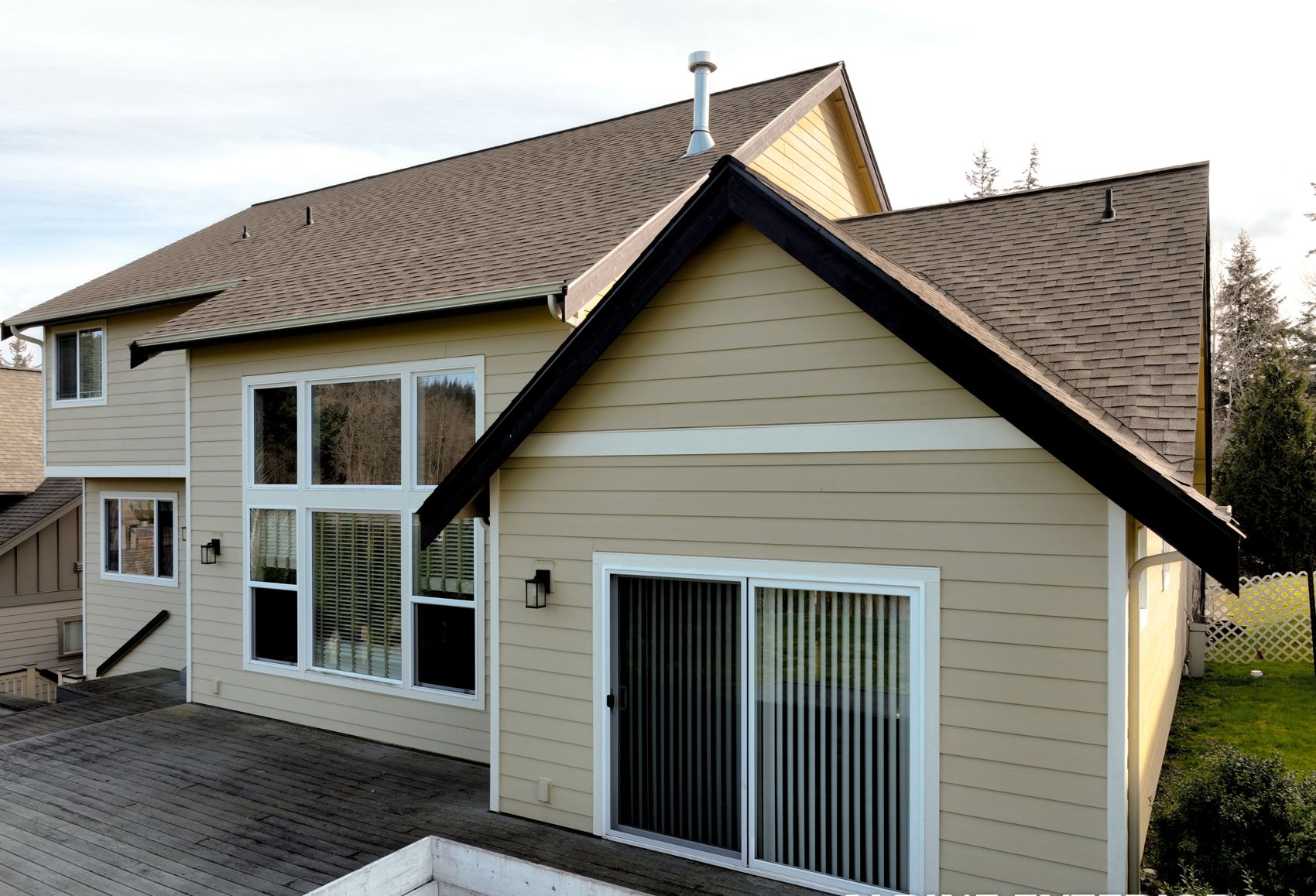
Custer sits a few miles inland from Birch Bay, Semiahmoo Bay, and the Strait of Georgia, out in the flat, open farmland north of Bellingham. That location gives it two things most siding products were never designed to handle at the same time: near-constant rain for eight or nine months of the year, and wide-open wind exposure that drives that rain sideways into walls instead of letting it run straight down the way it's supposed to. Add occasional hard frosts in winter, salt air moving in off the water, and a growing season that keeps moss and algae fed almost year-round, and you have a climate that is genuinely harder on exterior siding than most of the country experiences.
Homeowners across Bellingham, Ferndale, Lynden, Blaine, Birch Bay, Sudden Valley, and the islands deal with variations on the same problem, but Custer's open exposure and proximity to salt water put it near the top of the list. Wind-driven rain off Bellingham Bay and the Strait pushes moisture into seams, corners, and butt joints that were only ever rated for water running down a flat wall — not water being forced sideways into a joint under pressure. Meanwhile the Washington State Energy Code has, over the past several code cycles, pushed builders toward tighter, better-insulated wall assemblies. That's good for heating bills, but it also means less incidental air movement behind the siding to dry out any water that does get in. A wall built to today's energy code standards can hold moisture longer than an older, leakier one if the water-resistive barrier or flashing details behind the siding aren't right, which makes catching problems early even more important than it used to be.
This checklist reflects what we actually see on inspections around Custer and the rest of Whatcom County, not a generic national list. Walk your own house against it once or twice a year and you'll catch most problems while they're still a repair instead of a full re-side.
Do this in two passes: first from a normal walking distance around the exterior, then up close with your hands, and finally a quick check from inside near exterior walls. Most people skip the second and third passes and miss the early signs because of it.
Look for these from a normal walking distance — no ladder required.
If you only have ten minutes, check these spots first: the bottom courses closest to grade, inside corners, butt joints, and anywhere flashing meets siding — around windows, doors, hose bibs, and vents. Water either pools, gets trapped, or finds a physical gap to exploit at these locations before it does anywhere else on a flat run of wall. A homeowner who checks these four spots twice a year will catch the large majority of developing problems before they spread.
Exterior clues up close (get within arm's reach) and a few things worth checking from inside:
How different siding materials actually fail is not the same across products, so what you're looking for should shift depending on what's on your walls.
Not every failed item means a full re-side, and not every item is purely cosmetic either. The honest answer depends on how far the problem has traveled — through the coating, into the material itself, or into the wall assembly behind it.
Learning to tell the difference between paint failure and structural failure saves most homeowners real money, because a lot of what looks alarming at first glance is genuinely just surface-level.
| What You See | Likely Just Cosmetic | Likely a Real Problem |
|---|---|---|
| Color fading or chalking | Even fading across a whole wall, no texture change | Patchy fading paired with cracking or bubbling |
| Green or black streaking | Surface growth that scrubs off with a soft wash | Growth that returns within weeks, or sits under lifted paint |
| Small dents or scuffs | Isolated, panel is still flat and firm | Dent is soft to the touch or ringed with cracking |
| Nail pops or visible fasteners | One or two, panel otherwise tight | Widespread, with rust streaking or panel movement |
| Hairline surface cracks | Shallow, doesn't catch a fingernail, no gap behind it | Crack you can feel, or one that widens toward a corner or joint |
Siding problems in this climate rarely stay small. Whatcom County's rain doesn't give a wall many dry stretches to recover in, so a gap that lets in a little water in October is usually letting in a lot more by the following spring. What happens if you wait is fairly predictable: a coating failure that would have been a repaint becomes a substrate failure that requires replacing boards; a soft spot the size of a coin becomes a section of wall sheathing; a small leak at one butt joint becomes a moisture problem that shows up two rooms away, because water travels sideways and downward inside a wall cavity far more than most people expect. We're not going to invent numbers for how fast that happens on your specific house — it depends on orientation, drainage, and how the siding was originally installed — but in this region, \"next season\" is a realistic worst case, not a scare tactic.
Once you've found a real problem, the fix generally falls into one of three tiers, and the right one depends on how far the damage has spread — not just on which material you have.
| Approach | Best For | Rough Cost Range | What It Doesn't Fix |
|---|---|---|---|
| Spot repair | A handful of damaged boards or panels, sound siding elsewhere | Low hundreds to low thousands, depending on access and matching | A systemic flashing or drainage problem elsewhere on the wall |
| Recoat / repaint | Wood or fiber cement with a sound substrate but a tired paint film | Low thousands for an average home, more with extensive prep | Rot, cracked panels, or failed flashing underneath the coating |
| Full re-side | Widespread rot, warping, or a siding system past its service life | Mid five figures for an average home, varies by size and material | N/A — this is the reset option |
These are rough ranges, not quotes. Actual cost depends heavily on square footage, how much of the wall sheathing underneath needs repair, and which material you choose going forward. Any contractor who gives you a firm number without walking the whole exterior first is guessing.
A homeowner can catch most of what's on this list from the ground and from a step ladder. A professional inspection goes further, and it's worth bringing one in for a few specific situations.
Call a professional if you find any soft spot, musty smell, or interior staining — these usually mean water has already gotten past the siding, and figuring out how far it's traveled means opening things up in a way that isn't a weekend project. Call a professional if damage shows up on a wall you can't safely or fully see from the ground, particularly upper stories or areas near steep roof pitches. And call a professional before you repaint or recoat anything you're not sure about — paint over an active moisture problem and you've just hidden the one visual clue that would have told you something was wrong.
What a proper inspection looks at is more than a walk-around: it includes probing suspect wood with an awl or moisture meter rather than just looking at it, checking behind trim and around penetrations — vents, hose bibs, light fixtures — where flashing is most likely to have been done wrong the first time, and pulling a board or panel in a representative spot to see what the water-resistive barrier and sheathing look like behind the visible layer. That last step is the difference between guessing and knowing, because siding can look fine on the face and still be failing behind it.
Alpine Exteriors (WA contractor license ALPINI751OW) serves Bellingham, Ferndale, Lynden, Blaine, Birch Bay, Sudden Valley, Custer, and the islands, and we're happy to take a look and offer straightforward recommendations even if you're not ready to commit to a full project yet. Send us a few photos or describe what you're seeing, and we can often tell you whether it's worth a site visit before you spend money on a service call.
On new installations and full re-sides, Alpine Exteriors has standardized on James Hardie fiber cement as our default recommendation for this climate, though it isn't the only material we install and it isn't right for every budget. James Hardie fiber cement resists moisture absorption into the material itself better than wood-based products, holds paint longer between recoats, and — worth mentioning plainly — it's non-combustible, which some homeowners weigh alongside the weather performance. The trade-offs are real: it costs more up front than vinyl, it's heavier and slower to install, and it still depends entirely on correct flashing and caulking at every joint, so a poor installation of Hardie fiber cement can fail in some of the same ways a poor installation of anything else can. We'll walk through material options honestly rather than pushing one product regardless of your house or budget.
Most of what extends siding life in Whatcom County isn't glamorous. Keep gutters clear so water isn't dumping onto the courses below them. Keep vegetation trimmed back a few feet from every wall so leaves and branches aren't holding moisture against the siding and shading it from ever fully drying. Wash moss and algae off with a soft brush and a mild cleaner rather than a pressure washer, which can force water behind panels and under caulking at exactly the joints you're trying to protect. Re-caulk at corners, butt joints, and around trim every few years — caulking is a wear item, not a one-time install, and it's the cheapest insurance against water finding its way into a joint. None of this stops siding from aging, but it slows the rate, and in a climate this wet, slowing the rate is most of the battle.
Press and look. Cosmetic paint failure is usually even across a wall, doesn't change the texture of the siding underneath, and the material stays firm when you press on it. Real damage tends to be patchy rather than even, comes with cracking, bubbling, or a soft spot when pressed, and often shows up first at corners, butt joints, or the bottom courses closest to grade rather than spread evenly across a whole wall. When in doubt, press on it — paint failure feels the same as sound siding underneath; real damage usually doesn't.
Whatcom County's combination of near-constant rain, wind-driven moisture, and salt air near the water rewards a material that doesn't absorb moisture into the material itself the way wood-based products do. James Hardie fiber cement holds up better against that combination over the long run and holds paint longer between recoats, which matters in a climate that doesn't give a coating many dry months to cure and rest. That said, it costs more up front than vinyl and depends just as much on correct installation, so it's not an automatic answer for every project — we still discuss vinyl, wood, and engineered wood honestly with homeowners who have different priorities or budgets.
Small problems compound faster here than in drier climates because the wall rarely gets a long enough dry stretch to arrest the damage on its own. A coating issue can become a substrate issue, and a substrate issue can become a sheathing issue, often within a single wet season rather than several years. Waiting doesn't always end badly on every house, but treating a real warning sign as something to revisit \"next summer\" is a bet against a climate that isn't in your favor.
When it wipes or scrubs away with a soft brush and a mild cleaner and doesn't come back within a few weeks, and the siding underneath is still flat, firm, and free of cracking once it's clean. Surface growth that keeps returning quickly, or that's growing under a lifted edge of paint rather than on top of an intact surface, has usually found a spot that stays wet longer than the rest of the wall — which is worth a closer look even if the growth itself isn't the real problem.
A checklist gets you most of the way there, but Whatcom County's weather doesn't leave much room for guessing on the details that matter — flashing, caulking, and what's happening behind the visible layer. Alpine Exteriors (WA contractor license ALPINI751OW) works throughout Bellingham, Ferndale, Lynden, Blaine, Birch Bay, Sudden Valley, Custer, and the islands, and we're happy to walk your exterior with you, point out what's cosmetic versus what's worth addressing now, and give you an honest read on repair, recoat, or replace before you spend a dollar. Reach out to schedule a walk-through.